Hack Ruben I, Becker Anton S, Bode-Lesniewska Beata, Exner G Ulrich, Müller Daniel A, Ferraro Daniela A, Warnock Geoffrey I, Burger Irene A, Britschgi Christian
Department of Nuclear Medicine, University Hospital Zürich, University of Zürich, 8091 Zürich, Switzerland.
Department of Interventional and Diagnostic Radiology, University Hospital Zürich, University of Zürich, 8091 Zürich, Switzerland.
Life (Basel). 2021 Aug 24;11(9):869. doi: 10.3390/life11090869.
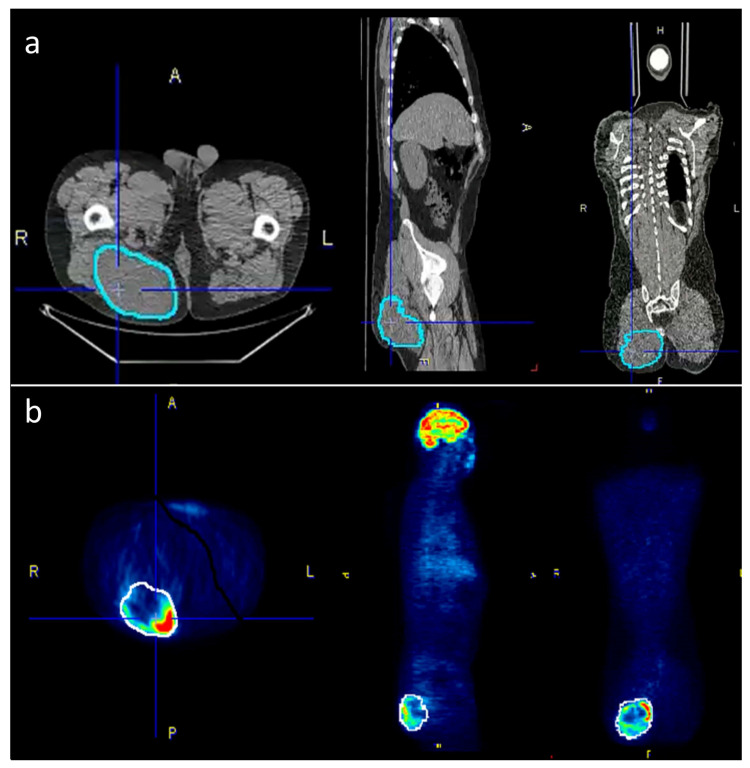
The role of positron-emission tomography/computed-tomography (PET/CT) in the management of sarcomas and as a prognostic tool has been studied. However, it remains unclear which metric is the most useful. We aimed to investigate if volume-based PET metrics (Tumor volume (TV) and total lesions glycolysis (TLG)) are superior to maximal standardized uptake value (SUVmax) and other metrics in predicting survival of patients with soft tissue and bone sarcomas.
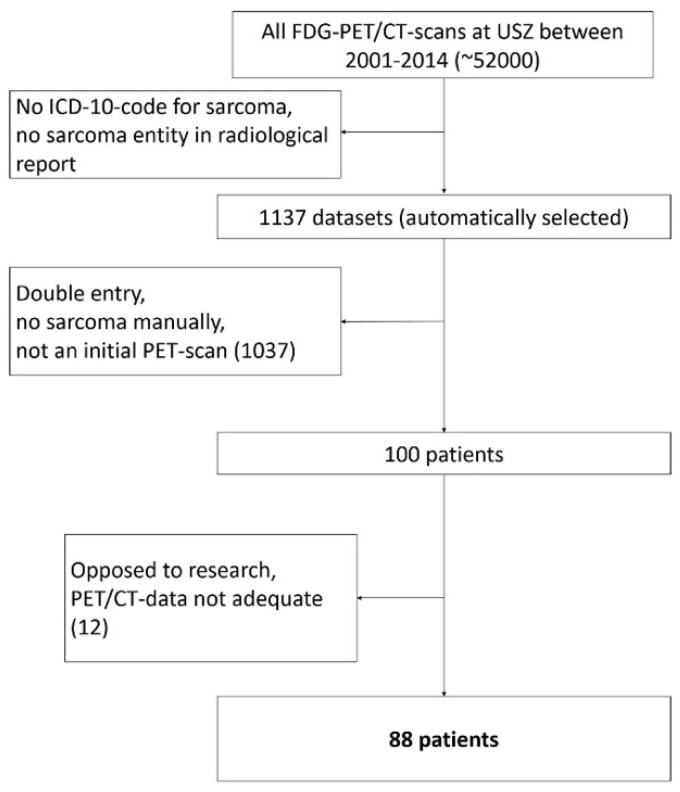
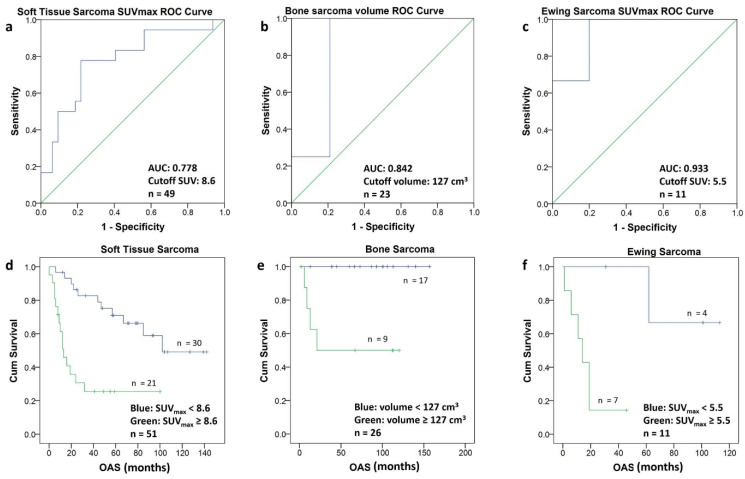
In this retrospective cohort study, we screened over 52'000 PET/CT scans to identify patients diagnosed with either soft tissue, bone or Ewing sarcoma and had a staging scan at our institution before initial therapy. We used a Wilcoxon signed-rank to assess which PET/CT metric was associated with survival in different patient subgroups. Receiver-Operating-Characteristic curve analysis was used to calculate cutoff values.
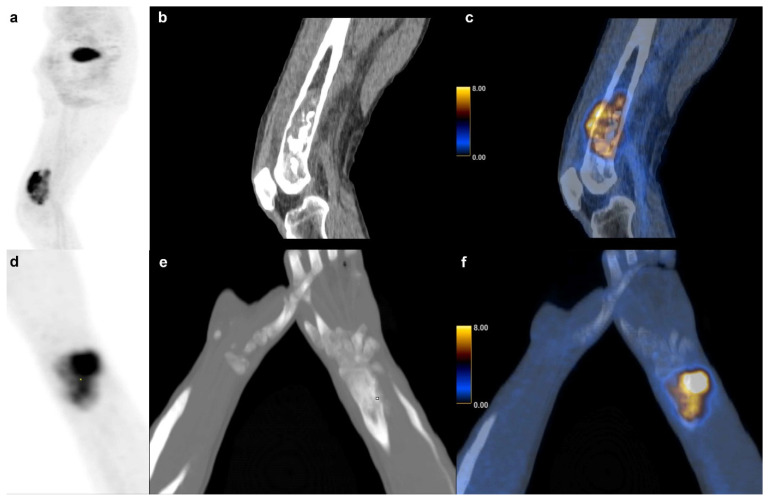
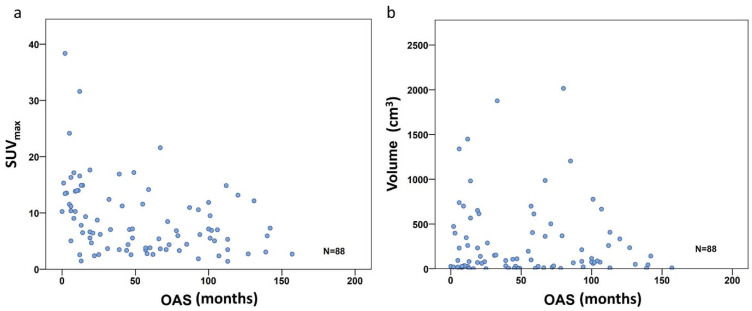
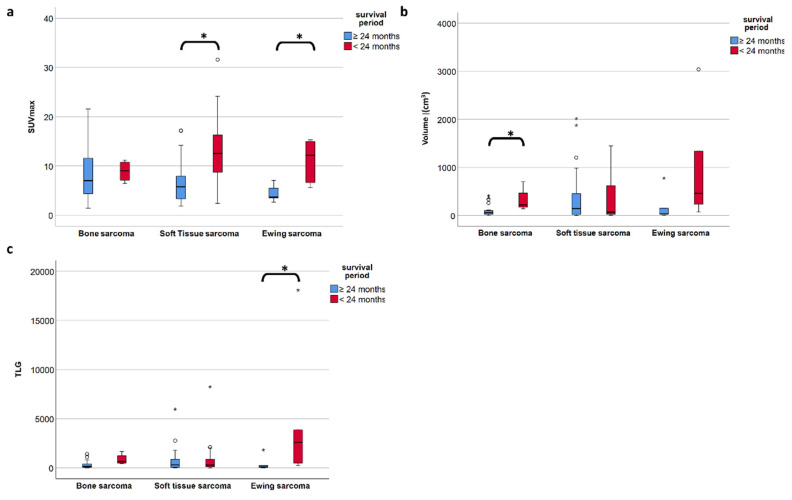
We identified a total of 88 patients with soft tissue (51), bone (26) or Ewing (11) sarcoma. Median age at presentation was 40 years (Range: 9-86 years). High SUVmax was most significantly associated with short survival (defined as <24 months) in soft tissue sarcoma (with a median and range of SUVmax 12.5 (8.8-16.0) in short (n = 18) and 5.5 (3.3-7.2) in long survival (≥24 months) (n = 31), with ( = 0.001). Similar results were seen in Ewing sarcoma (with a median and range of SUVmax 12.1 (7.6-14.7) in short (n = 6) and 3.7 (3.5-5.5) in long survival (n = 5), with ( = 0.017). However, no PET-specific metric but tumor-volume was significantly associated ( = 0.035) with survival in primary bone sarcomas (with a median and range of 217 cm (186-349) in short survival (n = 4) and 60 cm (22-104) in long survival (n = 19), with ( = 0.035). TLG was significantly inversely associated with long survival only in Ewing sarcoma ( = 0.03).
Our analysis shows that the outcome of soft tissue, bone and Ewing sarcomas is associated with different PET/CT metrics. We could not confirm the previously suggested superiority of volume-based metrics in soft tissue sarcomas, for which we found SUVmax to remain the best prognostic factor. However, bone sarcomas should probably be evaluated with tumor volume rather than FDG PET activity.
正电子发射断层扫描/计算机断层扫描(PET/CT)在肉瘤管理及作为预后工具方面的作用已得到研究。然而,哪种指标最有用仍不明确。我们旨在研究基于体积的PET指标(肿瘤体积(TV)和总病变糖酵解(TLG))在预测软组织和骨肉瘤患者生存方面是否优于最大标准化摄取值(SUVmax)及其他指标。
在这项回顾性队列研究中,我们筛查了超过52000份PET/CT扫描,以识别诊断为软组织、骨或尤因肉瘤且在初始治疗前在我们机构进行分期扫描的患者。我们使用Wilcoxon符号秩检验来评估哪种PET/CT指标与不同患者亚组的生存相关。采用受试者操作特征曲线分析来计算临界值。
我们共识别出88例软组织(51例)、骨(26例)或尤因(11例)肉瘤患者。就诊时的中位年龄为40岁(范围:9 - 86岁)。在软组织肉瘤中,高SUVmax与短生存期(定义为<24个月)最显著相关(短生存期(n = 18)的SUVmax中位数及范围为12.5(8.8 - 16.0),长生存期(≥24个月)(n = 31)为5.5(3.3 - 7.2),P = 0.001)。在尤因肉瘤中也观察到类似结果(短生存期(n = 6)的SUVmax中位数及范围为12.1(7.6 - 14.7),长生存期(n = 5)为3.7(3.5 - 5.5),P = 0.017)。然而,在原发性骨肉瘤中,除肿瘤体积外,没有PET特异性指标与生存显著相关(P = 0.035)(短生存期(n = 4)的肿瘤体积中位数及范围为217 cm³(186 - 349),长生存期(n = 19)为60 cm³(22 - 104),P = 0.035)。仅在尤因肉瘤中,TLG与长生存期显著负相关(P = 0.03)。
我们的分析表明,软组织、骨和尤因肉瘤的预后与不同的PET/CT指标相关。我们无法证实先前提出的基于体积的指标在软组织肉瘤中的优越性,我们发现SUVmax仍然是最佳预后因素。然而,骨肉瘤可能应以肿瘤体积而非FDG PET活性进行评估。