Benali Karim, Verain Julien, Hammache Nefissa, Guenancia Charles, Hooks Darren, Magnin-Poull Isabelle, Toussaint-Hacquard Marie, de Chillou Christian, Sellal Jean-Marc
Département de Cardiologie, CHRU de Nancy, 54500 Vandœuvre lès-Nancy, France.
INSERM-IADI, U1254, 54500 Vandœuvre lès-Nancy, France.
J Clin Med. 2021 Sep 18;10(18):4240. doi: 10.3390/jcm10184240.
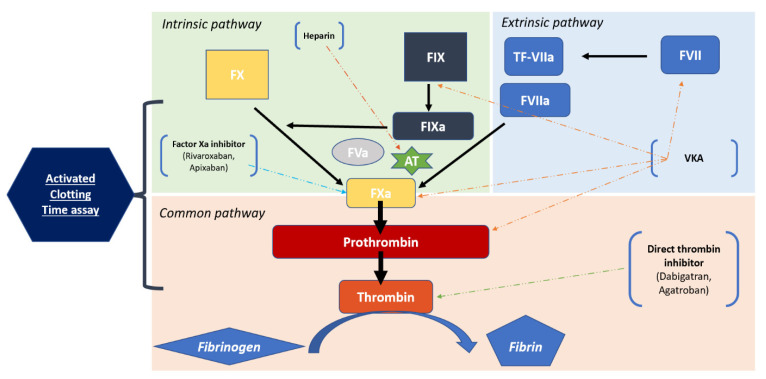
Activated Clotting Time (ACT) guided heparinization is the gold standard for titrating unfractionated heparin (UFH) administration during atrial fibrillation (AF) ablation procedures. The current ACT target (300 s) is based on studies in patients receiving a vitamin K antagonist (VKA). Several studies have shown that in patients receiving Direct Oral Anticoagulants (DOACs), the correlation between ACT values and UFH delivered dose is weak.
To assess the relationship between ACT and real heparin anticoagulant effect measured by anti-Xa activity in patients receiving different anticoagulant treatments.
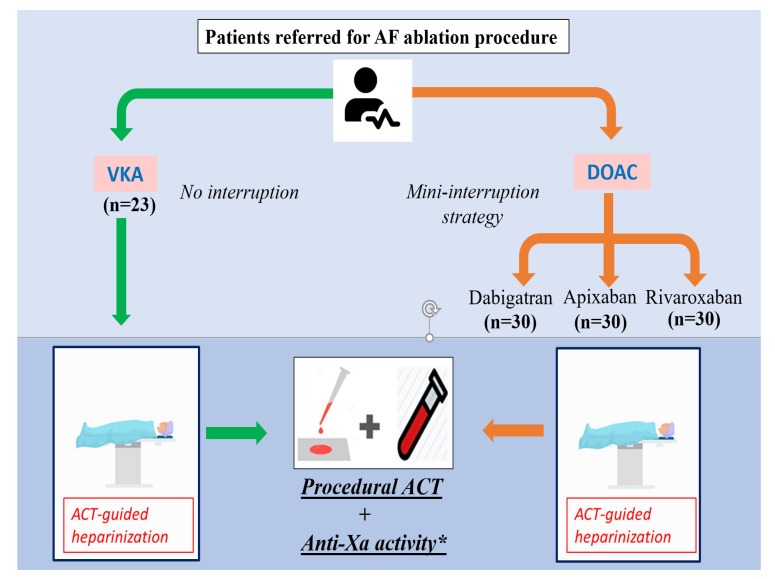
Patients referred for AF catheter ablation in our centre were prospectively included depending on their anticoagulant type.
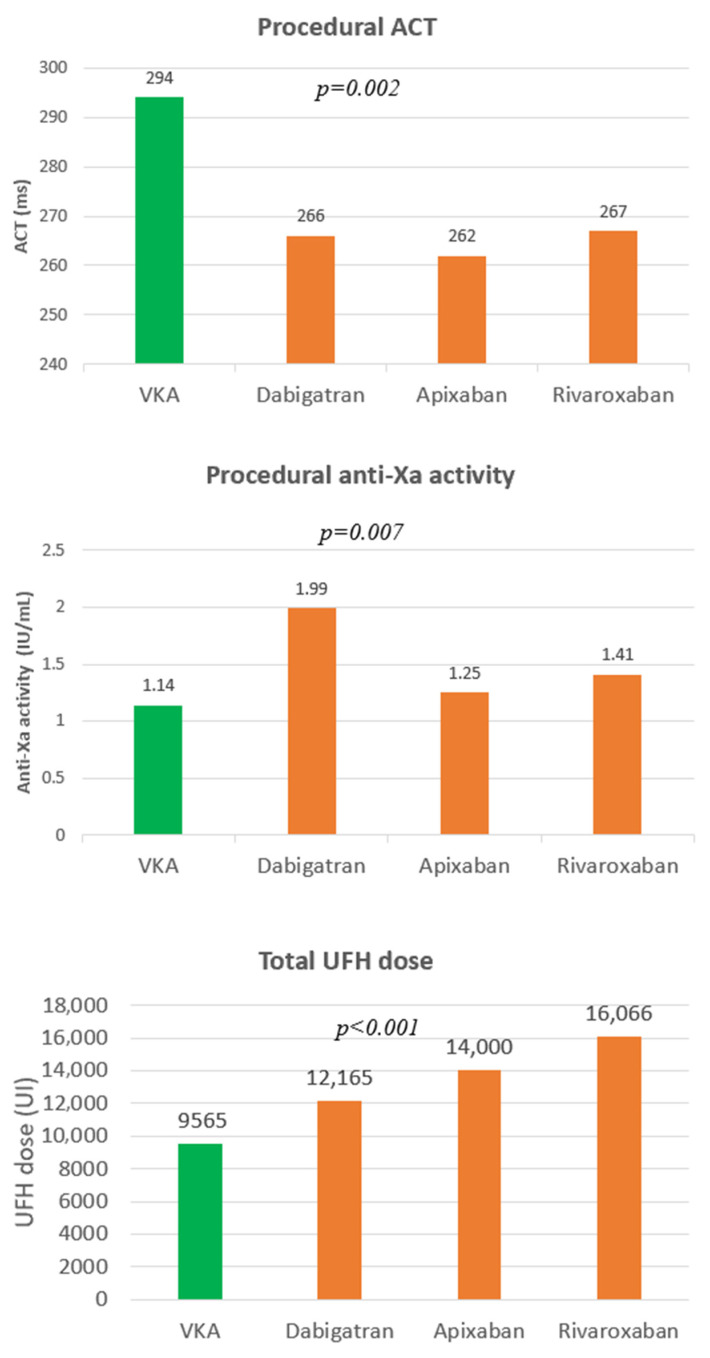
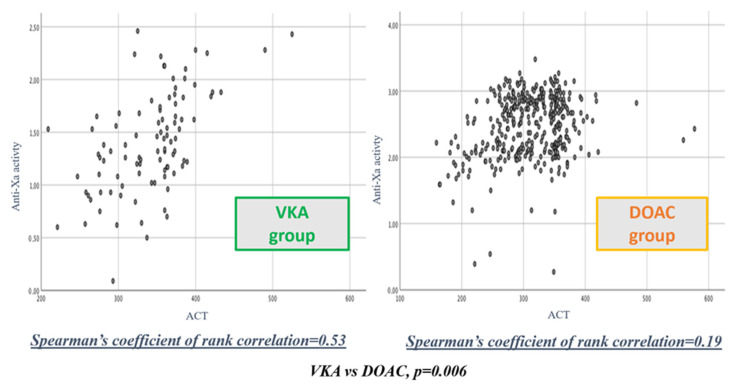
113 patients were included, receiving rivaroxaban ( = 30), apixaban ( = 30), dabigatran ( = 30), and VKA ( = 23). To meet target ACT, a higher UFH dose was required in DOAC than VKA patients (14,077.8 IU vs. 9565.2 IU, < 0.001), leading to a longer time to achieve target ACT (46.5 min vs. 27.3 min, = 0.001). The correlation of ACT and anti-Xa activity was tighter in the VKA group (Spearman correlation ρ = 0.53), compared to the DOAC group (ρ = 0.19). Despite lower ACT values in the DOAC group, this group demonstrated a higher mean anti-Xa activity compared to the VKA group (1.56 ± 0.39 vs. 1.14 ± 0.36; = 0.002).
Use of a conventional ACT threshold at 300 s during AF ablation procedures leads to a significant increase in UFH administration in patients treated with DOACs. This increase corresponds more likely to an overdosing than a real increase in UFH requirement.
活化凝血时间(ACT)指导下的肝素化是心房颤动(AF)消融手术期间滴定普通肝素(UFH)给药的金标准。当前的ACT目标值(300秒)是基于接受维生素K拮抗剂(VKA)治疗的患者的研究得出的。多项研究表明,在接受直接口服抗凝剂(DOAC)治疗的患者中,ACT值与UFH给药剂量之间的相关性较弱。
评估接受不同抗凝治疗的患者中ACT与通过抗Xa活性测量的实际肝素抗凝效果之间的关系。
根据抗凝类型,前瞻性纳入在我们中心接受AF导管消融的患者。
共纳入113例患者,分别接受利伐沙班(n = 30)、阿哌沙班(n = 30)、达比加群(n = 30)和VKA(n = 23)治疗。为达到目标ACT,DOAC组患者所需的UFH剂量高于VKA组患者(14,077.8 IU对9565.2 IU,P < 0.001),导致达到目标ACT的时间更长(46.5分钟对27.3分钟,P = 0.001)。与DOAC组(ρ = 0.19)相比,VKA组中ACT与抗Xa活性的相关性更强(Spearman相关性ρ = 0.53)。尽管DOAC组的ACT值较低,但该组的平均抗Xa活性高于VKA组(1.56±0.39对1.14±0.36;P = 0.002)。
在AF消融手术期间使用300秒的传统ACT阈值会导致接受DOAC治疗的患者UFH给药量显著增加。这种增加更可能是用药过量,而非实际UFH需求量的增加。