Wasylyshyn Anastasia I, Linder Kathleen A, Kauffman Carol A, Richards Blair J, Maurer Stephen M, Sheffield Virginia M, Benitez Colon Lydia, Miceli Marisa H
Division of Infectious Diseases, University of Michigan Health System, Ann Arbor, MI 48109, USA.
Infectious Diseases Section, VA Ann Arbor Healthcare System, Ann Arbor, MI 48105, USA.
J Fungi (Basel). 2021 Sep 15;7(9):761. doi: 10.3390/jof7090761.
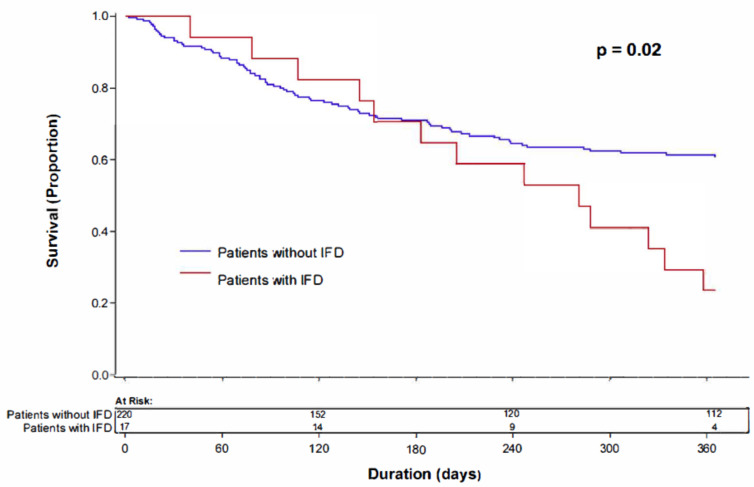
This single-center retrospective study of invasive fungal disease (IFD) enrolled 251 adult patients undergoing induction chemotherapy for newly diagnosed acute myeloid leukemia (AML) from 2014-2019. Patients had primary AML ( = 148, 59%); antecedent myelodysplastic syndrome ( = 76, 30%), or secondary AML ( = 27, 11%). Seventy-five patients (30%) received an allogeneic hematopoietic cell transplant within the first year after induction chemotherapy. Proven/probable IFD occurred in 17 patients (7%). Twelve of the 17 (71%) were mold infections, including aspergillosis ( = 6), fusariosis ( = 3), and mucomycosis ( = 3). Eight breakthrough IFD (B-IFD), seven of which were due to molds, occurred in patients taking antifungal prophylaxis. Patients with proven/probable IFD had a significantly greater number of cumulative neutropenic days than those without an IFD, HR = 1.038 (95% CI 1.018-1.059), = 0.0001. By cause-specific proportional hazards regression, the risk for IFD increased by 3.8% for each day of neutropenia per 100 days of follow up. Relapsed/refractory AML significantly increased the risk for IFD, HR = 7.562 (2.585-22.123), = 0.0002, and Kaplan-Meier analysis showed significantly higher mortality at 1 year in patients who developed a proven/probable IFD, = 0.02. IFD remains an important problem among patients with AML despite the use of antifungal prophylaxis, and development of IFD is associated with increased mortality in these patients.
这项关于侵袭性真菌病(IFD)的单中心回顾性研究纳入了2014年至2019年期间251例因新诊断的急性髓系白血病(AML)接受诱导化疗的成年患者。患者包括原发性AML(n = 148,59%)、既往骨髓增生异常综合征(n = 76,30%)或继发性AML(n = 27,11%)。75例患者(30%)在诱导化疗后的第一年内接受了异基因造血细胞移植。确诊/疑似IFD发生在17例患者中(7%)。这17例中的12例(71%)为霉菌感染,包括曲霉病(n = 6)、镰刀菌病(n = 3)和毛霉病(n = 3)。在接受抗真菌预防治疗的患者中发生了8例突破性IFD(B-IFD),其中7例由霉菌引起。确诊/疑似IFD的患者累计中性粒细胞减少天数显著多于未发生IFD的患者,HR = 1.038(95%CI 1.018 - 1.059),P = 0.0001。通过病因特异性比例风险回归分析,每100天随访中中性粒细胞减少每一天,IFD风险增加3.8%。复发/难治性AML显著增加了IFD风险,HR = 7.562(2.585 - 22.123),P = 0.0002,Kaplan-Meier分析显示确诊/疑似IFD的患者1年死亡率显著更高,P = 0.02。尽管使用了抗真菌预防治疗,但IFD在AML患者中仍然是一个重要问题,IFD的发生与这些患者死亡率增加相关。