Med-X Research Institute, School of Biomedical Engineering, Shanghai Jiao Tong University, Shanghai 200030, China.
Int J Mol Sci. 2021 Sep 15;22(18):9951. doi: 10.3390/ijms22189951.
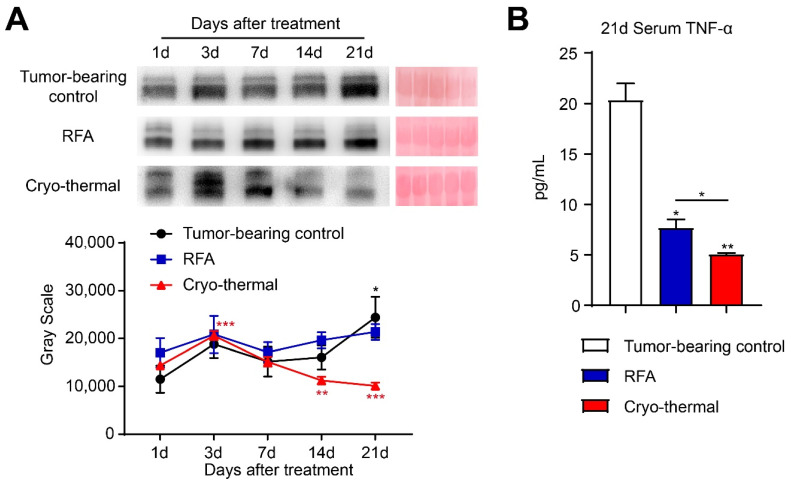
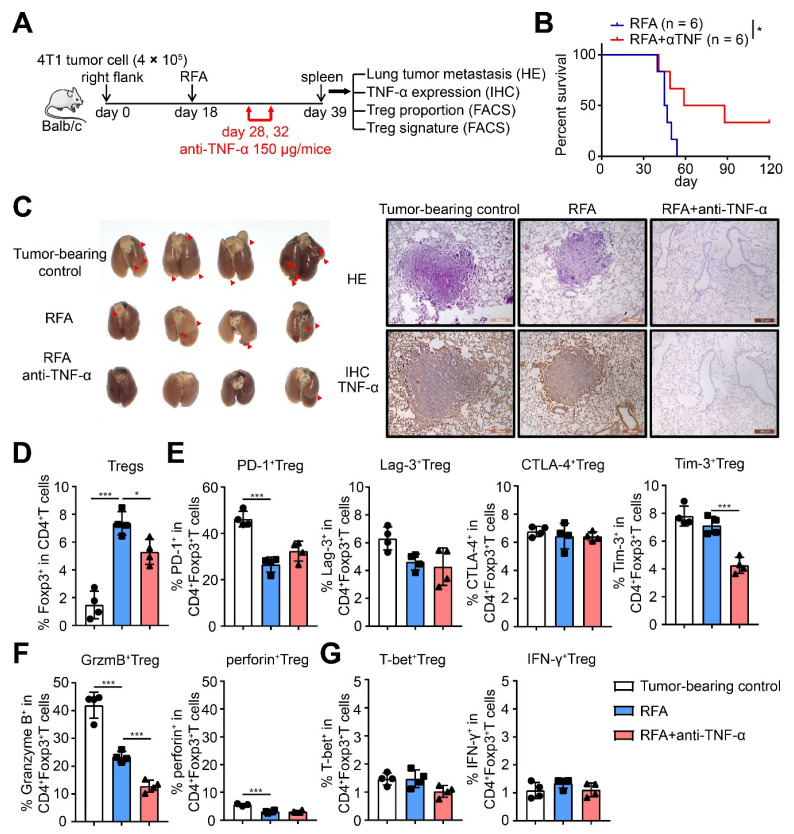
Immunotherapy has emerged as a therapeutic pillar in tumor treatment, but only a minority of patients get benefit. Overcoming the limitations of immunosuppressive environment is effective for immunotherapy. Moreover, host T cell activation and longevity within tumor are required for the long-term efficacy. In our previous study, a novel cryo-thermal therapy was developed to improve long-term survival in B16F10 melanoma and s.q. 4T1 breast cancer mouse models. We determined that cryo-thermal therapy induced Th1-dominant CD4 T cell differentiation and the downregulation of Tregs in B16F10 model, contributing to tumor-specific and long-lasting immune protection. However, whether cryo-thermal therapy can affect the differentiation and function of T cells in a s.q. 4T1 model remains unknown. In this study, we also found that cryo-thermal therapy induced Th1-dominant differentiation of CD4 T cells and the downregulation of effector Tregs. In particular, cryo-thermal therapy drove the fragility of Tregs and impaired their function. Furthermore, we discovered the downregulated level of serum tumor necrosis factor-α at the late stage after cryo-thermal therapy which played an important role in driving Treg fragility. Our findings revealed that cryo-thermal therapy could reprogram the suppressive environment and induce strong and durable antitumor immunity, which facilitate the development of combination strategies in immunotherapy.
免疫疗法已成为肿瘤治疗的重要支柱,但只有少数患者受益。克服免疫抑制环境的限制对免疫疗法有效。此外,宿主 T 细胞在肿瘤内的激活和长寿对于长期疗效是必需的。在我们之前的研究中,开发了一种新型的冷冻-热疗来提高 B16F10 黑色素瘤和 s.q. 4T1 乳腺癌小鼠模型的长期存活率。我们确定冷冻-热疗诱导了 Th1 优势的 CD4 T 细胞分化和 B16F10 模型中 Tregs 的下调,有助于肿瘤特异性和持久的免疫保护。然而,冷冻-热疗是否能影响 s.q. 4T1 模型中 T 细胞的分化和功能尚不清楚。在这项研究中,我们还发现冷冻-热疗诱导了 CD4 T 细胞的 Th1 优势分化和效应性 Tregs 的下调。特别是,冷冻-热疗驱动 Tregs 的脆弱性并损害其功能。此外,我们发现冷冻-热疗后晚期血清肿瘤坏死因子-α水平下调,在驱动 Treg 脆弱性方面发挥重要作用。我们的研究结果表明,冷冻-热疗可以重新编程抑制性环境并诱导强烈和持久的抗肿瘤免疫,这有助于免疫疗法联合策略的发展。