Peng Xintong, Zhou Yanling, Tao Yongguang, Liu Shuang
Key Laboratory of Carcinogenesis and Cancer Invasion, Ministry of Education, Department of Pathology, Xiangya Hospital, Central South University, Changsha 410078, China.
Key Laboratory of Carcinogenesis of the Ministry of Health, Cancer Research Institute, School of Basic Medicine, Central South University, Changsha 410078, China.
Pathogens. 2021 Aug 31;10(9):1113. doi: 10.3390/pathogens10091113.
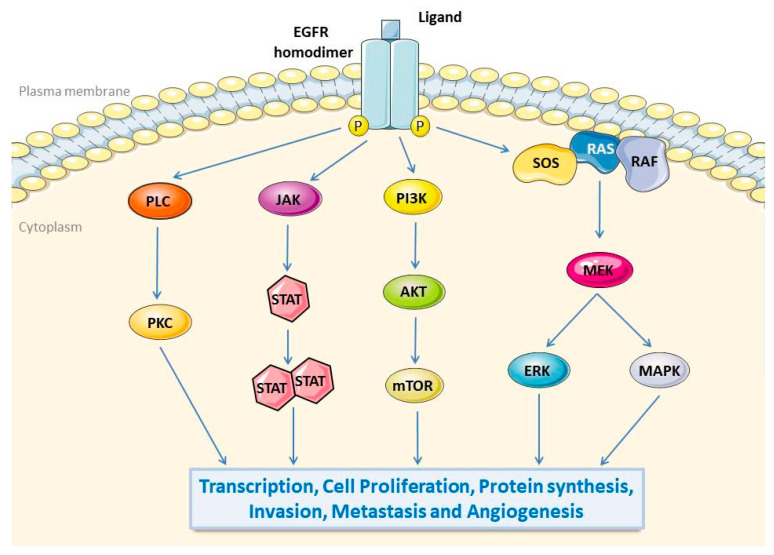
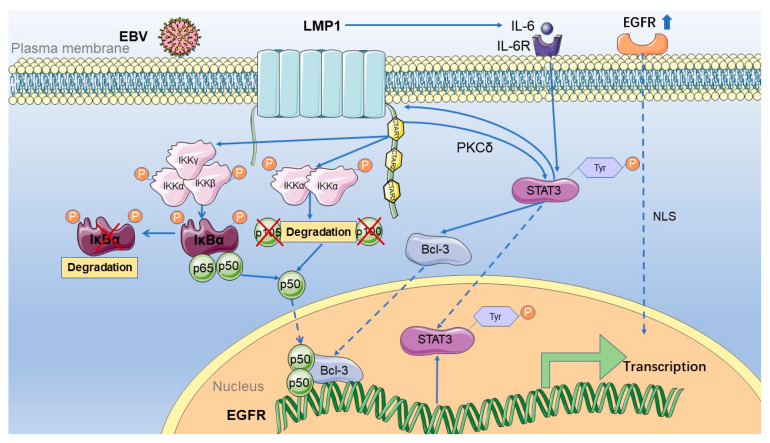
Epstein-Barr virus (EBV), a type 4 γ herpes virus, is recognized as a causative agent in nasopharyngeal carcinoma (NPC). Incidence of EBV-positive NPC have grown in recent decades along with worse outcomes compared with their EBV-negative counterparts. Latent membrane protein 1 (LMP1), encoded by EBV, induces NPC progression. The epidermal growth factor receptor (EGFR), a member of the ErbB family of receptor tyrosine kinases (RTK), is a driver of tumorigenesis, including for NPC. Little data exist on the relationship between EGFR and EBV-induced NPC. In our initial review, we found that LMP1 promoted the expression of EGFR in NPC in two main ways: the NF-κB pathway and STAT3 activation. On the other hand, EGFR also enhances EBV infection in NPC cells. Moreover, activation of EGFR signalling affects NPC cell proliferation, cell cycle progression, angiogenesis, invasion, and metastasis. Since EGFR promotes tumorigenesis and progression by downstream signalling pathways, causing poor outcomes in NPC patients, EGFR-targeted drugs could be considered a newly developed anti-tumor drug. Here, we summarize the major studies on EBV, EGFR, and LMP1-regulatory EGFR expression and nucleus location in NPC and discuss the clinical efficacy of EGFR-targeted agents in locally advanced NPC (LA NPC) and recurrent or metastatic NPC (R/M NPC) patients.
爱泼斯坦-巴尔病毒(EBV)是一种4型γ疱疹病毒,被认为是鼻咽癌(NPC)的致病因子。近几十年来,EBV阳性鼻咽癌的发病率不断上升,与EBV阴性鼻咽癌相比,其预后更差。EBV编码的潜伏膜蛋白1(LMP1)可诱导鼻咽癌进展。表皮生长因子受体(EGFR)是受体酪氨酸激酶(RTK)的ErbB家族成员,是包括鼻咽癌在内的肿瘤发生的驱动因素。关于EGFR与EBV诱导的鼻咽癌之间的关系,目前的数据很少。在我们最初的综述中,我们发现LMP1主要通过两种方式促进鼻咽癌中EGFR的表达:NF-κB途径和STAT3激活。另一方面,EGFR也增强了NPC细胞中的EBV感染。此外,EGFR信号的激活影响NPC细胞的增殖、细胞周期进程、血管生成、侵袭和转移。由于EGFR通过下游信号通路促进肿瘤发生和进展,导致NPC患者预后不良,因此EGFR靶向药物可被视为一种新开发的抗肿瘤药物。在这里,我们总结了关于EBV、EGFR和LMP1调节EGFR在鼻咽癌中的表达和核定位的主要研究,并讨论了EGFR靶向药物在局部晚期鼻咽癌(LA NPC)和复发或转移性鼻咽癌(R/M NPC)患者中的临床疗效。