Rehabilitation Engineering Lab, Department of Kinesiology and Community Health, University of Illinois at Urbana-Champaign, Champaign, IL, 61820, USA.
Department of Creative Product Design, Asia University, Taichung, 41354, Taiwan.
BMC Musculoskelet Disord. 2021 Sep 27;22(1):831. doi: 10.1186/s12891-021-04705-8.
Physical activity may benefit health and reduce risk for chronic complications in normal and people with diabetes and peripheral vascular diseases. However, it is unclear whether leg muscle fatigue after weight-bearing physical activities, such as brisk walking, may increase risk for plantar tissue injury. In the literature, there is no evidence on the effect of muscle fatigue on plantar pressure after various walking intensities. The objectives of this study were to investigate the effects of various walking intensities on leg muscle fatigue and plantar pressure patterns.
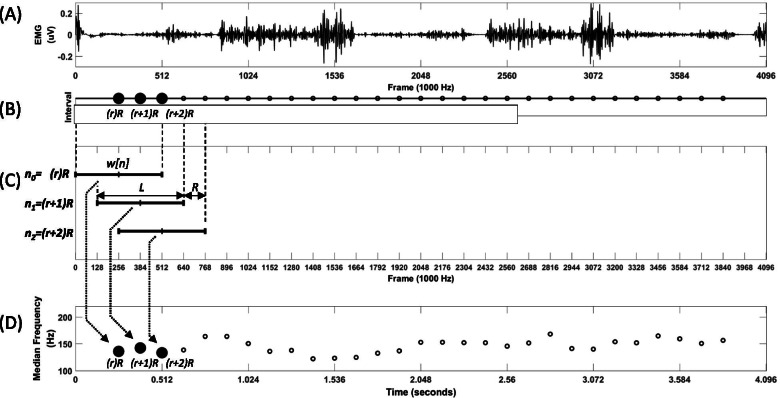
A 3 × 2 factorial design, including 3 walking speeds (1.8 (slow and normal walking), 3.6 (brisk walking), and 5.4 (slow running) mph) and 2 walking durations (10 and 20 min) for a total of 6 walking intensities, was tested in 12 healthy participants in 3 consecutive weeks. The median frequency and complexity of electromyographic (EMG) signals of tibialis anterior (TA) and gastrocnemius medialis (GM) were used to quantify muscle fatigue. Fourier transform was used to compute the median frequency and multiscale entropy was used to calculate complexity of EMG signals. Peak plantar pressure (PPP) values at the 4 plantar regions (big toe, first metatarsal head, second metatarsal head, and heel) were calculated.
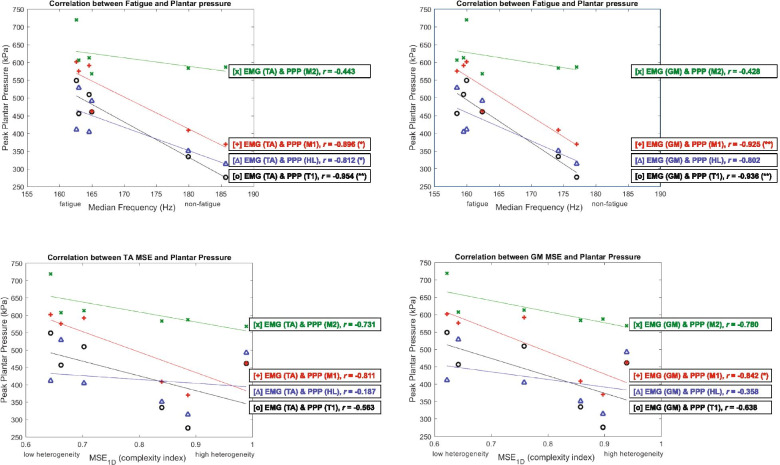
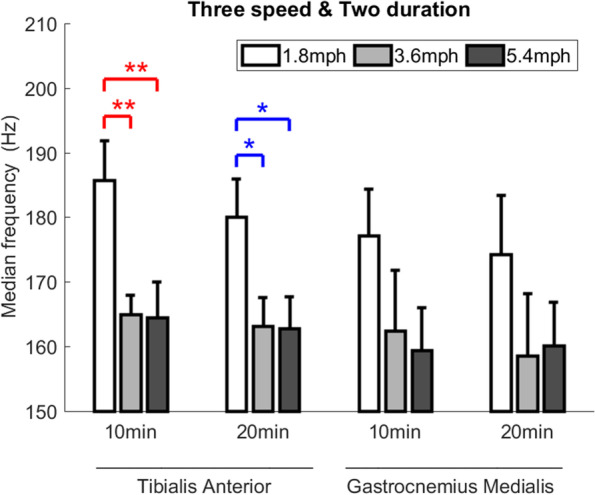
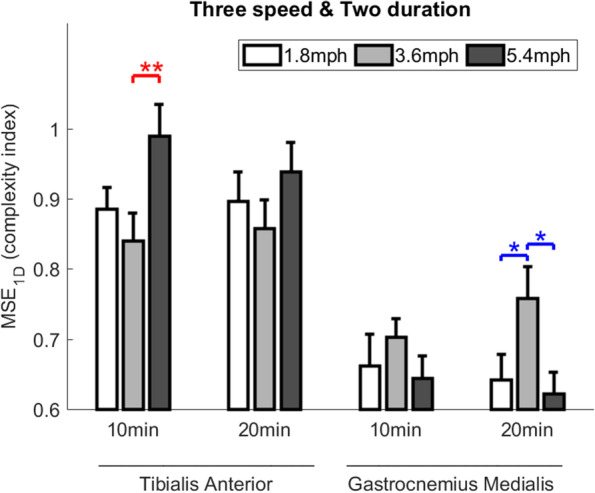
Two-way ANOVA showed that the walking speed (at 1.8, 3.6, 5.4 mph) significantly affected leg muscle fatigue, and the duration factor (at 10 and 20 min) did not. The one-way ANOVA showed that there were four significant pairwise differences of the median frequency of TA, including walking speed of 1.8 and 3.6 mph (185.7 ± 6.1 vs. 164.9 ± 3.0 Hz, P = 0.006) and 1.8 and 5.4 mph (185.7 ± 6.1 vs. 164.5 ± 5.5 Hz, P = 0.006) for the 10-min duration; and walking speed of 1.8 and 3.6 mph (180.0 ± 5.9 vs. 163.1 ± 4.4 Hz, P = 0.024) and 1.8 and 5.4 mph (180.0 ± 5.9 vs. 162.8 ± 4.9 Hz, P = 0.023) for the 20-min duration. The complexity of TA showed a similar trend with the median frequency of TA. The median frequency of TA has a significant negative correlation with PPP on the big toe ( r = -0.954, P = 0.003) and the first metatarsal head ( r = -0.896, P = 0.016).
This study demonstrated that brisk walking and slow running speeds (3.6 and 5.4 mph) cause an increase in muscle fatigue of TA compared to slow walking speed (1.8 mph); and the increased muscle fatigue is significantly related to a higher PPP.
体力活动可能有益于健康,并降低患有糖尿病和外周血管疾病的人群发生慢性并发症的风险。然而,目前尚不清楚承重体力活动(如快走)后腿部肌肉疲劳是否会增加足底组织损伤的风险。在文献中,尚无关于各种行走强度下肌肉疲劳对足底压力影响的证据。本研究旨在探讨不同行走强度对腿部肌肉疲劳和足底压力模式的影响。
采用 3×2 析因设计,包括 3 种步行速度(1.8(慢走和正常行走)、3.6(快走)和 5.4(慢跑)英里/小时)和 2 种步行时间(10 和 20 分钟),共 6 种步行强度,共 12 名健康参与者在 3 周内连续测试。采用表面肌电图(EMG)信号的中值频率和复杂度来量化肌肉疲劳。采用傅里叶变换计算 EMG 信号的中值频率,采用多尺度熵计算复杂度。计算 4 个足底区域(大脚趾、第一跖骨头、第二跖骨头和脚跟)的峰值足底压力(PPP)值。
双因素方差分析显示,行走速度(1.8、3.6、5.4 英里/小时)显著影响腿部肌肉疲劳,而持续时间因素(10 和 20 分钟)没有影响。单因素方差分析显示,TA 的中值频率有四个显著的两两差异,包括 10 分钟持续时间时的行走速度 1.8 和 3.6 英里/小时(185.7±6.1 与 164.9±3.0 Hz,P=0.006)和 1.8 和 5.4 英里/小时(185.7±6.1 与 164.5±5.5 Hz,P=0.006);以及 20 分钟持续时间时的行走速度 1.8 和 3.6 英里/小时(180.0±5.9 与 163.1±4.4 Hz,P=0.024)和 1.8 和 5.4 英里/小时(180.0±5.9 与 162.8±4.9 Hz,P=0.023)。TA 的复杂度呈现出与 TA 的中值频率相似的趋势。TA 的中值频率与大脚趾(r=-0.954,P=0.003)和第一跖骨头(r=-0.896,P=0.016)的 PPP 呈显著负相关。
本研究表明,与慢走速度(1.8 英里/小时)相比,快走和慢跑速度(3.6 和 5.4 英里/小时)会导致 TA 的肌肉疲劳增加;而增加的肌肉疲劳与更高的 PPP 显著相关。