Gene Center and Department of Biochemistry, Ludwig-Maximilians-Universität München, Feodor-Lynen-Straße 25, 81377, Munich, Germany.
Research Unit Apoptosis in Hematopoietic Stem Cells, Helmholtz Zentrum München, German Research Center for Environmental Health (HMGU), Neuherberg, Germany.
J Hematol Oncol. 2021 Sep 27;14(1):155. doi: 10.1186/s13045-021-01163-6.
Acute myeloid leukaemia (AML) stem cells (LSCs) cause disease relapse. The CD47 "don't eat me signal" is upregulated on LSCs and contributes to immune evasion by inhibiting phagocytosis through interacting with myeloid-specific signal regulatory protein alpha (SIRPα). Activation of macrophages by blocking CD47 has been successful, but the ubiquitous expression of CD47 on healthy cells poses potential limitations for such therapies. In contrast, CD123 is a well-known LSC-specific surface marker utilized as a therapeutic target. Here, we report the development of SIRPα-αCD123 fusion antibodies that localize the disruption of CD47/SIRPα signalling to AML while specifically enhancing LSC clearance.
SIRPα-αCD123 antibodies were generated by fusing the extracellular domain of SIRPα to an αCD123 antibody. The binding properties of the antibodies were analysed by flow cytometry and surface plasmon resonance. The functional characteristics of the fusion antibodies were determined by antibody-dependent cellular phagocytosis and antibody-dependent cellular cytotoxicity assays using primary AML patient cells. Finally, an in vivo engraftment assay was utilized to assess LSC targeting.
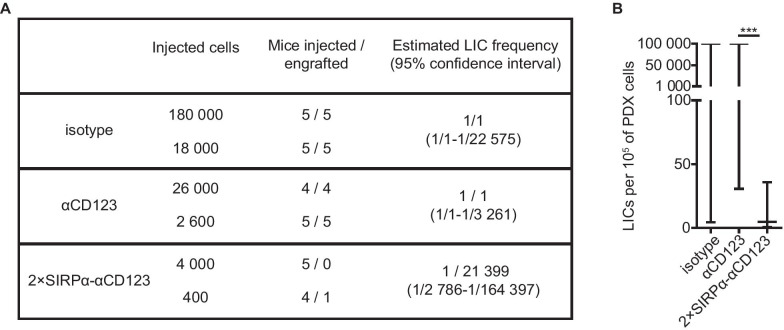
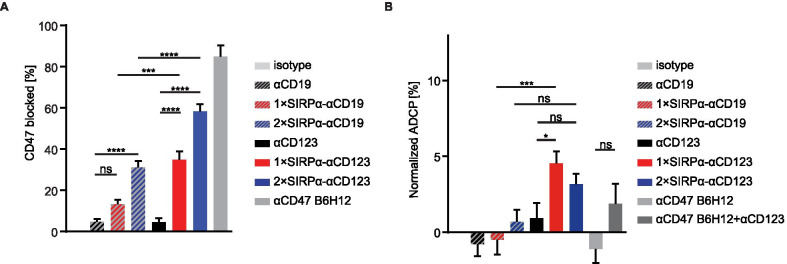
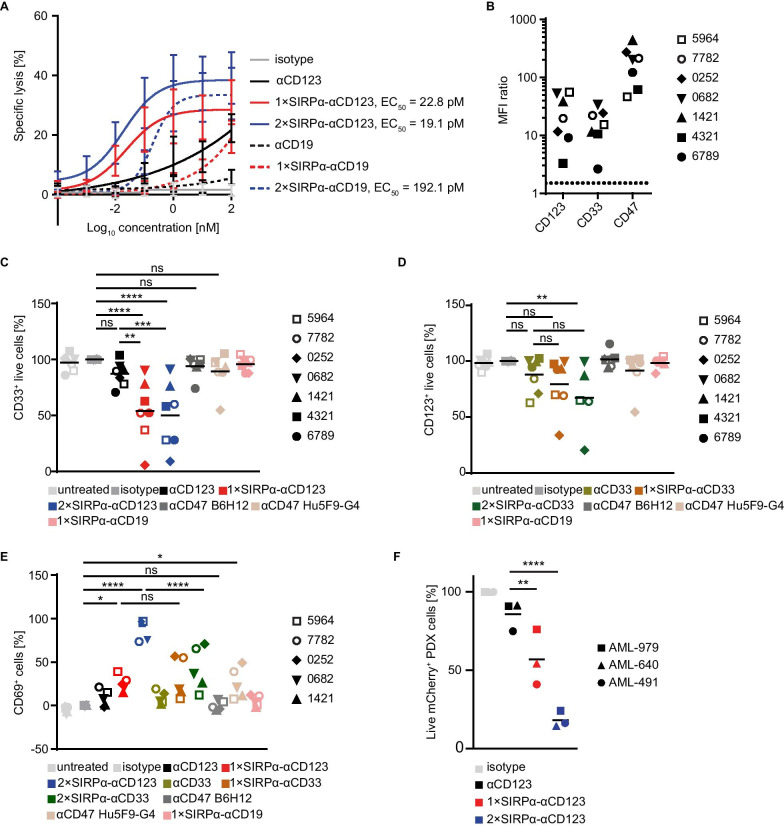
SIRPα-αCD123 fusion antibodies exhibited increased binding and preferential targeting of CD123 CD47 AML cells even in the presence of CD47 healthy cells. Furthermore, SIRPα-αCD123 fusion antibodies confined disruption of the CD47-SIRPα axis locally to AML cells. In vitro experiments demonstrated that SIRPα-αCD123 antibodies greatly enhanced AML cell phagocytosis mediated by allogeneic and autologous macrophages. Moreover, SIRPα-αCD123 fusion antibodies efficiently targeted LSCs with in vivo engraftment potential.
SIRPα-αCD123 antibodies combine local CD47 blockade with specific LSC targeting in a single molecule, minimize the risk of targeting healthy cells and efficiently eliminate AML LSCs. These results validate SIRPα-αCD123 antibodies as promising therapeutic interventions for AML.
急性髓系白血病 (AML) 干细胞 (LSCs) 导致疾病复发。LSCs 上上调了 CD47“别吃我信号”,通过与髓系特异性信号调节蛋白 alpha (SIRPα) 相互作用抑制吞噬作用,从而有助于免疫逃逸。通过阻断 CD47 激活巨噬细胞已取得成功,但 CD47 在健康细胞上的广泛表达对这类治疗方法提出了潜在的限制。相比之下,CD123 是一种众所周知的 LSC 特异性表面标志物,可用作治疗靶点。在这里,我们报告了 SIRPα-αCD123 融合抗体的开发,该抗体将 CD47/SIRPα 信号的破坏局限于 AML,同时特异性增强 LSC 清除。
通过将 SIRPα 的细胞外结构域融合到 αCD123 抗体上来生成 SIRPα-αCD123 抗体。通过流式细胞术和表面等离子体共振分析抗体的结合特性。通过使用原代 AML 患者细胞进行抗体依赖性细胞吞噬和抗体依赖性细胞细胞毒性测定来确定融合抗体的功能特性。最后,利用体内植入测定来评估 LSC 靶向性。
SIRPα-αCD123 融合抗体表现出增加的结合和对 CD123+CD47+AML 细胞的优先靶向性,即使在存在 CD47 健康细胞的情况下也是如此。此外,SIRPα-αCD123 融合抗体将 CD47-SIRPα 轴的破坏局限于 AML 细胞。体外实验表明,SIRPα-αCD123 抗体极大地增强了同种异体和自体巨噬细胞介导的 AML 细胞吞噬作用。此外,SIRPα-αCD123 融合抗体在体内植入实验中有效地靶向具有植入潜力的 LSCs。
SIRPα-αCD123 抗体将局部 CD47 阻断与单个分子中的特定 LSC 靶向相结合,最大限度地降低了靶向健康细胞的风险,并有效地消除了 AML LSCs。这些结果验证了 SIRPα-αCD123 抗体作为 AML 有前途的治疗干预措施。