Department of Neurosurgery and Spine Surgery, University Hospital Essen, University of Duisburg-Essen, 45147, Essen, Germany.
Institute for Diagnostic and Interventional Radiology and Neuroradiology, University Hospital Essen, University of Duisburg-Essen, Essen, Germany.
Sci Rep. 2021 Sep 28;11(1):19191. doi: 10.1038/s41598-021-98462-2.
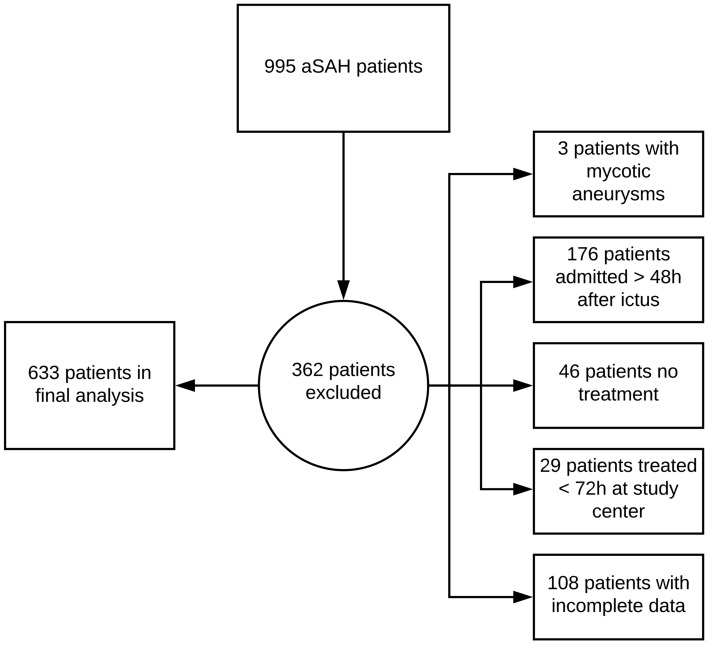
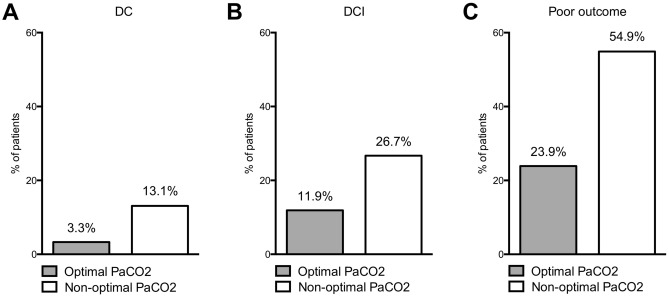
The partial pressure of carbon dioxide (PaCO2) in the arterial blood is a strong vasomodulator affecting cerebral blood flow and the risk of cerebral edema and ischemia after acute brain injury. In turn, both complications are related to poor outcome in patients with aneurysmal subarachnoid hemorrhage (aSAH). We aimed to analyze the effect of PaCO2 levels on the course and outcome of aSAH. All patients of a single institution treated for aSAH over 13.5 years were included (n = 633). Daily PaCO2 values from arterial blood gas measurements were recorded for up to 2 weeks after ictus. The study endpoints were: delayed cerebral ischemia (DCI), need for decompressive craniectomy due to increased intracranial pressure > 20 mmHg refractory to conservative treatment and poor outcome at 6-months follow-up (modified Rankin scale > 2). By correlations with the study endpoints, clinically relevant cutoffs for the 14-days mean values for the lowest and highest daily PaCO2 levels were defined by receiver operating characteristic curve analysis. Association with the study endpoints for the identifies subgroups was analyzed using multivariate analysis. The optimal range for PaCO2 values was identified between 30 and 38 mmHg. ASAH patients with poor initial condition (WFNS 4/5) were less likely to show PaCO2 values within the range of 30-38 mmHg (p < 0.001, OR = 0.44). In the multivariate analysis, PaCO2 values between 30 and 38 mmHg were associated with a lower risk for decompressive craniectomy (p = 0.042, aOR = 0.27), DCI occurrence (p = 0.035; aOR = 0.50), and poor patient outcome (p = 0.004; aOR = 0.42). The data from this study shows an independent positive association between low normal mean PaCO2 values during the acute phase of aSAH and patients' outcome. This effect might be attributed to the reduction of intracranial hypertension and alterations in the cerebral blood flow.
动脉血二氧化碳分压(PaCO2)是一种强烈的血管调节剂,影响脑血流和急性颅脑损伤后脑水肿和缺血的风险。反过来,这两种并发症都与动脉瘤性蛛网膜下腔出血(aSAH)患者的不良预后有关。我们旨在分析 PaCO2 水平对 aSAH 病程和结局的影响。纳入了单中心治疗 aSAH 超过 13.5 年的所有患者(n=633)。记录发病后最多 2 周内的动脉血气测量的每日 PaCO2 值。研究终点为:迟发性脑缺血(DCI)、因颅内压升高>20mmHg 而需要减压性颅骨切除术且保守治疗无效和 6 个月随访时预后不良(改良Rankin 量表>2)。通过与研究终点的相关性,通过接收者操作特征曲线分析定义了 14 天最低和最高每日 PaCO2 水平的平均值的临床相关截止值。使用多变量分析分析了识别亚组与研究终点的关联。PaCO2 值的最佳范围在 30 至 38mmHg 之间。初始状况较差的 aSAH 患者(WFNS 4/5)不太可能出现 30-38mmHg 之间的 PaCO2 值(p<0.001,OR=0.44)。在多变量分析中,30 至 38mmHg 之间的 PaCO2 值与减压性颅骨切除术风险降低相关(p=0.042,aOR=0.27)、DCI 发生(p=0.035;aOR=0.50)和患者预后不良(p=0.004;aOR=0.42)。本研究的数据表明,aSAH 急性期低正常平均 PaCO2 值与患者预后之间存在独立的正相关。这种效应可能归因于颅内压的降低和脑血流的改变。