Xuanwu Hospital of Capital Medical University, 45 Changchun Street, Xicheng District, Beijing, 100032, China.
BMC Musculoskelet Disord. 2021 Sep 29;22(1):833. doi: 10.1186/s12891-021-04720-9.
Hybrid Oxford unicompartmental knee arthroplasty (OUKA) consists of cementless femoral prostheses and cemented tibial prostheses. Although a hybrid OUKA has been used in clinical practice, the clinical outcome has not been reported. The purpose of this study was to compare the short-term clinical outcomes and rate of residual bone cement extrusion between hybrid and cemented prostheses and analyse the possible reasons for differences between outcomes.
A total of 128 knees (118 patients) with end-stage osteoarthritis were included in this study, of which underwent consecutive operations using unicondylar Oxford phase 3 implants from July 2017 and September 2019 in our centre. Follow-up was performed at 6 weeks, 3 and 6 months, 1 year and every year after operation, and complications and changes in the Oxford knee score (OKS) were recorded. The OKS of the two groups was analysed by the generalized estimating equation approach. Prosthesis-based standard fluoroscopy was performed in a timely manner after each operation, and the rate of residual cement extrusion of the two groups was estimated using T-tests and a multivariate regression analysis.
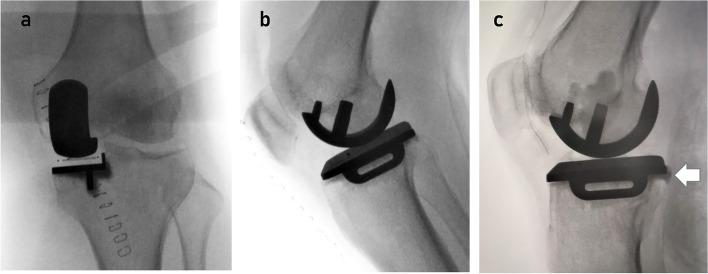
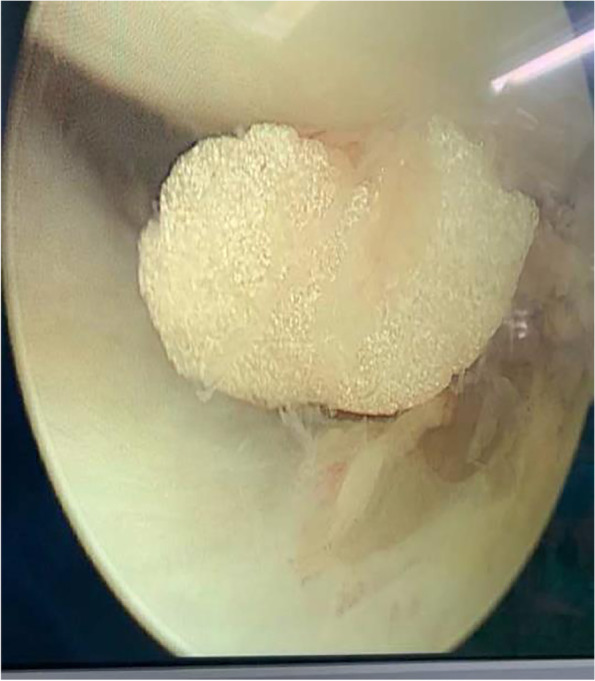
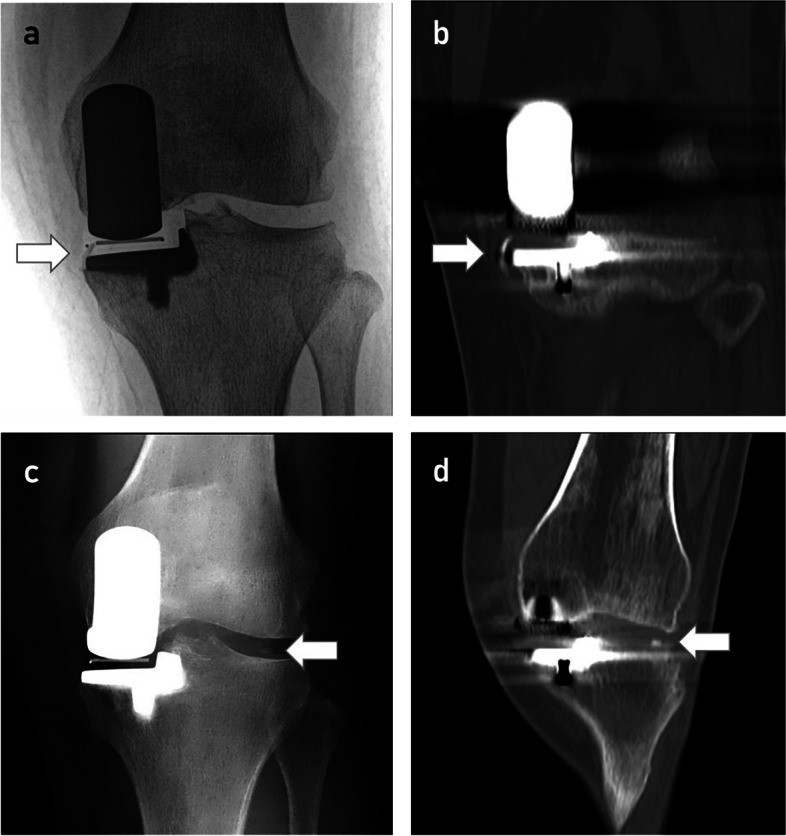
Excluding the cases that lost follow-up, a total of 120 knees (65 in hybrid group and 55 in cemented group) were included in the analysis. There was no statistically significant difference in patient characteristics between the two groups (p > 0.05). The average follow-up time was 23.4 months (and ranged from 12 to 38 months). As of the last follow-up, there were no complications, such as dislocation, fracture, prosthesis loosening and subsidence, but one patient in the cemented group experienced symptoms caused by residual loose cement. Postoperative OKS in both groups improved significantly (p < 0.001). There was no significant difference in the OKS at any point during the follow-up or in the improvement of the OKS between the two groups (p > 0.05). Residual cement was mainly extruded behind the tibial prosthesis. The rate of hybrid periprosthetic residual cement extrusion was significantly lower in the hybrid group than in the cemented group, and the difference was statistically significant (OR = 3.38; p = 0.014).
Hybrid OUKA is as effective as cemented OUKA in the short term after operation and can significantly reduce the residual cement extrusion rate around the tibial prosthesis.
混合 Oxford 单髁膝关节置换术(OUKA)由非骨水泥股骨假体和骨水泥胫骨假体组成。尽管混合 OUKA 已在临床实践中应用,但尚未报道其临床结果。本研究旨在比较混合和骨水泥假体的短期临床结果和残留骨水泥挤出率,并分析结果差异的可能原因。
本研究共纳入 128 例(118 例患者)终末期骨关节炎患者,均于 2017 年 7 月至 2019 年 9 月在我院行单髁 Oxford 第 3 期植入物连续手术。术后 6 周、3 个月、6 个月、1 年及每年进行随访,记录并发症和牛津膝关节评分(OKS)的变化。采用广义估计方程方法分析两组的 OKS。每次手术后及时进行基于假体的标准荧光透视检查,采用 t 检验和多元回归分析估计两组残留水泥挤出率。
排除失访病例后,共纳入 120 例膝关节(混合组 65 例,骨水泥组 55 例)进行分析。两组患者的一般资料无统计学差异(p>0.05)。平均随访时间为 23.4 个月(12~38 个月)。末次随访时,无脱位、骨折、假体松动和下沉等并发症,但骨水泥组有 1 例患者出现残留松动水泥引起的症状。两组术后 OKS 均显著改善(p<0.001)。随访期间任何时间点的 OKS 均无差异,两组 OKS 改善情况亦无差异(p>0.05)。残留水泥主要挤出在胫骨假体后方。混合组胫骨假体周围残留骨水泥挤出率明显低于骨水泥组,差异有统计学意义(OR=3.38;p=0.014)。
混合 OUKA 术后短期与骨水泥 OUKA 一样有效,可显著降低胫骨假体周围残留骨水泥挤出率。