School of Integrative Medicine, Tianjin University of Traditional Chinese Medicine, Tianjin, 301617, China.
Department of Rheumatology, The First Affiliated Hospital of Guangzhou University of Chinese Medicine, Guangzhou, 510000, China.
Sci Rep. 2021 Sep 29;11(1):19305. doi: 10.1038/s41598-021-98437-3.
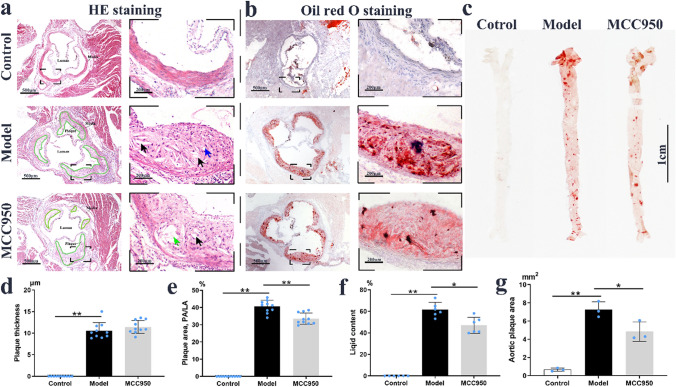
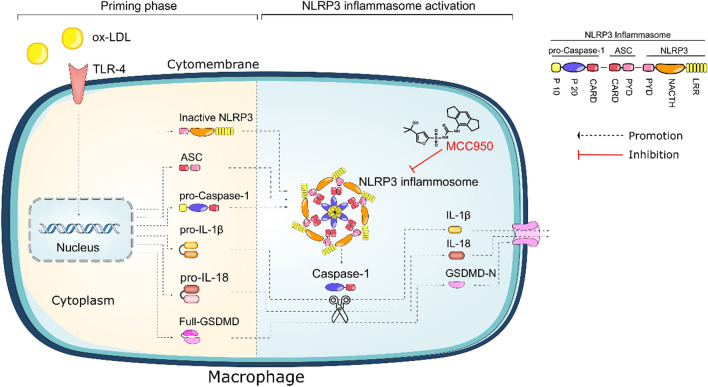
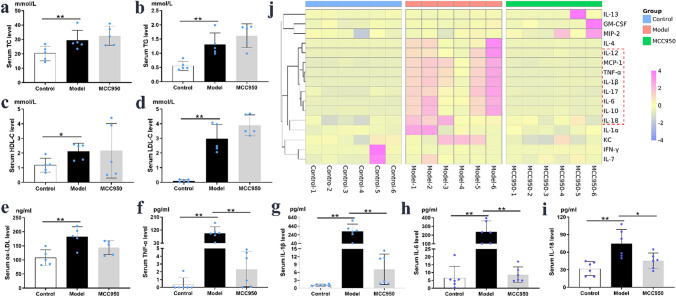
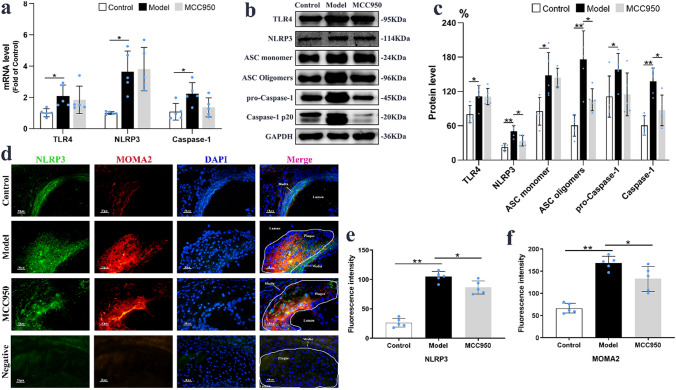
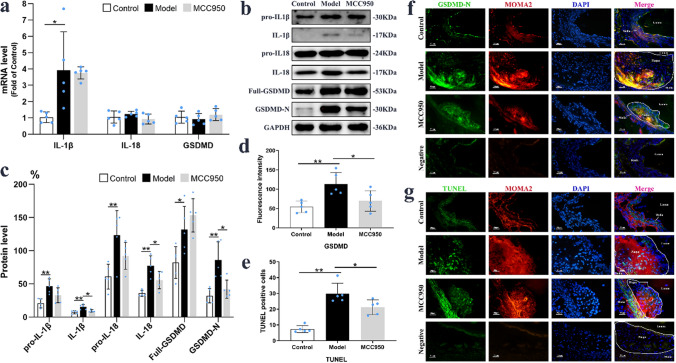
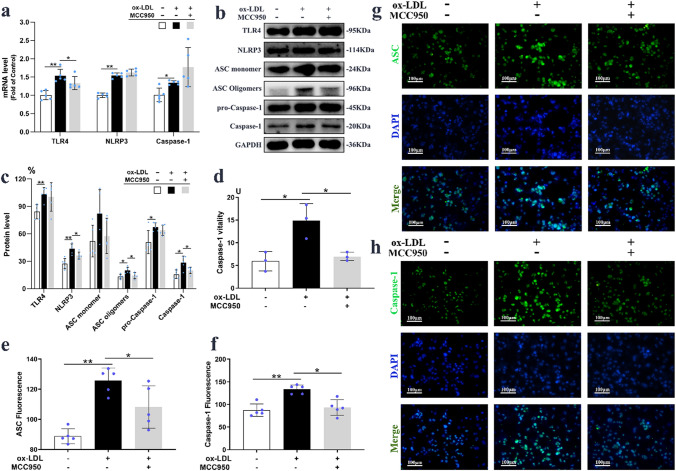
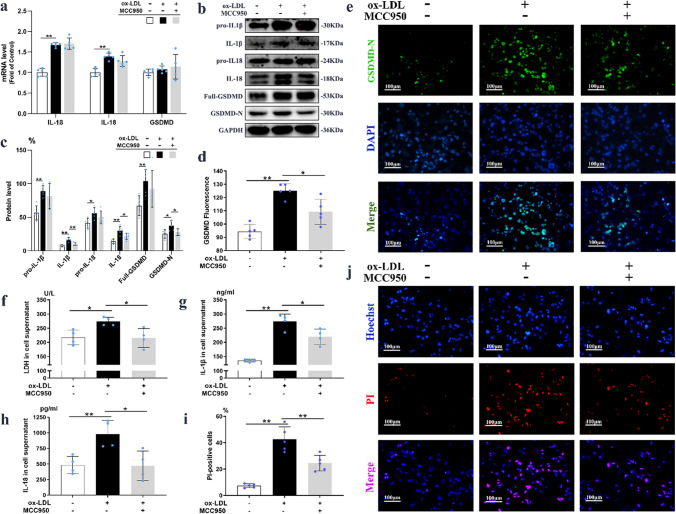
NLRP3 inflammasome is a vital player in macrophages pyroptosis, which is a type of proinflammatory cell-death and takes part in the pathogenesis of atherosclerosis. In this study, we used apoE mice and ox-LDL induced THP-1 derived macrophages to explore the mechanisms of MCC950, a selective NLRP3 inhibitor in treating atherosclerosis. For the in vivo study, MCC950 was intraperitoneal injected to 8-week-old apoE mice fed with high-fat diet for 12 weeks. For the in vitro study, THP-1 derived macrophages were treated with ox-LDL and MCC950 for 48 h. MCC950 administration reduced plaque areas and macrophages contents, but did not improve the serum lipid profiles in aortic root of apoE mice. MCC950 inhibited the activation of NLRP3/ASC/Caspase-1/GSDMD-N axis, and alleviated macrophages pyroptosis and the production of IL-1β and IL-18 both in aorta and in cell lysates. However, MCC950 did not affect the expression of TLR4 or the mRNA levels of NLRP3 inflammasome and its downstream proteins, suggesting that MCC950 had no effects on the priming of NLRP3 inflammasome activation in macrophages. The anti-atherosclerotic mechanisms of MCC950 on attenuating macrophages inflammation and pyroptosis involved in inhibiting the assembly and activation of NLRP3 inflammasome, rather than interrupting its priming.
NLRP3 炎性小体是巨噬细胞细胞焦亡的关键调节因子,细胞焦亡是一种促炎细胞死亡方式,参与动脉粥样硬化的发病机制。在本研究中,我们使用载脂蛋白 E(apoE)小鼠和氧化型低密度脂蛋白(ox-LDL)诱导的 THP-1 衍生巨噬细胞来探讨 MCC950(一种选择性 NLRP3 抑制剂)治疗动脉粥样硬化的机制。在体内研究中,MCC950 通过腹腔注射给予喂食高脂肪饮食 12 周的 8 周龄 apoE 小鼠。在体外研究中,THP-1 衍生巨噬细胞用 ox-LDL 和 MCC950 处理 48 小时。MCC950 给药可减少斑块面积和巨噬细胞含量,但不能改善 apoE 小鼠主动脉根部的血清脂质谱。MCC950 抑制 NLRP3/ASC/Caspase-1/GSDMD-N 轴的激活,减轻巨噬细胞焦亡,并减轻 IL-1β 和 IL-18 在主动脉和细胞裂解物中的产生。然而,MCC950 不影响 TLR4 的表达或 NLRP3 炎性小体及其下游蛋白的 mRNA 水平,表明 MCC950 对巨噬细胞 NLRP3 炎性小体激活的初始阶段没有影响。MCC950 通过抑制 NLRP3 炎性小体的组装和激活来减轻巨噬细胞炎症和焦亡从而发挥抗动脉粥样硬化作用,而不是阻断其初始激活。