Bentlage Bastian, Collins Allen G
Marine Laboratory, University of Guam, Mangilao, Guam, USA.
National Museum of Natural History & National Systematics Laboratory of NOAA's Fisheries Service, Smithsonian Institution, Washington, DC, USA.
PeerJ. 2021 Sep 9;9:e12104. doi: 10.7717/peerj.12104. eCollection 2021.
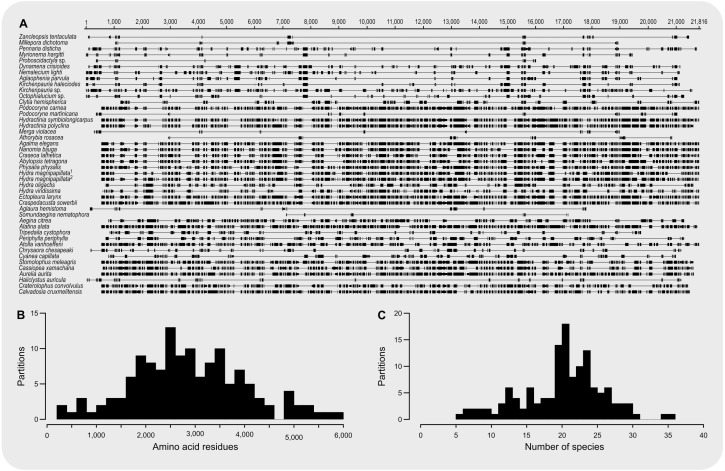
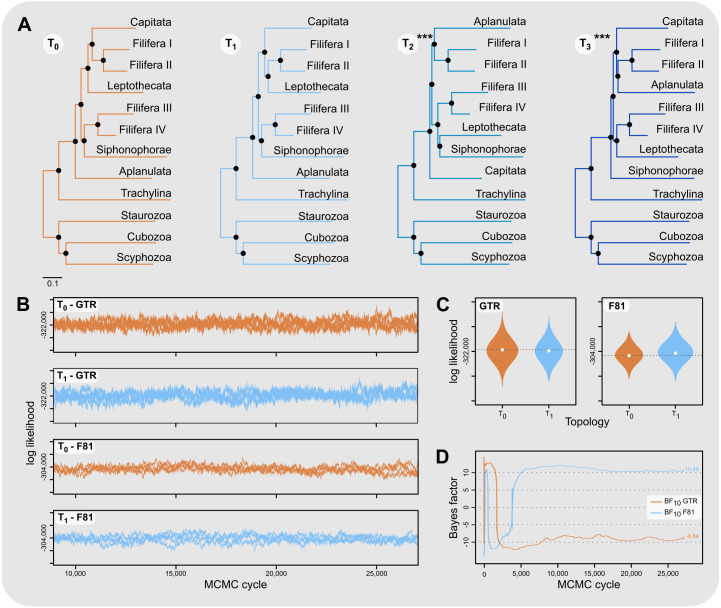
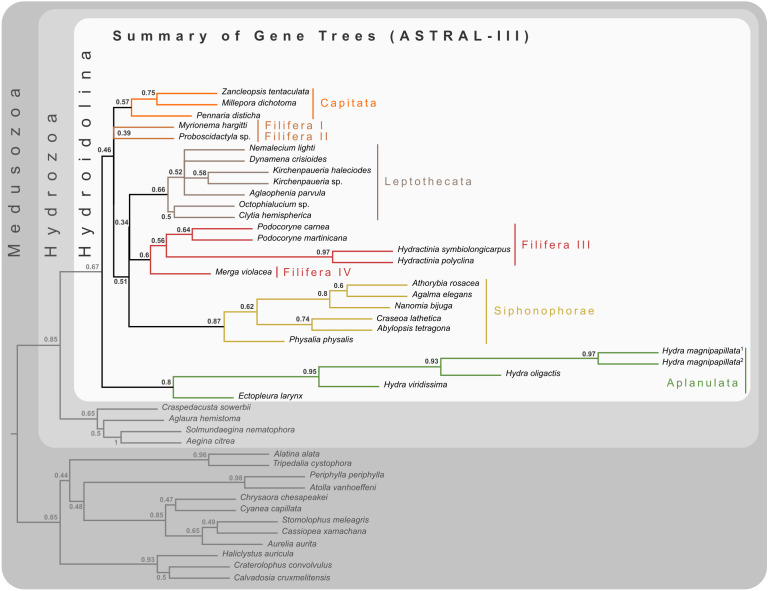
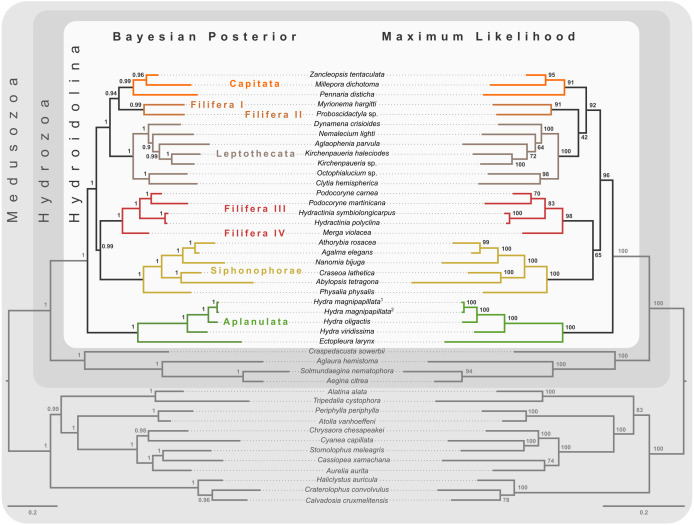
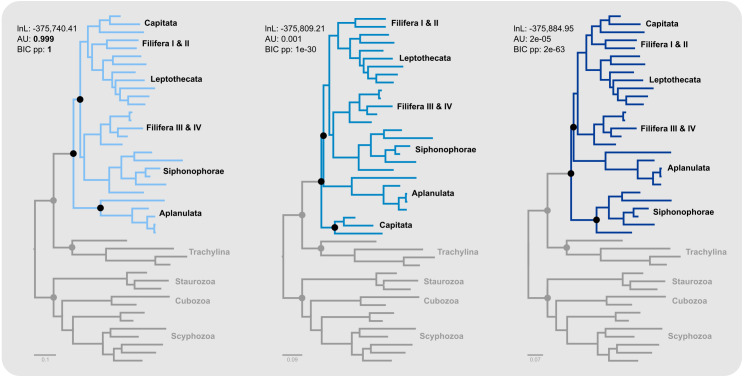
Higher-level relationships of the Hydrozoan subclass Hydroidolina, which encompasses the vast majority of medusozoan cnidarian species diversity, have been elusive to confidently infer. The most widely adopted phylogenetic framework for Hydroidolina based on ribosomal RNA data received low support for several higher level relationships. To address this issue, we developed a set of RNA baits to target more than a hundred loci from the genomes of a broad taxonomic sample of Hydroidolina for high-throughput sequencing. Using these data, we inferred the relationships of Hydroidolina using maximum likelihood and Bayesian approaches. Both inference methods yielded well-supported phylogenetic hypotheses that largely agree with each other. Using maximum likelihood and Baysian hypothesis testing frameworks, we found that several alternate topological hypotheses proposed previously may be rejected in light of the genomic data generated for this study. Both the maximum likelihood and Bayesian topologies inferred herein consistently score well across testing frameworks, suggesting that their consensus represents the most likely phylogenetic hypothesis of Hydroidolina. This phylogenetic framework places Aplanulata as sister lineage to the remainder of Hydroidolina. This is a strong deviation from previous phylogenetic analyses that placed Capitata or Siphonophorae as sister group to the remainder of Hydroidolina. Considering that Aplanulata represents a lineage comprised of species that for the most part possess a life cycle involving a solitary polyp and free-swimming medusa stage, the phylogenetic hypotheses presented herein have potentially large implications for clarifying the evolution of life cycles, coloniality, and the division of labor in Hydrozoa as taxon sampling for phylogenetic analyses becomes more complete.
水螅虫亚纲(Hydrozoan subclass Hydroidolina)包含了大多数水母类刺胞动物的物种多样性,其更高层次的系统发育关系一直难以确切推断。基于核糖体RNA数据,水螅虫亚纲最广泛采用的系统发育框架在几个更高层次的关系上支持度较低。为了解决这个问题,我们开发了一组RNA诱饵,用于靶向水螅虫亚纲广泛分类样本基因组中的一百多个位点,以进行高通量测序。利用这些数据,我们采用最大似然法和贝叶斯法推断水螅虫亚纲的关系。两种推断方法都产生了支持度良好的系统发育假设,且在很大程度上相互一致。使用最大似然法和贝叶斯假设检验框架,我们发现根据本研究生成的基因组数据,之前提出的几个替代拓扑假设可能被否定。本文推断的最大似然法和贝叶斯拓扑结构在各个检验框架中得分都很高,这表明它们的共识代表了水螅虫亚纲最可能的系统发育假设。这个系统发育框架将无节幼虫纲(Aplanulata)置于水螅虫亚纲其他类群的姐妹谱系位置。这与之前的系统发育分析有很大偏差,之前的分析将头螅纲(Capitata)或管水母目(Siphonophorae)置于水螅虫亚纲其他类群姐妹群的位置。考虑到无节幼虫纲代表了一个谱系,其组成物种大多具有包含单独水螅体和自由游动水母阶段的生命周期,随着用于系统发育分析的分类群采样变得更加完整,本文提出的系统发育假设对于阐明水螅虫纲生命周期、群体形成和劳动分工的进化可能具有重大意义。