Li Kailin, You Jieqiong, Wu Qian, Meng Wen, He Qiaojun, Yang Bo, Zhu Chengliang, Cao Ji
Institute of Pharmacology & Toxicology, Zhejiang Province Key Laboratory of Anti-Cancer Drug Research, College of Pharmaceutical Sciences, Zhejiang University, Hangzhou 310058, China.
Affiliated Hangzhou First People's Hospital, Zhejiang University School of Medicine, Hangzhou 310058, China.
Acta Pharm Sin B. 2021 Sep;11(9):2738-2748. doi: 10.1016/j.apsb.2021.01.002. Epub 2021 Jan 7.
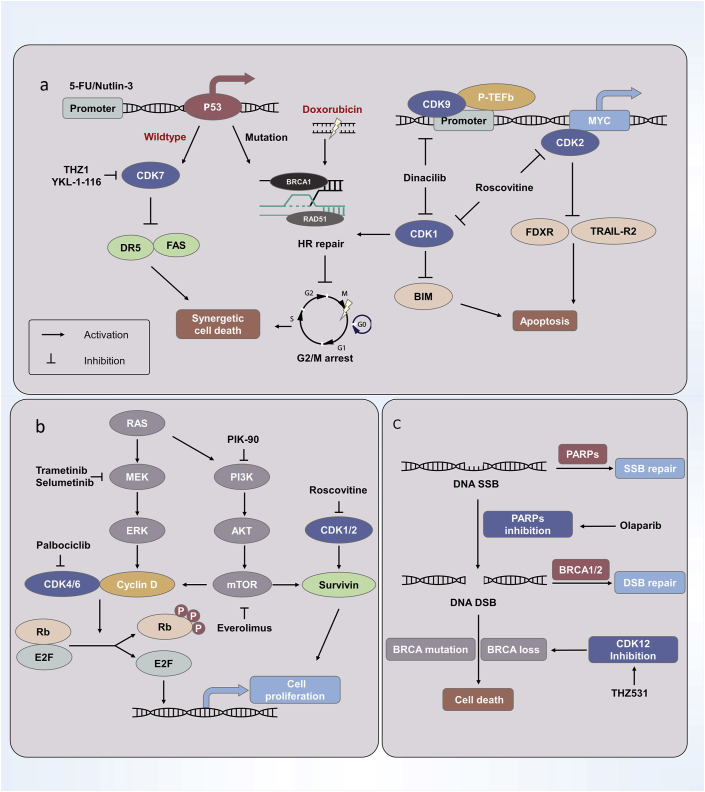
Synthetic lethality is a proven effective antitumor strategy that has attracted great attention. Large-scale screening has revealed many synthetic lethal genetic phenotypes, and relevant small-molecule drugs have also been implemented in clinical practice. Increasing evidence suggests that CDKs, constituting a kinase family predominantly involved in cell cycle control, are synthetic lethal factors when combined with certain oncogenes, such as , , and , which facilitate numerous antitumor treatment options based on CDK-related synthetic lethality. In this review, we focus on the synthetic lethal phenotype and mechanism related to CDKs and summarize the preclinical and clinical discoveries of CDK inhibitors to explore the prospect of CDK inhibitors as antitumor compounds for strategic synthesis lethality in the future.
合成致死是一种已被证实有效的抗肿瘤策略,备受关注。大规模筛选已揭示出许多合成致死基因表型,相关小分子药物也已应用于临床实践。越来越多的证据表明,细胞周期蛋白依赖性激酶(CDK)构成了一个主要参与细胞周期调控的激酶家族,当与某些癌基因(如 、 和 )联合时是合成致死因子,这促成了基于CDK相关合成致死的众多抗肿瘤治疗选择。在本综述中,我们聚焦于与CDK相关的合成致死表型和机制,并总结CDK抑制剂的临床前和临床研究发现,以探索CDK抑制剂作为未来用于合成致死策略的抗肿瘤化合物的前景。