Kuo Yu-Hsuan, Chan Ti-Chun, Lai Hong-Yue, Chen Tzu-Ju, Wu Li-Ching, Hsing Chung-Hsi, Li Chien-Feng
Division of Hematology and Oncology, Department of Internal Medicine, Chi-Mei Medical Center, Tainan, Taiwan.
College of Pharmacy and Science, Chia Nan University, Tainan, Taiwan.
Front Oncol. 2021 Sep 13;11:749142. doi: 10.3389/fonc.2021.749142. eCollection 2021.
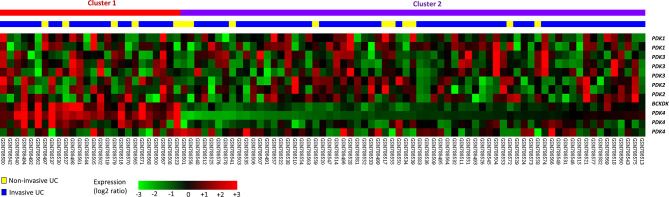
The mitochondrial pyruvate dehydrogenase complex (PDC) link glycolysis to the tricarboxylic acid cycle by decarboxylating pyruvate to acetyl coenzyme A irreversibly. Cancer cells are characterized by a shift in cellular metabolism from mitochondrial respiration to glycolysis. PDC activity inhibition mediated by phosphorylation pyruvate dehydrogenase kinase (PDK) has been linked to cancer. However, the clinical significance of PDKs in urothelial cancer prognosis is not clear. We investigated the role and prognostic value of PDK3 expression in patients with upper urinary tract urothelial carcinoma (UTUC) and urinary bladder urothelial carcinoma (UBUC).
We retrospectively analyzed clinical data and pathological features. Formalin-fixed urothelial carcinoma (UC) tissues were collected and embedded in paraffin. The correlation of PDK3 expression with clinical characteristics, pathological findings and patient outcomes, including metastasis-free survival (MFS) and disease-specific survival (DSS) were analyzed by Pearson's chi-square test, Kaplan-Meier analysis, and the multivariate Cox proportional hazards model.
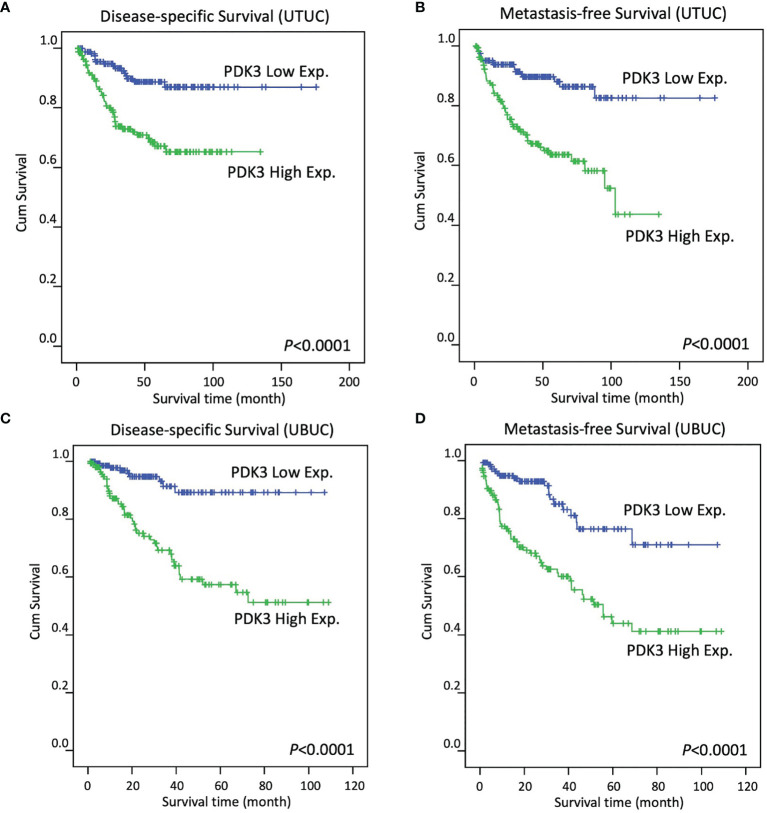
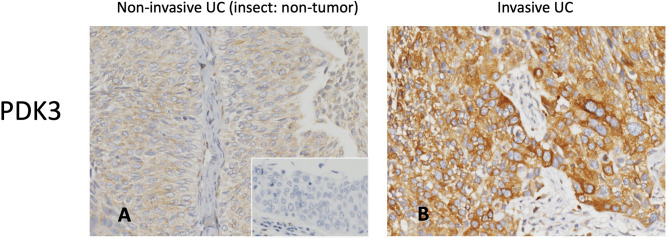
Data from 295 patients with UBUC and 340 patients with UTUC were evaluated. High PDK3 expression significantly correlated with several pathologic variables such as high T stage, lymph node metastases, high tumor grade, vascular invasion, and high mitotic rate (all < 0.001). High PDK3 expression was associated with poor disease-specific survival (DSS) ( < 0.0001) and metastatic free survival (MFS) ( < 0.0001) in a Kaplan-Meier analysis. Additionally, multivariate analysis demonstrated increased PDK3 expression is a significant predictive risk factor for DSS [hazard ratio (HR) in UBUC, 2.79, = 0.009; in UTUC, 2.561, = 0.03] and MFS (HR in UBUC, 1.907, = 0.024; in UTUC, 1.793, = 0.044). The gene co-expression analysis showed abundant co-upregulated genes were involved in the processes of DNA replication and repair through the Gene Ontology classification system.
High PDK3 expression has been linked to negative pathologic characteristics and poor oncological outcomes, suggesting that it could be used as a predictive biomarker for UC. PDK3 mRNA levels and its co-upregulated genes were strongly associated with DNA replication and repair. These results suggest that PDK3 may play a key role in tumor proliferation and development.
线粒体丙酮酸脱氢酶复合体(PDC)通过将丙酮酸不可逆地脱羧为乙酰辅酶A,将糖酵解与三羧酸循环联系起来。癌细胞的特征是细胞代谢从线粒体呼吸转变为糖酵解。由丙酮酸脱氢酶激酶(PDK)磷酸化介导的PDC活性抑制与癌症有关。然而,PDK在尿路上皮癌预后中的临床意义尚不清楚。我们研究了PDK3表达在上尿路尿路上皮癌(UTUC)和膀胱尿路上皮癌(UBUC)患者中的作用和预后价值。
我们回顾性分析了临床数据和病理特征。收集福尔马林固定的尿路上皮癌(UC)组织并石蜡包埋。通过Pearson卡方检验、Kaplan-Meier分析和多变量Cox比例风险模型分析PDK3表达与临床特征、病理结果和患者预后的相关性,包括无转移生存期(MFS)和疾病特异性生存期(DSS)。
评估了295例UBUC患者和340例UTUC患者的数据。高PDK3表达与多个病理变量显著相关,如高T分期、淋巴结转移、高肿瘤分级、血管侵犯和高有丝分裂率(均P<0.001)。在Kaplan-Meier分析中,高PDK3表达与较差的疾病特异性生存期(DSS)(P<0.0001)和无转移生存期(MFS)(P<0.0001)相关。此外,多变量分析表明,PDK3表达增加是DSS的显著预测风险因素[UBUC中的风险比(HR)为2.79,P=0.009;UTUC中的HR为2.561,P=0.03]和MFS(UBUC中的HR为1.907,P=0.024;UTUC中的HR为1.793,P=0.044)。基因共表达分析显示,通过基因本体分类系统,大量共上调基因参与了DNA复制和修复过程。
高PDK3表达与不良病理特征和较差的肿瘤学结局相关,提示其可作为UC的预测生物标志物。PDK3 mRNA水平及其共上调基因与DNA复制和修复密切相关。这些结果表明,PDK3可能在肿瘤增殖和发展中起关键作用。