de Castro Josimar Macedo, Stein Dirson João, Medeiros Helouise Richardt, de Oliveira Carla, Torres Iraci L S
Postgraduate Program in Medicine: Medical Sciences, School of Medicine, Universidade Federal do Rio Grande do Sul, Porto Alegre, Brazil.
Laboratory of Pain Pharmacology and Neuromodulation: Preclinical Studies, Experimental Research Center, Hospital de Clínicas de Porto Alegre, Porto Alegre, Brazil.
Front Nutr. 2021 Sep 13;8:648893. doi: 10.3389/fnut.2021.648893. eCollection 2021.
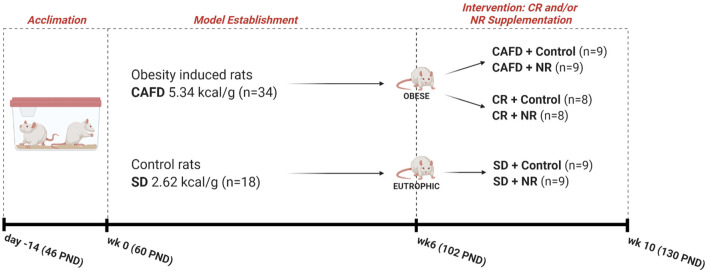
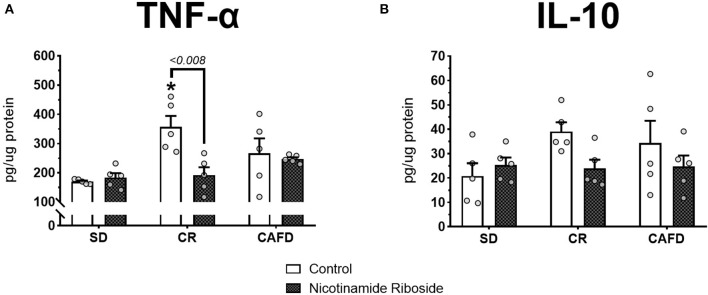
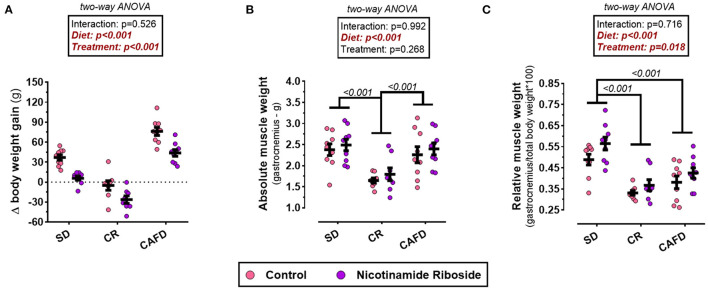
Obesity treatments, such as calorie restriction (CR), eventually lead to muscle wasting and higher rates of neuroinflammation, whereas hypothalamic inflammatory conditions impair body weight (BW) control. Nicotinamide riboside (NR) has been proposed against obesity but with little evidence on skeletal muscle tissue (SMT) and neuroinflammation. Therefore, we aimed to investigate the effects of CR on SMT and on hypothalamic inflammatory biomarkers in obese adult male Wistar rats, and whether NR supplementation alone or in combination with CR affects these parameters. Obesity was induced in rats through a cafeteria diet for 6 weeks. After that, a group of obese rats was exposed to CR, associated or not associated with NR supplementation (400 mg/kg), for another 4 weeks. As a result, obese rats, with or without CR, presented lower relative weight of SMT when compared with eutrophic rats. Rats under CR presented lower absolute SMT weight compared with obese and eutrophic rats, in addition to presenting elevated hypothalamic levels of TNF-α. NR supplementation, in all groups, enhanced weight loss and increased relative weight of the SMT. Furthermore, in animals under CR, NR reversed increases TNF-α levels in the hypothalamus. In this study, these data, although succinct, are the first to evidence the effects of NR on SMT and neuroinflammation when associated with CR, especially in obesity conditions. Therefore, this provides preliminary support for future studies in this investigative field. Furthermore, NR emerges as a potential adjuvant for preventing muscle mass loss in the weight loss processes.
肥胖治疗方法,如热量限制(CR),最终会导致肌肉萎缩和神经炎症发生率升高,而下丘脑炎症状态会损害体重(BW)控制。烟酰胺核糖(NR)已被提出用于对抗肥胖,但关于骨骼肌组织(SMT)和神经炎症的证据很少。因此,我们旨在研究CR对肥胖成年雄性Wistar大鼠SMT和下丘脑炎症生物标志物的影响,以及单独补充NR或与CR联合补充是否会影响这些参数。通过自助餐饮食6周诱导大鼠肥胖。之后,一组肥胖大鼠接受CR处理,无论是否与NR补充剂(400 mg/kg)联合使用,持续4周。结果,与营养正常的大鼠相比,无论是否接受CR处理,肥胖大鼠的SMT相对重量均较低。与肥胖和营养正常的大鼠相比,接受CR处理的大鼠SMT绝对重量较低,此外下丘脑TNF-α水平升高。在所有组中,补充NR均能增强体重减轻并增加SMT的相对重量。此外,在接受CR处理的动物中,NR可逆转下丘脑TNF-α水平的升高。在本研究中,这些数据虽然简洁,但首次证明了NR与CR联合使用时对SMT和神经炎症的影响,尤其是在肥胖情况下。因此,这为该研究领域的未来研究提供了初步支持。此外,NR有望成为减肥过程中预防肌肉量流失的潜在辅助剂。