Cardiovascular Research Institute Basel (CRIB) and Department of Cardiology, University Hospital Basel, University of Basel, Basel, Switzerland.
Department of Intensive Care Medicine, University Hospital Basel, University of Basel, Basel, Switzerland.
ESC Heart Fail. 2021 Apr;8(2):1717-1721. doi: 10.1002/ehf2.13249. Epub 2021 Feb 19.
Concern has been raised that treatment with angiotensin-converting enzyme inhibitors and angiotensin receptor blockers may increase the expression of angiotensin-converting enzyme 2 (ACE2), which acts as the entry receptor for SARS-CoV-2, and lead to an increased risk of death from SARS-CoV-2. We aimed to address this concern by evaluating the in vivo relationship of treatment with ACE inhibitors and angiotensin receptor blockers (ARB) with circulating plasma concentrations of ACE2 in a large cohort of patients with established cardiovascular disease (n = 1864) or cardiovascular risk factors (n = 2144) but without a history of heart failure.
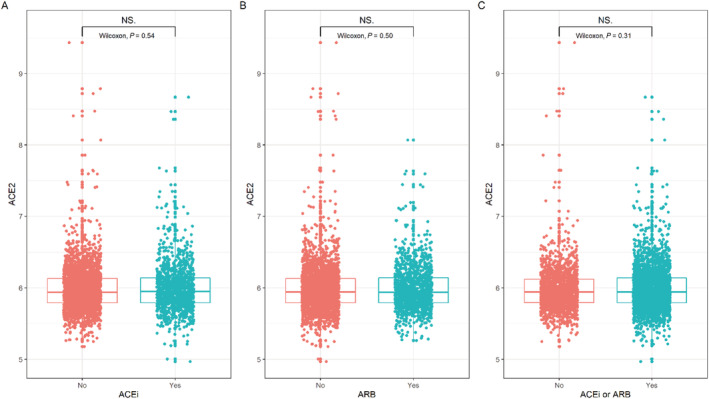
Angiotensin-converting enzyme 2 was measured in 4008 patients (median age 68, 33% women, 31% on ACE-inhibitors, 31% on ARB) using the SOMAscan proteomic platform (SomaLogic Inc, Colorado, USA). Plasma concentration of ACE2 was comparable in 1250 patients on ACE inhibitors (mean 5.99) versus patients without ACE inhibitors (mean 5.98, P = 0.54). Similarly, plasma concentration of ACE2 was comparable in 1260 patients on ARB (mean 5.99) versus patients without ARB (mean 5.98, P = 0.50). Plasma concentration of ACE2 was comparable in 2474 patients on either ACE inhibitors or ARB (mean 5.99) versus patients without ACE inhibitors or ARB (mean 5.98, P = 0.31). Multivariable quantile regression model analysis confirmed the lack of association between treatment with ACE inhibitors or ARB and ACE2 concentrations. Body mass index showed the only positive association with ACE2 plasma concentration (effect 0.015, 95% confidence interval 0.002 to 0.028, P = 0.024).
In a large cohort of patients with established cardiovascular disease or cardiovascular risk factors but without heart failure, ACE inhibitors and ARB were not associated with higher plasma concentrations of ACE2.
人们担心血管紧张素转换酶抑制剂(ACEI)和血管紧张素受体阻滞剂(ARB)的治疗可能会增加血管紧张素转换酶 2(ACE2)的表达,ACE2 是 SARS-CoV-2 的进入受体,从而导致 SARS-CoV-2 死亡风险增加。我们旨在通过评估 ACEI 和 ARB 治疗与已确诊心血管疾病(n=1864)或心血管危险因素(n=2144)但无心力衰竭病史的大量患者循环血浆中 ACE2 浓度之间的体内关系来解决这一担忧。
使用 SOMAscan 蛋白质组学平台(美国科罗拉多州的 SomaLogic Inc)在 4008 名患者(中位年龄 68 岁,33%为女性,31%服用 ACEI,31%服用 ARB)中测量 ACE2。在 1250 名服用 ACEI 的患者中(平均 ACE2 浓度为 5.99)与未服用 ACEI 的患者(平均 ACE2 浓度为 5.98,P=0.54)相比,ACE2 的血浆浓度相当。同样,在 1260 名服用 ARB 的患者中(平均 ACE2 浓度为 5.99)与未服用 ARB 的患者(平均 ACE2 浓度为 5.98,P=0.50)相比,ACE2 的血浆浓度相当。在 2474 名同时服用 ACEI 或 ARB 的患者中(平均 ACE2 浓度为 5.99)与未同时服用 ACEI 或 ARB 的患者(平均 ACE2 浓度为 5.98,P=0.31)相比,ACE2 的血浆浓度相当。多变量分位数回归模型分析证实 ACEI 或 ARB 治疗与 ACE2 浓度之间没有关联。体重指数与 ACE2 血浆浓度呈唯一正相关(效应 0.015,95%置信区间 0.002 至 0.028,P=0.024)。
在患有已确诊心血管疾病或心血管危险因素但无心力衰竭的大量患者中,ACEI 和 ARB 与较高的 ACE2 血浆浓度无关。