State Key Laboratory of Ecological Control of Fujian-Taiwan Crop Pests, Key Laboratory of Ministry of Education for Genetics, Breeding and Multiple Utilization of Crops, Plant Immunity Center, Fujian Agriculture and Forestry University, Fuzhou, Fujian 350002, China.
State Key Laboratory of Plant Genomics and National Centre for Plant Gene Research (Beijing), Institute of Genetics and Developmental Biology, Chinese Academy of Sciences, Beijing 100101, China.
Plant Physiol. 2021 Dec 4;187(4):2852-2864. doi: 10.1093/plphys/kiab445.
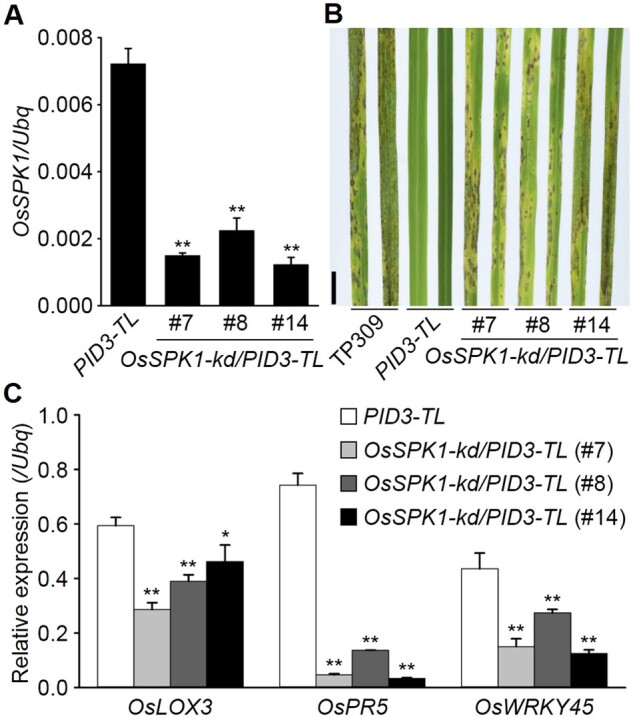
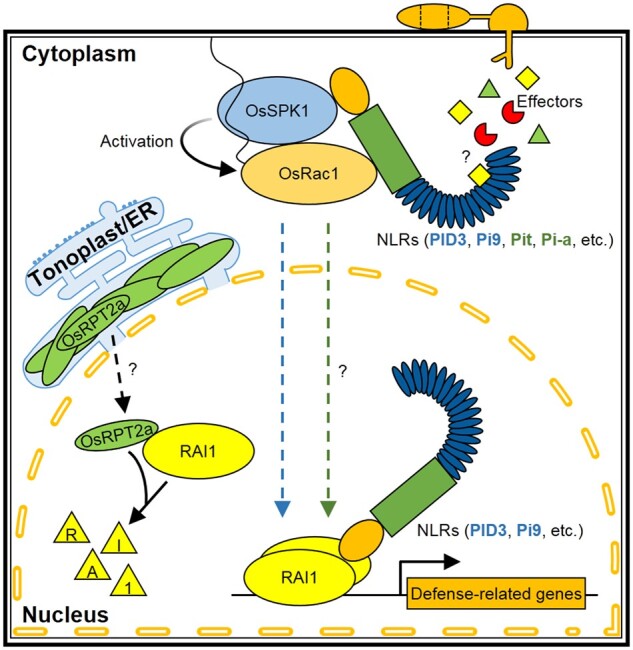
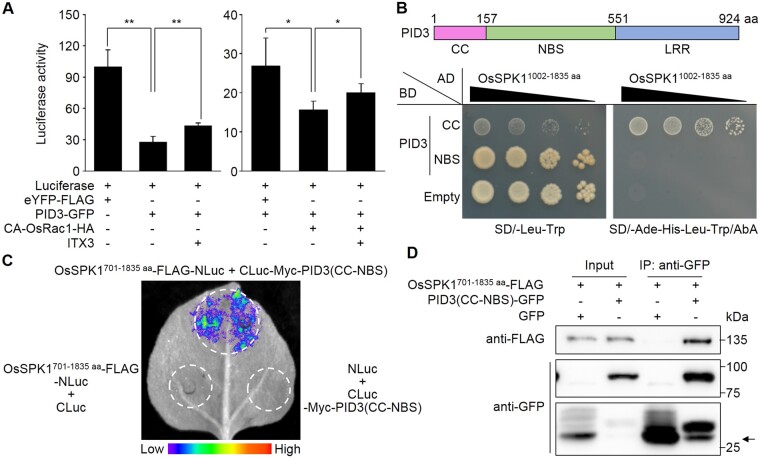
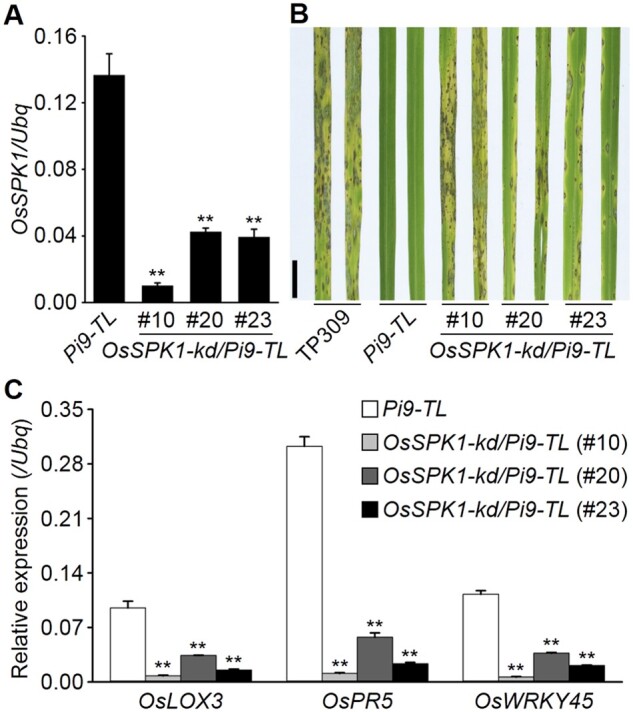
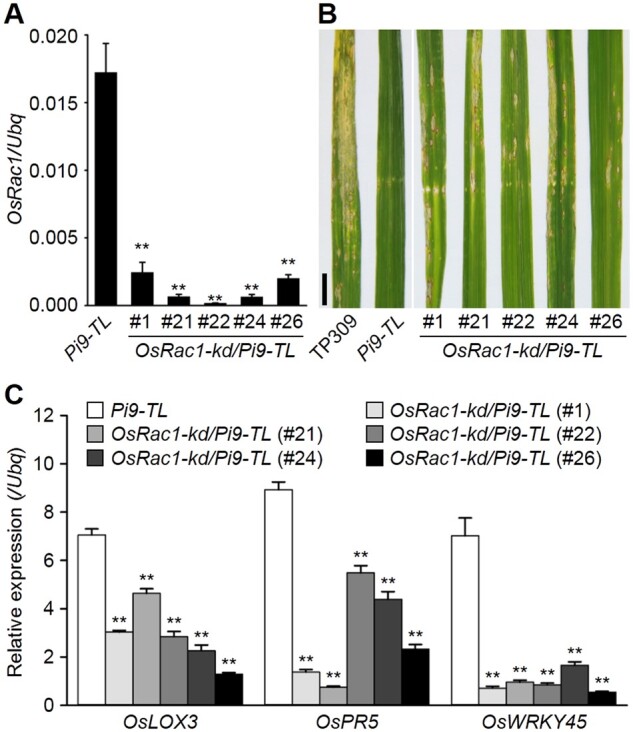
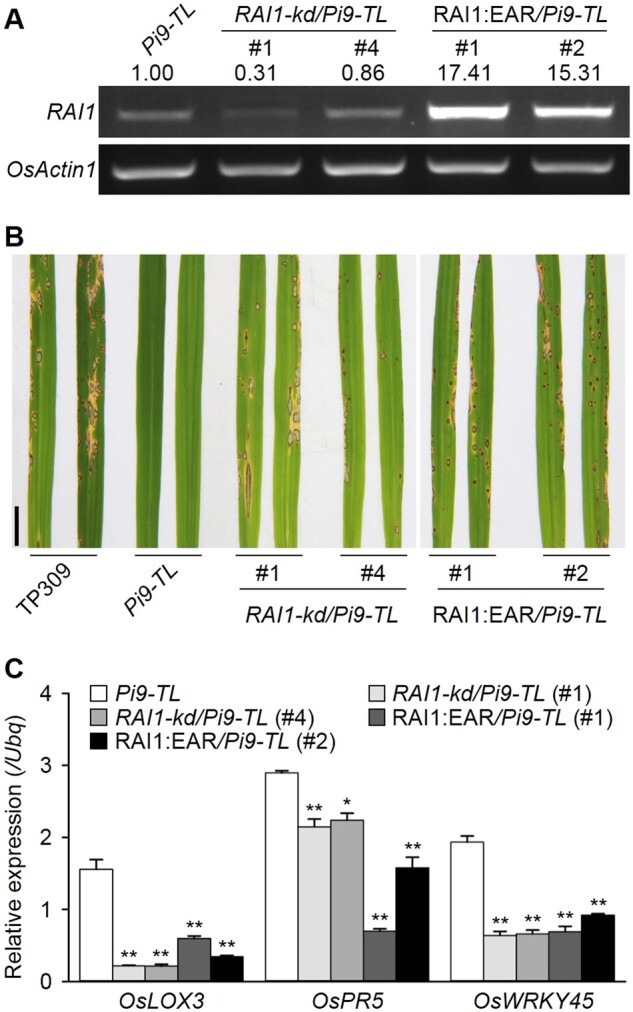
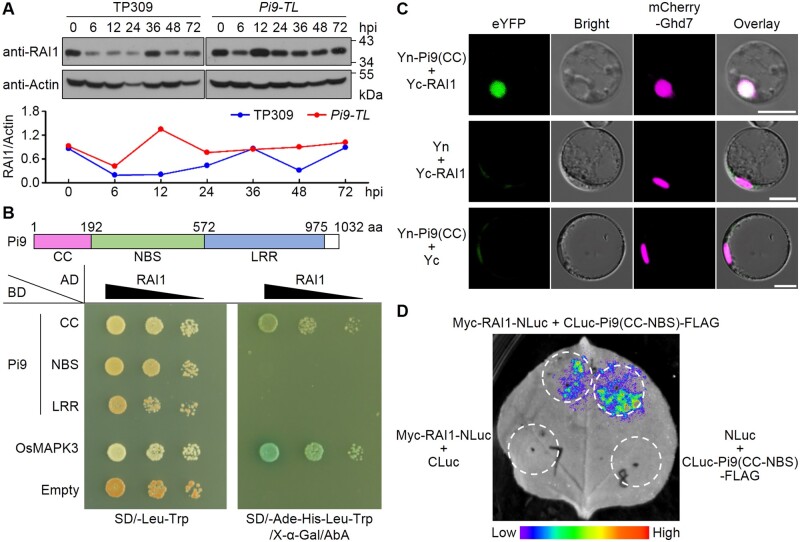
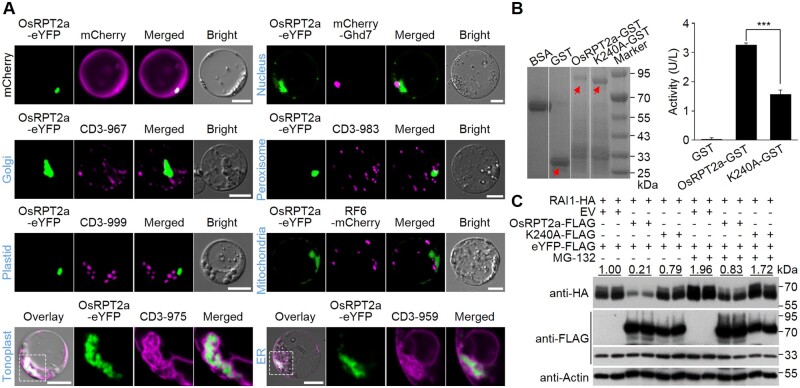
Resistance (R) proteins are important components of plant innate immunity. Most known R proteins are nucleotide-binding site leucine-rich repeat (NLR) proteins. Although a number of signaling components downstream of NLRs have been identified, we lack a general understanding of the signaling pathways. Here, we used the interaction between rice (Oryza sativa) and Magnaporthe oryzae to study signaling of rice NLRs in response to blast infection. We found that in blast resistance mediated by the NLR PIRICULARIA ORYZAE RESISTANCE IN DIGU 3 (PID3), the guanine nucleotide exchange factor OsSPK1 works downstream of PID3. OsSPK1 activates the small GTPase OsRac1, which in turn transduces the signal to the transcription factor RAC IMMUNITY1 (RAI1). Further investigation revealed that the three signaling components also play important roles in disease resistance mediated by the distantly related NLR protein Pi9, suggesting that the OsSPK1-OsRac1-RAI1 signaling pathway could be conserved across rice NLR-induced blast resistance. In addition, we observed changes in RAI1 levels during blast infection, which led to identification of OsRPT2a, a subunit of the 19S regulatory particle of the 26S proteasome. OsRPT2a seemed to be responsible for RAI1 turnover in a 26S proteasome-dependent manner. Collectively, our results suggest a defense signaling route that might be common to NLR proteins in response to blast infection.
抗性(R)蛋白是植物先天免疫的重要组成部分。大多数已知的 R 蛋白是核苷酸结合位点富含亮氨酸重复(NLR)蛋白。尽管已经鉴定出了许多 NLR 下游的信号成分,但我们缺乏对信号通路的总体理解。在这里,我们利用水稻(Oryza sativa)与稻瘟病菌(Magnaporthe oryzae)之间的互作来研究水稻 NLR 对稻瘟病感染的信号响应。我们发现,在由 NLR PIRICULARIA ORYZAE RESISTANCE IN DIGU 3(PID3)介导的抗性中,鸟嘌呤核苷酸交换因子 OsSPK1 位于 PID3 的下游。OsSPK1 激活小分子 GTP 酶 OsRac1,后者将信号转导至转录因子 RAC IMMUNITY1(RAI1)。进一步的研究表明,这三个信号成分在由远缘相关 NLR 蛋白 Pi9 介导的抗性中也发挥重要作用,这表明 OsSPK1-OsRac1-RAI1 信号通路可能在水稻 NLR 诱导的稻瘟病抗性中保守。此外,我们观察到在稻瘟病感染过程中 RAI1 水平的变化,这导致了 OsRPT2a 的鉴定,OsRPT2a 是 26S 蛋白酶体 19S 调节颗粒的一个亚基。OsRPT2a 似乎以依赖于 26S 蛋白酶体的方式负责 RAI1 的周转。总之,我们的结果表明了一种防御信号途径,可能是 NLR 蛋白对稻瘟病感染的共同反应。