Community and Health Research Unit (CaHRU), School of Health and Social Care, University of Lincoln, Lincoln, UK.
Centre for Ethnic Health Research, Leicester Diabetes Centre, University of Leicester, Leicester, UK.
Health Expect. 2022 Feb;25(1):223-231. doi: 10.1111/hex.13367. Epub 2021 Oct 1.
Guillain-Barré syndrome (GBS) is a rare inflammatory peripheral nerve disorder with variable recovery. Evidence is lacking on experiences of people with GBS and measurement of these experiences.
We aimed to develop and validate an instrument to measure experiences of people with GBS.
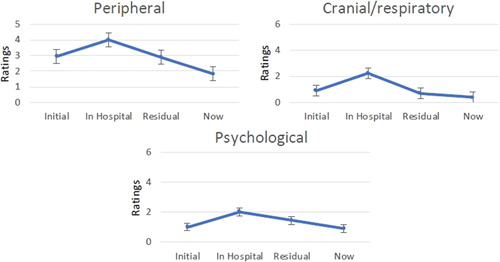
We used a cross-sectional design and online self-administered questionnaire survey. Question domains, based on a previous systematic review and qualitative study, covered experiences of GBS, symptom severity at each stage, healthcare and factors supporting or hindering recovery. Descriptive, exploratory factor and reliability analyses and multivariable regression analysis were used to investigate the relationships between variables of interest, explore questionnaire reliability and validity and identify factors predicting recovery.
People with a previous diagnosis of GBS were recruited through a social media advert.
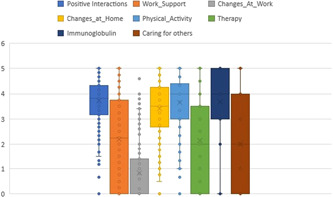
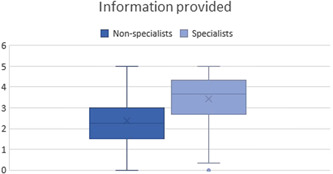
A total of 291 responders, of different sexes, and marital statuses, were included, with most diagnosed between 2015 and 2019. Factor analysis showed four scales: symptoms, information provided, factors affecting recovery and care received. Positive social interactions, physical activity including physiotherapy and movement, changes made at home and immunoglobulin treatment were important for recovery. Multivariable models showed that immunoglobulin and/or plasma exchange were significant predictors of recovery. Employment and recovery factors (positive interactions, work support and changes at work or home, physical activity and therapy), though associated with recovery, did not reach statistical significance.
The questionnaire demonstrated good internal reliability of scales and subscales and construct validity for people following GBS.
Patients were involved in developing and piloting the questionnaire.
吉兰-巴雷综合征(GBS)是一种罕见的、具有多种恢复情况的炎症性周围神经疾病。目前缺乏对 GBS 患者体验的证据,也缺乏对这些体验的衡量方法。
我们旨在开发和验证一种衡量 GBS 患者体验的工具。
我们采用了横断面设计和在线自我管理问卷调查。问题领域基于之前的系统评价和定性研究,涵盖了 GBS 的体验、每个阶段的症状严重程度、医疗保健以及支持或阻碍恢复的因素。我们使用描述性、探索性因素和可靠性分析以及多变量回归分析来研究感兴趣变量之间的关系,探索问卷的可靠性和有效性,并确定预测恢复的因素。
通过社交媒体广告招募了先前诊断为 GBS 的患者。
共有 291 名不同性别和婚姻状况的应答者被纳入研究,大多数人在 2015 年至 2019 年期间被诊断。因子分析显示出四个量表:症状、提供的信息、影响恢复的因素和接受的护理。积极的社交互动、包括物理治疗和运动在内的身体活动、家庭环境的改变和免疫球蛋白治疗对恢复很重要。多变量模型显示,免疫球蛋白和/或血浆置换是恢复的重要预测因素。尽管就业和恢复因素(积极的互动、工作支持以及工作或家庭环境的改变、身体活动和治疗)与恢复相关,但并未达到统计学意义。
该问卷在 GBS 患者中表现出了良好的量表和子量表内部可靠性以及结构有效性。
患者参与了问卷的开发和试点。