
SCO-spondin,一种调节脑脊液活动的巨大细胞外基质蛋白。
SCO-spondin, a giant matricellular protein that regulates cerebrospinal fluid activity.
机构信息
Departamento de Biología Celular, Facultad de Ciencias Biológicas, Universidad de Concepción, Concepción, Chile.
出版信息
Fluids Barriers CNS. 2021 Oct 2;18(1):45. doi: 10.1186/s12987-021-00277-w.
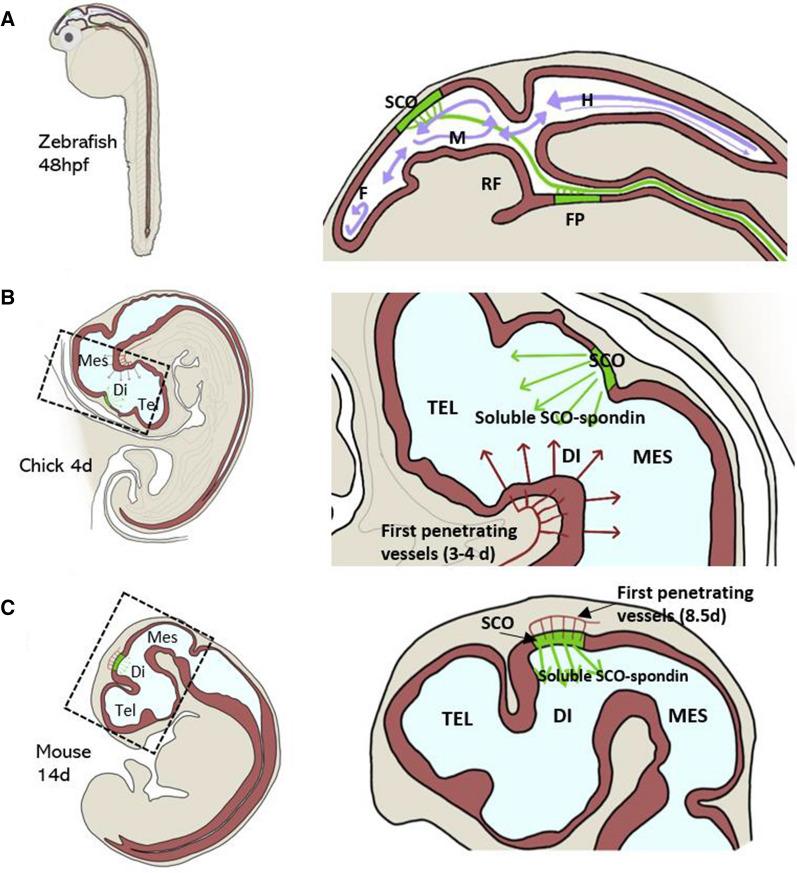
Cerebrospinal fluid is a clear fluid that occupies the ventricular and subarachnoid spaces within and around the brain and spinal cord. Cerebrospinal fluid is a dynamic signaling milieu that transports nutrients, waste materials and neuroactive substances that are crucial for the development, homeostasis and functionality of the central nervous system. The mechanisms that enable cerebrospinal fluid to simultaneously exert these homeostatic/dynamic functions are not fully understood. SCO-spondin is a large glycoprotein secreted since the early stages of development into the cerebrospinal fluid. Its domain architecture resembles a combination of a matricellular protein and the ligand-binding region of LDL receptor family. The matricellular proteins are a group of extracellular proteins with the capacity to interact with different molecules, such as growth factors, cytokines and cellular receptors; enabling the integration of information to modulate various physiological and pathological processes. In the same way, the LDL receptor family interacts with many ligands, including β-amyloid peptide and different growth factors. The domains similarity suggests that SCO-spondin is a matricellular protein enabled to bind, modulate, and transport different cerebrospinal fluid molecules. SCO-spondin can be found soluble or polymerized into a dynamic threadlike structure called the Reissner fiber, which extends from the diencephalon to the caudal tip of the spinal cord. Reissner fiber continuously moves caudally as new SCO-spondin molecules are added at the cephalic end and are disaggregated at the caudal end. This movement, like a conveyor belt, allows the transport of the bound molecules, thereby increasing their lifespan and action radius. The binding of SCO-spondin to some relevant molecules has already been reported; however, in this review we suggest more than 30 possible binding partners, including peptide β-amyloid and several growth factors. This new perspective characterizes SCO-spondin as a regulator of cerebrospinal fluid activity, explaining its high evolutionary conservation, its apparent multifunctionality, and the lethality or severe malformations, such as hydrocephalus and curved body axis, of knockout embryos. Understanding the regulation and identifying binding partners of SCO-spondin are crucial for better comprehension of cerebrospinal fluid physiology.
脑脊液是一种透明的液体,填充在大脑和脊髓的脑室和蛛网膜下腔。脑脊液是一种动态的信号环境,它运输营养物质、废物和神经活性物质,这些物质对中枢神经系统的发育、稳态和功能至关重要。使脑脊液能够同时发挥这些稳态/动态功能的机制尚未完全理解。SCO-spondin 是一种大型糖蛋白,从发育早期开始分泌到脑脊液中。它的结构域架构类似于细胞外基质蛋白和 LDL 受体家族配体结合区的组合。细胞外基质蛋白是一群能够与不同分子(如生长因子、细胞因子和细胞受体)相互作用的细胞外蛋白,从而能够整合信息,调节各种生理和病理过程。同样,LDL 受体家族与许多配体相互作用,包括β-淀粉样肽和不同的生长因子。结构域的相似性表明 SCO-spondin 是一种能够结合、调节和转运不同脑脊液分子的细胞外基质蛋白。SCO-spondin 可以以可溶性或聚合形式存在,形成一种称为 Reissner 纤维的动态线状结构,从间脑延伸到脊髓的尾端。随着新的 SCO-spondin 分子在头部末端添加并在尾部末端解聚,Reissner 纤维不断向尾部移动。这种类似于输送带的运动允许结合分子的运输,从而增加它们的寿命和作用半径。SCO-spondin 与一些相关分子的结合已经被报道;然而,在这篇综述中,我们提出了超过 30 种可能的结合伙伴,包括肽β-淀粉样蛋白和几种生长因子。这种新的观点将 SCO-spondin 描述为脑脊液活动的调节剂,解释了其高度的进化保守性、明显的多功能性,以及 knockout 胚胎的致死性或严重畸形,如脑积水和弯曲的体轴。理解 SCO-spondin 的调节和鉴定其结合伙伴对于更好地理解脑脊液生理学至关重要。




 Zotero 插件