Univ Montpellier, CHU Montpellier (LBPC-PPC), INSERM (IRMB, INM), Montpellier, France.
Centre de Neurologie Cognitive et Service de Biochimie et de Biologie Moléculaire, Groupe Hospitalier Lariboisière Fernand-Widal, INSERMU942, Université Paris Diderot, Paris, France.
Alzheimers Res Ther. 2020 Oct 2;12(1):123. doi: 10.1186/s13195-020-00696-1.
Amyloid pathology, which is one of the characteristics of Alzheimer's disease (AD), results from altered metabolism of the beta-amyloid (Aβ) peptide in terms of synthesis, clearance, or aggregation. A decrease in cerebrospinal fluid (CSF) level Aβ1-42 is evident in AD, and the CSF ratio Aβ42/Aβ40 has recently been identified as one of the most reliable diagnostic biomarkers of amyloid pathology. Variations in inter-individual levels of Aβ1-40 in the CSF have been observed in the past, but their origins remain unclear. In addition, the variation of Aβ40 in the context of AD studied in several studies has yielded conflicting results.
Here, we analyzed the levels of Aβ1-40 using multicenter data obtained on 2466 samples from six different cohorts in which CSF was collected under standardized protocols, centrifugation, and storage conditions. Tau and p-tau (181) concentrations were measured using commercially available in vitro diagnostic immunoassays. Concentrations of CSF Aβ1-42 and Aβ1-40 were measured by ELISA, xMAP technology, chemiluminescence immunoassay (CLIA), and mass spectrometry. Statistical analyses were calculated for parametric and non-parametric comparisons, linear regression, correlation, and odds ratios. The statistical tests were adjusted for the effects of covariates (age, in particular).
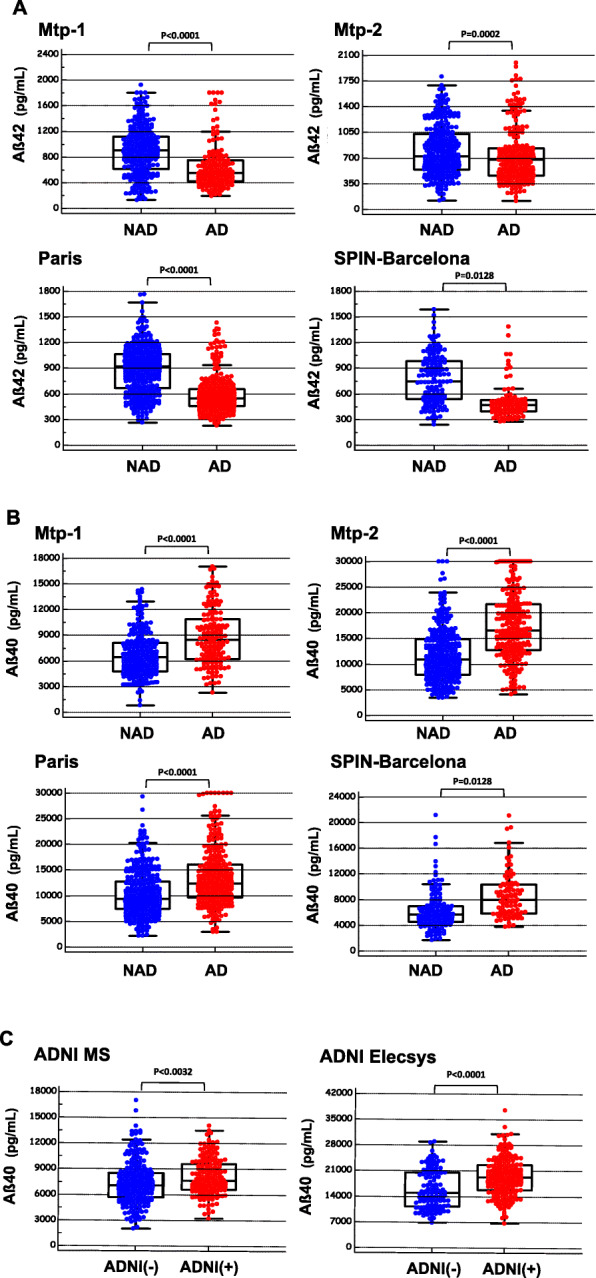
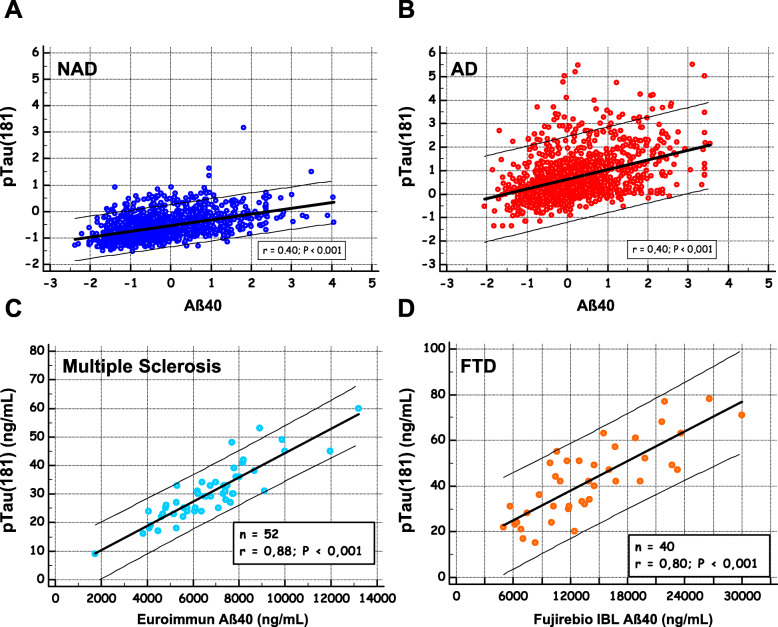
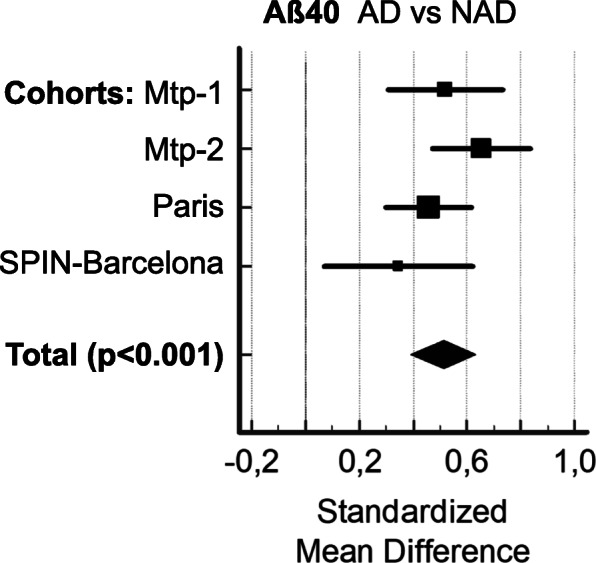
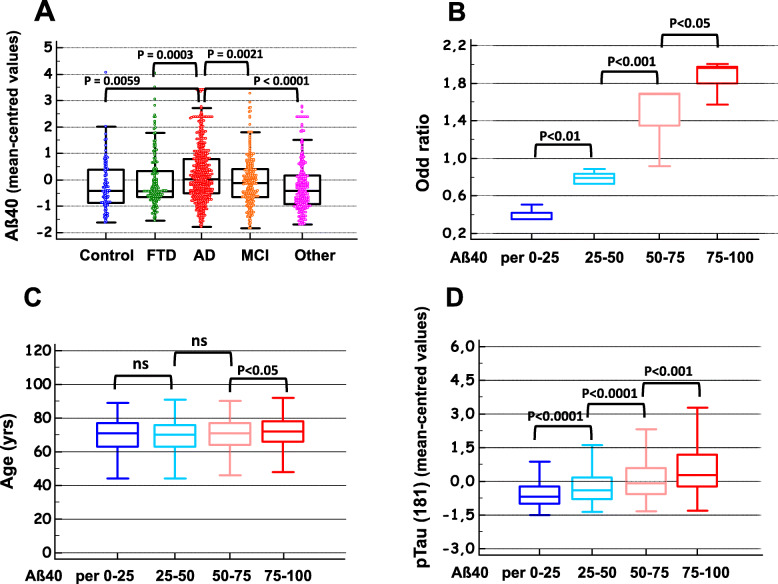
Regardless of the analysis method used and the cohorts, a slight but significant age-independent increase in the levels of Aβ40 in CSF was observed in AD. We also found a strong positive correlation between the levels of Aβ1-40 and p-tau (181) in CSF, particularly in control patients.
These results indicate that an increase in the baseline level of amyloid peptides, which are associated with an increase in p-tau (181), may be a biological characteristic and possibly a risk factor for AD. Further studies will be needed to establish a causal link between increased baseline levels of Aβ40 and the development of the disease.
淀粉样蛋白病理学是阿尔茨海默病(AD)的特征之一,其起因是β-淀粉样蛋白(Aβ)肽在合成、清除或聚集方面的代谢改变。AD 患者脑脊液(CSF)中 Aβ1-42 水平降低,CSF 中 Aβ42/Aβ40 比值最近已被确定为淀粉样蛋白病理学最可靠的诊断生物标志物之一。过去曾观察到 CSF 中 Aβ1-40 的个体间水平存在差异,但其来源尚不清楚。此外,在几项研究中研究 AD 时,Aβ40 的变化结果相互矛盾。
在这里,我们使用从六个不同队列中获得的 2466 个样本的多中心数据来分析 Aβ1-40 水平,这些样本是根据标准化方案收集的,经过离心和储存条件处理。使用市售的体外诊断免疫测定法测量 Tau 和 p-tau(181)浓度。CSF Aβ1-42 和 Aβ1-40 浓度通过 ELISA、xMAP 技术、化学发光免疫测定法(CLIA)和质谱法测量。进行了参数和非参数比较、线性回归、相关性和比值比的统计分析。这些统计测试针对协变量(尤其是年龄)的影响进行了调整。
无论使用何种分析方法和队列,AD 患者的 CSF 中 Aβ40 水平都出现了轻微但显著的与年龄无关的增加。我们还发现 CSF 中 Aβ1-40 与 p-tau(181)之间存在强烈的正相关,尤其是在对照患者中。
这些结果表明,与 p-tau(181)增加相关的淀粉样肽基础水平的增加可能是 AD 的生物学特征,并且可能是 AD 的风险因素。需要进一步的研究来确定 Aβ40 基础水平升高与疾病发展之间的因果关系。