Division of Endocrinology and Metabolism, Department of Internal Medicine, Korea University College of Medicine, Seoul, South Korea.
Division of Endocrinology and Metabolism, Department of Internal Medicine, Korea University College of Medicine, Seoul, South Korea.
Metabolism. 2022 Mar;128:154894. doi: 10.1016/j.metabol.2021.154894. Epub 2021 Sep 30.
This study aimed to determine the relative and independent contributions of impaired metabolic health and obesity to critical coronavirus disease 2019 (COVID-19).
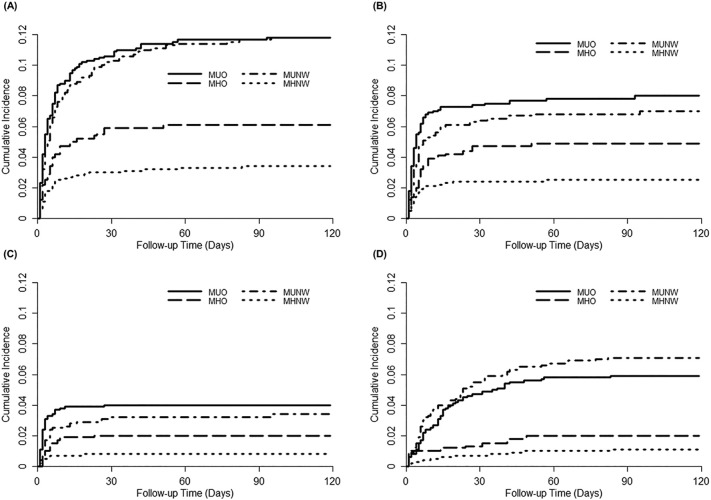
We analyzed 4069 COVID-19 patients between January and June 2020 in South Korea, classified into four groups according to metabolic health status and body mass index (BMI): metabolically healthy normal weight (MHNW), metabolically unhealthy normal weight (MUNW), metabolically healthy obesity (MHO), and metabolically unhealthy obesity (MUO). The primary outcome was a composite of intensive care unit (ICU) admission, invasive mechanical ventilation (IMV), extracorporeal membrane oxygenation (ECMO), and death. Multivariable Cox proportional hazard regression models were used to estimate the hazard ratio (HR) for the outcome.
The incidence rate (per 100 person-months) of critical COVID-19 was the lowest in the MHNW group (0.90), followed by the MHO (1.64), MUNW (3.37), and MUO (3.37) groups. Compared with MHNW, a significantly increased risk of critical COVID-19 was observed in MUNW (HR, 1.41; 95% CI, 1.01-1.98) and MUO (HR, 1.77; 95% CI, 1.39-2.44) but not in MHO (HR, 1.48; 95% CI, 0.98-2.23). The risk of ICU admission or IMV/ECMO was increased only in MUO; however, the risk of death was significantly higher in MUNW and MUO. The risk of critical COVID-19 increased insignificantly by 2% per 1 kg/m BMI increase but significantly by 13% per 1 metabolically unhealthy component increase, even after mutually adjusting for BMI and metabolic health status.
Metabolic health is more important to COVID-19 outcomes than obesity itself, suggesting that metabolic health status should be considered for a precise and tailored management of COVID-19 patients.
本研究旨在确定代谢健康受损和肥胖对重症新型冠状病毒肺炎(COVID-19)的相对和独立影响。
我们分析了 2020 年 1 月至 6 月期间韩国的 4069 例 COVID-19 患者,根据代谢健康状况和体重指数(BMI)将其分为四组:代谢健康正常体重(MHNW)、代谢不健康正常体重(MUNW)、代谢健康肥胖(MHO)和代谢不健康肥胖(MUO)。主要结局是重症监护病房(ICU)入院、有创机械通气(IMV)、体外膜氧合(ECMO)和死亡的复合结局。多变量 Cox 比例风险回归模型用于估计结局的风险比(HR)。
在 MHNW 组,重症 COVID-19 的发生率(每 100 人月)最低(0.90),其次是 MHO(1.64)、MUNW(3.37)和 MUO(3.37)组。与 MHNW 相比,MUNW(HR,1.41;95%CI,1.01-1.98)和 MUO(HR,1.77;95%CI,1.39-2.44)发生重症 COVID-19 的风险显著增加,但 MHO 组(HR,1.48;95%CI,0.98-2.23)并非如此。只有 MUO 组 ICU 入院或 IMV/ECMO 的风险增加,而 MUNW 和 MUO 组的死亡风险显著更高。BMI 每增加 1kg/m2,重症 COVID-19 的风险增加 2%,但代谢不健康成分每增加 1 个,风险增加 13%,即使在相互调整 BMI 和代谢健康状况后也是如此。
代谢健康对 COVID-19 结局的重要性超过肥胖本身,这表明代谢健康状况应考虑用于 COVID-19 患者的精准和定制化管理。