Division of Dermatology and Allergy, Department of Immunodermatology and Allergy Research, Hannover Medical School, Hannover, Germany.
Cluster of Excellence RESIST (EXC 2155), Hannover Medical School, Hannover, Germany.
Allergy. 2022 Apr;77(4):1245-1253. doi: 10.1111/all.15120. Epub 2021 Oct 22.
Atopic dermatitis (AD) is one of the most common inflammatory skin diseases worldwide and Staphylococcus aureus colonization and secondary infections occur in the majority of AD patients. Allergic sensitizations against microbial antigens have been discussed as possible trigger factors of AD. Recently, we reported IgE sensitization against fibronectin-binding protein 1 (FBP1), an essential virulence component in S. aureus, in a subgroup of patients suffering from AD. To expand these findings by investigating delayed-type immune reactions, the objective of this study was to detect and phenotypically characterize FBP1-specific T cells as possible trigger factors in AD.
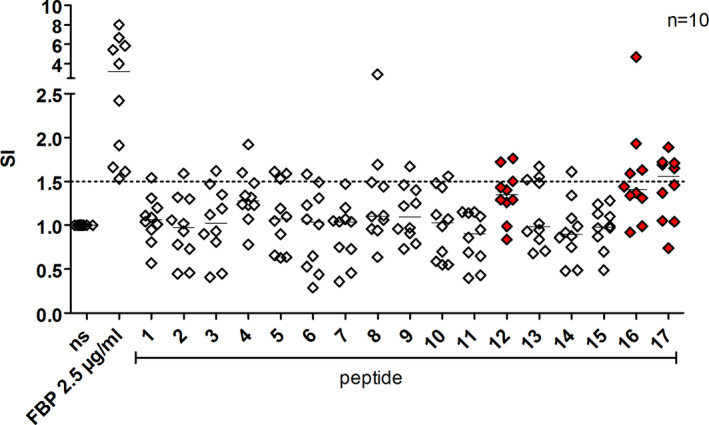
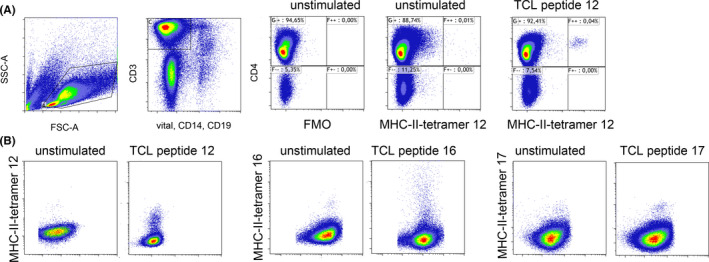
Immunodominant T-cell epitopes were mapped by proliferation testing of patient-derived FBP1-specific T-cell lines after stimulation with single 15mer peptides, which were derived from different functional domains of the FBP1 sequence. Major histocompatibility complex class II tetramers carrying immunodominant epitopes successfully stained T helper cells in 8 out of 8 HLA-matched, IgE-sensitized AD patients.
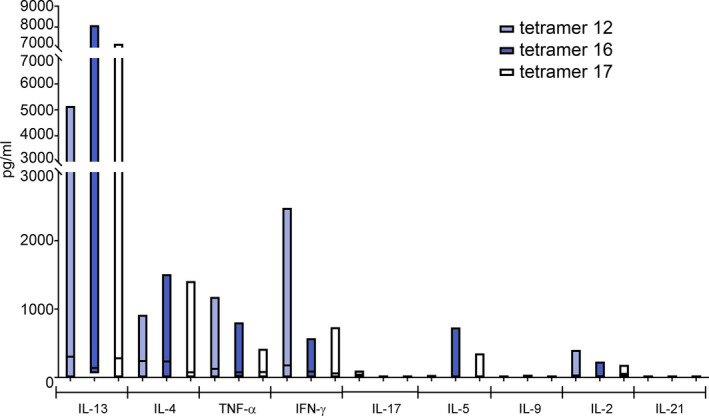
Cytokine profiling of multimer-sorted cells revealed that predominantly the type 2 cytokines IL-13 and IL-4 were secreted by these cells. In contrast, IL-17, the marker cytokine for response to extracellular pathogens, was scarcely detectable.
We demonstrate that FBP1 contains immunodominant peptides that induce a specific pro-inflammatory T helper cell response with increased Th2 levels that can drive an allergic inflammation in sensitized AD patients.
特应性皮炎(AD)是全球最常见的炎症性皮肤病之一,金黄色葡萄球菌定植和继发感染发生在大多数 AD 患者中。针对微生物抗原的过敏致敏已被讨论为 AD 的可能触发因素。最近,我们报道了对金黄色葡萄球菌中一种必需毒力成分纤维连接蛋白结合蛋白 1(FBP1)的 IgE 致敏,在患有 AD 的患者亚群中。为了通过研究迟发型免疫反应扩展这些发现,本研究的目的是检测和表型分析 FBP1 特异性 T 细胞作为 AD 的可能触发因素。
通过用源自 FBP1 序列不同功能域的单个 15 mer 肽刺激患者衍生的 FBP1 特异性 T 细胞系来进行增殖试验,以绘制免疫优势 T 细胞表位。携带免疫显性表位的主要组织相容性复合物 II 四聚体成功地在 8 名 HLA 匹配、IgE 致敏的 AD 患者中的 8 名患者中对 T 辅助细胞进行染色。
对多聚体分选细胞进行细胞因子谱分析显示,这些细胞主要分泌 2 型细胞因子 IL-13 和 IL-4。相比之下,很少检测到细胞外病原体反应的标记细胞因子 IL-17。
我们证明 FBP1 含有免疫显性肽,可诱导具有增加的 Th2 水平的特异性促炎 T 辅助细胞反应,可在致敏的 AD 患者中驱动过敏炎症。