Gueroun Sonia K M, Torres Tatiana M, Dos Santos Antonina, Vasco-Rodrigues Nuno, Canning-Clode João, Andrade Carlos
Mariculture Centre of Calheta, Calheta, Madeira, Portugal.
Madeira Oceanic Observatory-ARDITI/OOM, Funchal, Madeira, Portugal.
PeerJ. 2021 Sep 13;9:e12056. doi: 10.7717/peerj.12056. eCollection 2021.
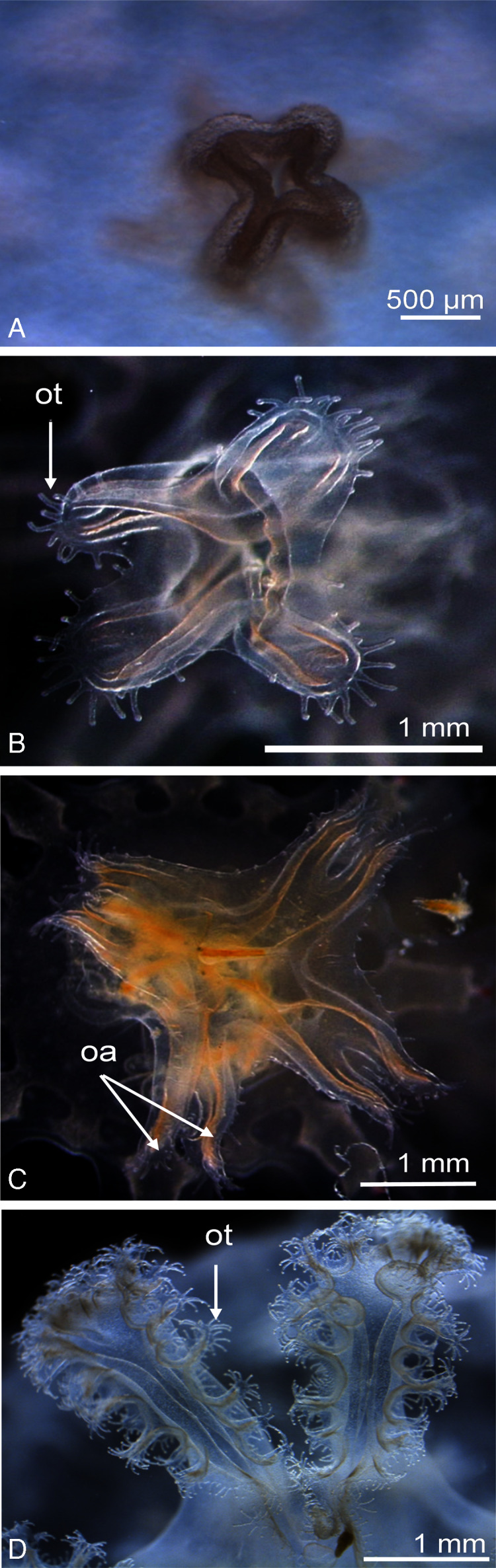
Jellyfish proliferations, which are conspicuous and natural events, cause blooms that may lead to severe consequences for anthropogenic activities and ecosystem structure and functioning. Although research during the last decade has focused on factors influencing the different jellyfish life stages, few species currently have their full life cycle known. In this context, we describe for the first time the developmental stages in the life cycle of , from planula to young medusa, reared in the laboratory. The species displays the typical Rhizostomida metagenetic life cycle. Mature scyphistomae display 16 tentacles and a total body length of 1.5 ± 0.2 mm. Only podocyst production and strobilation were observed. Strobilation, occurring continuously under laboratory conditions, was mainly polydisc. The eight-rayed typical ephyrae, with a total body diameter of 2.4 ± 0.4 mm at detachment, showed development typical of the Rhizostomida. As a first step in studying this species' ecology, we also present preliminary assessments of: (i) the influence of different temperature and salinity regimes on planulae survival, settlement and metamorphosis and (ii) the effect of temperature and diet on asexual reproduction. The results showed a high tolerance of planulae to a wide range of salinities (15‰ to 25‰), while polyp development was significantly faster at higher temperature (20-25 °C). Strobilation onset was 2-3 times faster at 20 °C (10.6 ± 5.4 to 15 ± 6.6 day at various tested diet) than at 15 °C (32.2 ± 3 day). Feeding was a key factor as unfed polyps never underwent strobilation during the trial. Finally, we present the spatial and seasonal distribution of in the Tagus estuary (Portugal) in 2019, showing its occurrence throughout the year (except in April), with most observations recorded on the northern shoreline. As shows the ability to form blooms and a wide tolerance for temperature and salinity (for planulae and medusae stage), it is essential to understand its life cycle.
水母大量繁殖是显著的自然现象,会引发水华,可能给人类活动以及生态系统的结构和功能带来严重后果。尽管过去十年的研究聚焦于影响水母不同生命阶段的因素,但目前已知完整生命周期的物种寥寥无几。在此背景下,我们首次描述了在实验室中饲养的[物种名称]从浮浪幼虫到幼体水母的生命周期发育阶段。该物种呈现典型的根口水母纲世代交替生命周期。成熟的螅状体有16条触手,体长1.5±0.2毫米。仅观察到包囊产生和横裂生殖。在实验室条件下持续发生的横裂生殖主要是多盘裂。典型的八辐碟状幼体在脱离时的总体直径为2.4±0.4毫米,显示出根口水母纲的典型发育特征。作为研究该物种生态学的第一步,我们还给出了以下方面的初步评估:(i)不同温度和盐度条件对浮浪幼虫存活、附着和变态的影响,以及(ii)温度和食物对无性繁殖的影响。结果表明,浮浪幼虫对广泛的盐度范围(15‰至25‰)具有较高耐受性,而在较高温度(20 - 25°C)下,水螅体发育明显更快。在20°C时横裂生殖开始的速度比15°C时快2 - 3倍(在各种测试食物条件下,20°C时为10.6±5.4至15±6.6天,15°C时为32.2±3天)。摄食是一个关键因素,因为未喂食的水螅体在试验期间从未发生横裂生殖。最后,我们展示了2019年[物种名称]在塔霍河河口(葡萄牙)的空间和季节分布,表明其全年出现(4月除外),大多数观测记录在北岸线。由于[物种名称]有形成水华的能力,并且对温度和盐度(浮浪幼虫和水母阶段)有广泛耐受性,了解其生命周期至关重要。