Al-Rawi Safa, Zolezzi Monica, Eltorki Yassin
Al Wakrah Hospital, Hamad Medical Corporation, Doha, Qatar E-mail:
College of Pharmacy, QU Health, Qatar University, Doha, Qatar.
Qatar Med J. 2021 Sep 27;2021(2):27. doi: 10.5339/qmj.2021.27. eCollection 2021.
Individuals with serious mental illness (SMI) experience premature death, likely due to increased rates of obesity and cardiovascular disease (CVD). This study was conducted to estimate the CVD risk in a cohort of individuals with SMI receiving outpatient psychiatric services in Qatar and to assess contributory CVD risk factors.
This is a retrospective review of the electronic medical records of a cohort of outpatients with SMI attending a mental health clinic in Doha, Qatar. The CVD risk was estimated using two risk prediction tools: the American Heart Association and the American College of Cardiology (AHA/ACC) risk calculator and the World Health Organization/International Society of Hypertension (WHO/ISH) CVD risk prediction charts for the Eastern Mediterranean region. Descriptive and inferential statistics were used to analyze the demographic and clinical data. Data were analyzed using Statistical Package for the Social Sciences.
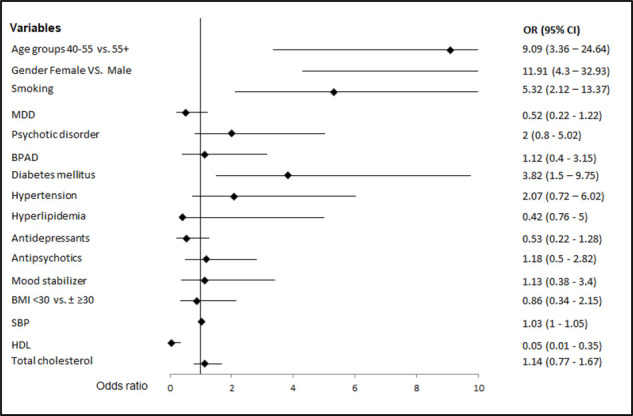
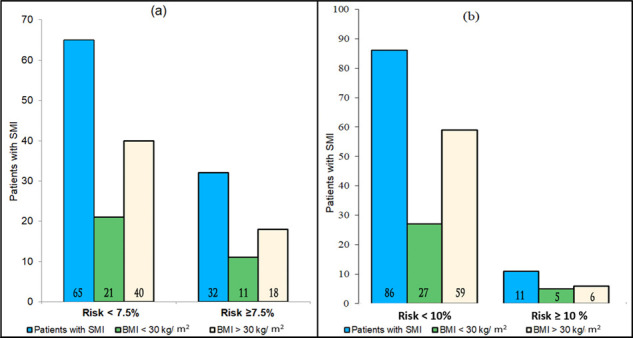
Of the 346 eligible patients, 28% (n = 97) had obtainable data for the estimation of their CVD risk using both tools. Approximately one-third of the cohort (33%) were classified as high risk using the AHA/ACC risk calculator, and 13.3% were classified as intermediate to high risk using the WHO/ISH CVD risk prediction charts. Based on the AHA/ACC risk scores, among those with a high CVD risk, almost two-thirds had CVD modifiable risk factors (i.e., smoking, diabetes, dyslipidemia, and hypertension). No statistically significant difference in the CVD risk estimates was observed among individuals with a body mass index of more or lower than 30 kg/m ( = 0.815).
Based on the AHA/ACC risk calculator, approximately one-third of the study cohort had high CVD risk estimates. The WHO/ISH CVD risk prediction charts appeared to underestimate CVD risk, particularly for those identified as high risk using the AHA/ACC risk calculator. A closer alliance between psychiatrists and primary healthcare professionals to control modifiable cardiovascular risk factors among patients with SMI is necessary.
患有严重精神疾病(SMI)的个体过早死亡,可能是由于肥胖和心血管疾病(CVD)发病率增加所致。本研究旨在估计在卡塔尔接受门诊精神科服务的一组SMI个体的CVD风险,并评估CVD的促成风险因素。
这是一项对卡塔尔多哈一家心理健康诊所的一组SMI门诊患者电子病历的回顾性研究。使用两种风险预测工具估计CVD风险:美国心脏协会和美国心脏病学会(AHA/ACC)风险计算器,以及世界卫生组织/国际高血压学会(WHO/ISH)东地中海区域CVD风险预测图表。使用描述性和推断性统计分析人口统计学和临床数据。数据使用社会科学统计软件包进行分析。
在346名符合条件的患者中,28%(n = 97)有可用于使用两种工具估计其CVD风险的数据。使用AHA/ACC风险计算器,约三分之一的队列(33%)被归类为高风险,使用WHO/ISH CVD风险预测图表,13.3%被归类为中高风险。根据AHA/ACC风险评分,在CVD高风险者中,近三分之二有CVD可改变风险因素(即吸烟、糖尿病、血脂异常和高血压)。体重指数高于或低于30 kg/m的个体之间,CVD风险估计值无统计学显著差异(P = 0.815)。
根据AHA/ACC风险计算器,约三分之一的研究队列CVD风险估计值较高。WHO/ISH CVD风险预测图表似乎低估了CVD风险,特别是对于那些使用AHA/ACC风险计算器被确定为高风险的个体。精神科医生和初级医疗保健专业人员之间建立更紧密的联盟,以控制SMI患者中可改变的心血管风险因素是必要的。