Elsanhoury Ahmed, Nelki Vivian, Kelle Sebastian, Van Linthout Sophie, Tschöpe Carsten
Berlin Institute of Health at Charite (BIH), Universitätsmedizin Berlin, BIH Center for Regenerative Therapies (BCRT), Berlin, Germany.
German Center for Cardiovascular Research (DZHK), Partner Site Berlin, Berlin, Germany.
Front Cardiovasc Med. 2021 Sep 17;8:720690. doi: 10.3389/fcvm.2021.720690. eCollection 2021.
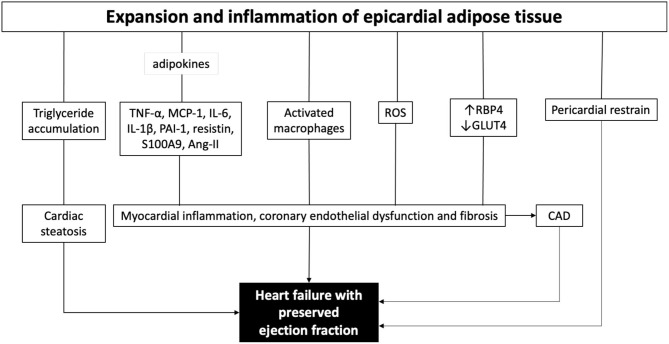
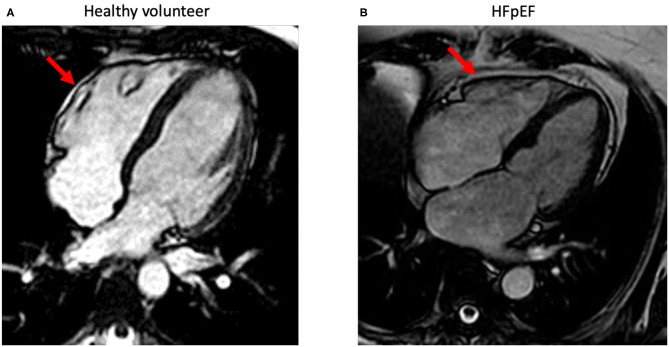
Heart failure with preserved ejection fraction (HFpEF) is a heterogeneous syndrome with diverse etiologies and pathophysiological factors. Obesity and type 2 diabetes mellitus (T2DM), conditions that coexist frequently, induce a cluster of metabolic and non-metabolic signaling derangements which are in favor to induce inflammation, fibrosis, myocyte stiffness, all hallmarks of HFpEF. In contrast to other HFpEF risk factors, obesity and T2DM are often associated with the generation of enlarged epicardial adipose tissue (EAT). EAT acts as an endocrine tissue that may exacerbate myocardial inflammation and fibrosis various paracrine and vasocrine signals. In addition, an abnormally large EAT poses mechanical stress on the heart pericardial restrain. HFpEF patients with enlarged EAT may belong to a unique phenotype that can benefit from specific EAT-targeted interventions, including life-style modifications and pharmacologically statins and fat modifying anti-diabetics drugs; like metformin, sodium-glucose cotransporter 2 inhibitors, or glucagon-like peptide-1 receptor agonists, respectively.
射血分数保留的心力衰竭(HFpEF)是一种异质性综合征,具有多种病因和病理生理因素。肥胖和2型糖尿病(T2DM)这两种常常共存的病症,会引发一系列代谢和非代谢信号紊乱,这些紊乱有利于诱发炎症、纤维化、心肌细胞僵硬,而这些都是HFpEF的典型特征。与其他HFpEF危险因素不同,肥胖和T2DM常与心外膜脂肪组织(EAT)增大有关。EAT作为一种内分泌组织,可能通过各种旁分泌和血管分泌信号加剧心肌炎症和纤维化。此外,异常增大的EAT会因心包束缚对心脏造成机械应力。EAT增大的HFpEF患者可能属于一种独特的表型,能够从特定的针对EAT的干预措施中获益,包括生活方式改变以及药物治疗,如他汀类药物和脂肪调节抗糖尿病药物,分别如二甲双胍、钠-葡萄糖协同转运蛋白2抑制剂或胰高血糖素样肽-1受体激动剂。