
LNA 寡核苷酸通过靶向乳酸脱氢酶 B 介导自身免疫性心肌炎的抗炎作用。
LNA oligonucleotide mediates an anti-inflammatory effect in autoimmune myocarditis via targeting lactate dehydrogenase B.
机构信息
Department of Internal Medicine III, University of Heidelberg, Heidelberg, Germany.
DZHK (German Centre for Cardiovascular Research), Partner Site Heidelberg/Mannheim, University of Heidelberg, Heidelberg, Germany.
出版信息
Immunology. 2022 Feb;165(2):158-170. doi: 10.1111/imm.13421. Epub 2021 Oct 13.
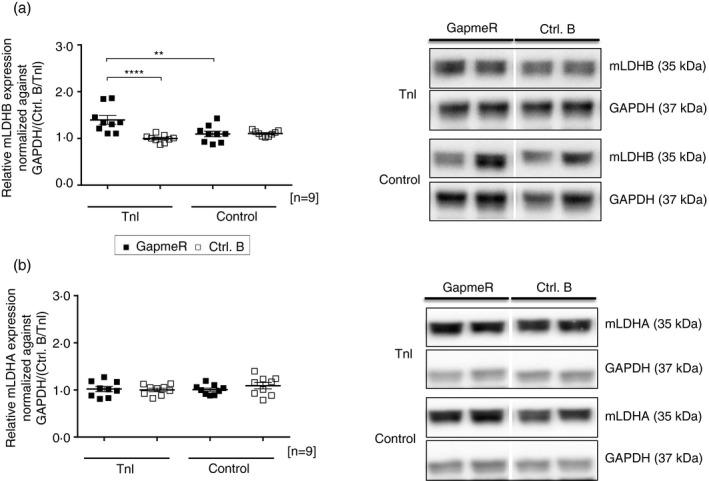
Treatment of myocarditis is often limited to symptomatic treatment due to unknown pathomechanisms. In order to identify new therapeutic approaches, the contribution of locked nucleic acid antisense oligonucleotides (LNA ASOs) in autoimmune myocarditis was investigated. Hence, A/J mice were immunized with cardiac troponin I (TnI) to induce experimental autoimmune myocarditis (EAM) and treated with LNA ASOs. The results showed an unexpected anti-inflammatory effect for one administered LNA ASO MB_1114 by reducing cardiac inflammation and fibrosis. The target sequence of MB_1114 was identified as lactate dehydrogenase B (mLDHB). For further analysis, mice received mLdhb-specific GapmeR during induction of EAM. Here, mice receiving the mLdhb-specific GapmeR showed increased protein levels of cardiac mLDHB and a reduced cardiac inflammation and fibrosis. The effect of increased cardiac mLDHB protein level was associated with a downregulation of genes of reactive oxygen species (ROS)-associated proteins, indicating a reduction in ROS. Here, the suppression of murine pro-apoptotic Bcl-2-associated X protein (mBax) was also observed. In our study, an unexpected anti-inflammatory effect of LNA ASO MB_1114 and mLdhb-specific GapmeR during induction of EAM could be demonstrated in vivo. This effect was associated with increased protein levels of cardiac mLDHB, mBax suppression and reduced ROS activation. Thus, LDHB and LNA ASOs may be considered as a promising target for directed therapy of myocarditis. Nevertheless, further investigations are necessary to clarify the mechanism of action of anti-inflammatory LDHB-triggered effects.
心肌炎的治疗通常由于发病机制不明而仅限于对症治疗。为了确定新的治疗方法,研究了锁核酸反义寡核苷酸(LNA ASO)在自身免疫性心肌炎中的作用。因此,用心肌肌钙蛋白 I(TnI)免疫 A/J 小鼠诱导实验性自身免疫性心肌炎(EAM),并用 LNA ASO 进行治疗。结果显示,一种名为 MB_1114 的 LNA ASO 出人意料地具有抗炎作用,可减少心脏炎症和纤维化。MB_1114 的靶序列被鉴定为乳酸脱氢酶 B(mLDHB)。为了进一步分析,在 EAM 诱导期间,小鼠接受了 mLdhb 特异性 GapmeR。在此,接受 mLdhb 特异性 GapmeR 的小鼠显示心脏 mLDHB 蛋白水平升高,心脏炎症和纤维化减少。心脏 mLDHB 蛋白水平升高的作用与活性氧(ROS)相关蛋白的基因下调有关,表明 ROS 减少。此外,还观察到小鼠促凋亡 Bcl-2 相关 X 蛋白(mBax)的抑制。在本研究中,在 EAM 诱导期间,LNA ASO MB_1114 和 mLdhb 特异性 GapmeR 出人意料地表现出抗炎作用。这种作用与心脏 mLDHB 蛋白水平升高、mBax 抑制和 ROS 激活减少有关。因此,LDHB 和 LNA ASO 可被认为是心肌炎靶向治疗的有前途的靶标。然而,需要进一步的研究来阐明抗炎性 LDHB 触发作用的机制。




 Zotero 插件