
低分子肝素在 2019 年冠状病毒病中的应用与病毒持续时间缩短有关:一项回顾性多中心观察研究。
Low-molecular-weight heparin use in coronavirus disease 2019 is associated with curtailed viral persistence: a retrospective multicentre observational study.
机构信息
Department of Vascular Biology and Thrombosis Research, Center of Physiology and Pharmacology, Medical University of Vienna, Schwarzspanierstraße 17, 1090 Vienna, Austria.
Division of Visceral Surgery, Department of Surgery, Medical University of Vienna, General Hospital Vienna, Vienna, Austria.
出版信息
Cardiovasc Res. 2021 Dec 17;117(14):2807-2820. doi: 10.1093/cvr/cvab308.
AIMS
Anticoagulation was associated with improved survival of hospitalized coronavirus disease 2019 (COVID-19) patients in large-scale studies. Yet, the development of COVID-19-associated coagulopathy (CAC) and the mechanism responsible for improved survival of anticoagulated patients with COVID-19 remain largely elusive. This investigation aimed to explore the effects of anticoagulation and low-molecular-weight heparin (LMWH) in particular on patient outcome, CAC development, thromboinflammation, cell death, and viral persistence.
METHODS AND RESULTS
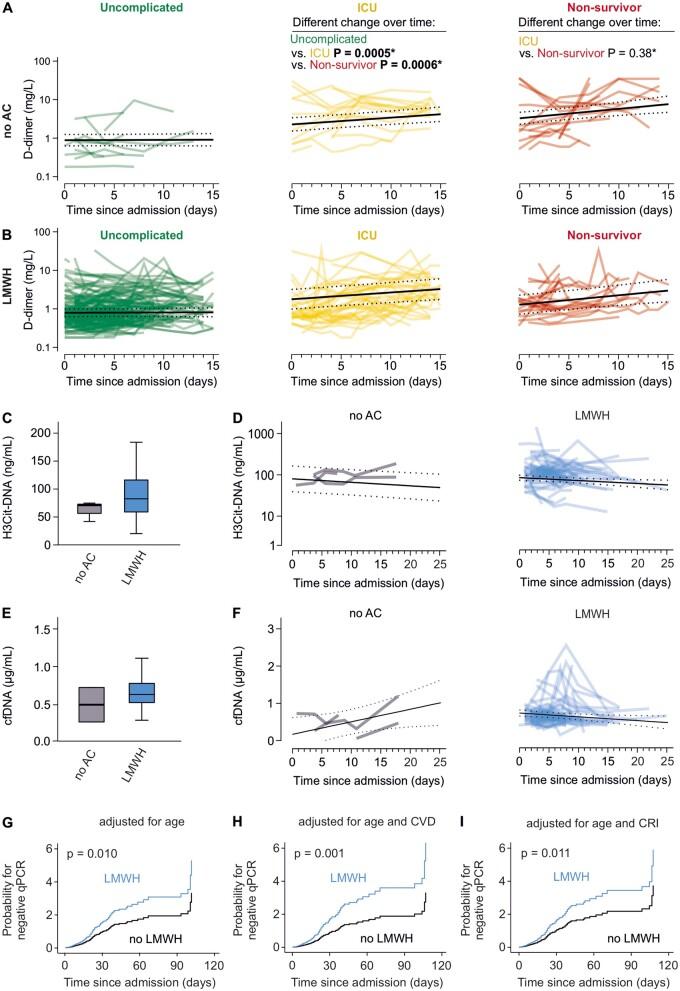
Data of 586 hospitalized COVID-19 patients from three different regions of Austria were evaluated retrospectively. Of these, 419 (71.5%) patients received LMWH and 62 (10.5%) received non-vitamin-K oral anticoagulants (NOACs) during hospitalization. Plasma was collected at different time points in a subset of 106 patients in order to evaluate markers of thromboinflammation (H3Cit-DNA) and the cell death marker cell-free DNA (cfDNA). Use of LMWH was associated with improved survival upon multivariable Cox regression (hazard ratio = 0.561, 95% confidence interval: 0.348-0.906). Interestingly, neither LMWH nor NOAC was associated with attenuation of D-dimer increase over time, or thromboinflammation. In contrast, anticoagulation was associated with a decrease in cfDNA during hospitalization, and curtailed viral persistence was observed in patients using LMWH leading to a 4-day reduction of virus positivity upon quantitative polymerase chain reaction [13 (interquartile range: 6-24) vs. 9 (interquartile range: 5-16) days, P = 0.009].
CONCLUSION
Time courses of haemostatic and thromboinflammatory biomarkers were similar in patients with and without LMWH, indicating either no effects of LMWH on haemostasis or that LMWH reduced hypercoagulability to levels of patients without LMWH. Nonetheless, anticoagulation with LMWH was associated with reduced mortality, improved markers of cell death, and curtailed viral persistence, indicating potential beneficial effects of LMWH beyond haemostasis, which encourages use of LMWH in COVID-19 patients without contraindications.
目的
在大规模研究中,抗凝治疗与改善住院的 2019 年冠状病毒病(COVID-19)患者的生存率相关。然而,COVID-19 相关凝血障碍(CAC)的发生发展以及抗凝治疗 COVID-19 患者生存率提高的机制仍未完全阐明。本研究旨在探讨抗凝治疗,特别是低分子肝素(LMWH)对患者预后、CAC 发展、血栓炎症、细胞死亡和病毒持续存在的影响。
方法和结果
回顾性分析了来自奥地利三个不同地区的 586 例住院 COVID-19 患者的数据。其中,419 例(71.5%)患者在住院期间接受了 LMWH,62 例(10.5%)患者接受了非维生素 K 口服抗凝剂(NOAC)。在 106 例患者的亚组中,不同时间点采集血浆以评估血栓炎症标志物(H3Cit-DNA)和细胞死亡标志物无细胞 DNA(cfDNA)。多变量 Cox 回归分析显示,使用 LMWH 与生存率提高相关(风险比=0.561,95%置信区间:0.348-0.906)。有趣的是,LMWH 和 NOAC 均与 D-二聚体随时间增加的减弱无关,也与血栓炎症无关。相反,抗凝治疗与住院期间 cfDNA 的减少相关,在使用 LMWH 的患者中观察到病毒持续存在减少,导致定量聚合酶链反应(PCR)病毒阳性时间缩短 4 天[13(四分位距:6-24)天 vs. 9(四分位距:5-16)天,P=0.009]。
结论
有和没有 LMWH 的患者的止血和血栓炎症生物标志物的时间过程相似,表明 LMWH 对止血没有影响,或者 LMWH 将高凝状态降低至没有 LMWH 的患者的水平。然而,LMWH 抗凝治疗与死亡率降低、细胞死亡标志物改善和病毒持续存在减少相关,表明 LMWH 除了止血之外还有潜在的有益作用,这鼓励在没有禁忌症的 COVID-19 患者中使用 LMWH。


 Zotero 插件