Department of Clinical Laboratory, Tongji Hospital, Tongji Medical College, Huazhong University of Science and Technology, Wuhan, China.
Department of Hematology, Tongji Hospital, Tongji Medical College, Huazhong University of Science and Technology, Wuhan, China.
J Thromb Haemost. 2020 May;18(5):1094-1099. doi: 10.1111/jth.14817. Epub 2020 Apr 27.
A relatively high mortality of severe coronavirus disease 2019 (COVID-19) is worrying, and the application of heparin in COVID-19 has been recommended by some expert consensus because of the risk of disseminated intravascular coagulation and venous thromboembolism. However, its efficacy remains to be validated.
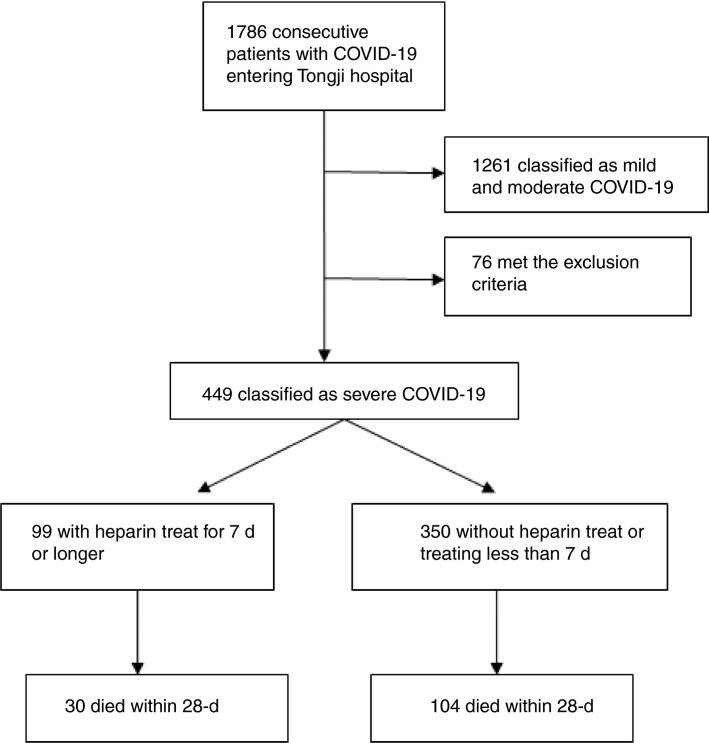
Coagulation results, medications, and outcomes of consecutive patients being classified as having severe COVID-19 in Tongji hospital were retrospectively analyzed. The 28-day mortality between heparin users and nonusers were compared, as was a different risk of coagulopathy, which was stratified by the sepsis-induced coagulopathy (SIC) score or D-dimer result.
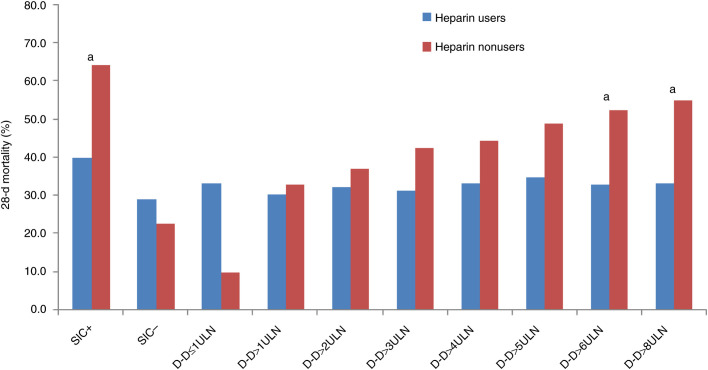
There were 449 patients with severe COVID-19 enrolled into the study, 99 of them received heparin (mainly with low molecular weight heparin) for 7 days or longer. D-dimer, prothrombin time, and age were positively, and platelet count was negatively, correlated with 28-day mortality in multivariate analysis. No difference in 28-day mortality was found between heparin users and nonusers (30.3% vs 29.7%, P = .910). But the 28-day mortality of heparin users was lower than nonusers in patients with SIC score ≥4 (40.0% vs 64.2%, P = .029), or D-dimer >6-fold of upper limit of normal (32.8% vs 52.4%, P = .017).
Anticoagulant therapy mainly with low molecular weight heparin appears to be associated with better prognosis in severe COVID-19 patients meeting SIC criteria or with markedly elevated D-dimer.
严重 2019 冠状病毒病(COVID-19)的死亡率相对较高,令人担忧,由于弥散性血管内凝血和静脉血栓栓塞的风险,肝素在 COVID-19 中的应用已被一些专家共识推荐。然而,其疗效仍有待验证。
回顾性分析了连续被分类为严重 COVID-19 的患者在同济医院的凝血结果、药物使用情况和结局。比较了肝素使用者和非使用者的 28 天死亡率,以及根据脓毒症诱导的凝血障碍(SIC)评分或 D-二聚体结果分层的不同凝血障碍风险。
本研究共纳入 449 例严重 COVID-19 患者,其中 99 例接受肝素(主要为低分子量肝素)治疗 7 天或以上。多元分析显示,D-二聚体、凝血酶原时间和年龄与 28 天死亡率呈正相关,血小板计数与 28 天死亡率呈负相关。肝素使用者和非使用者的 28 天死亡率无差异(30.3%比 29.7%,P=0.910)。但在 SIC 评分≥4 或 D-二聚体>正常上限 6 倍的患者中,肝素使用者的 28 天死亡率低于非使用者(40.0%比 64.2%,P=0.029;32.8%比 52.4%,P=0.017)。
抗凝治疗主要采用低分子量肝素,似乎与符合 SIC 标准或 D-二聚体显著升高的严重 COVID-19 患者的预后改善相关。