Department of Medicine and Therapeutics, The Chinese University of Hong Kong (CUHK), Hong Kong SAR, China.
Hong Kong Hub of Paediatric Excellence (HK HOPE), The Chinese University of Hong Kong (CUHK), Hong Kong SAR, China.
Cardiovasc Res. 2022 Sep 20;118(12):2652-2664. doi: 10.1093/cvr/cvab311.
Remdesivir is a prodrug of an adenosine triphosphate analogue and is currently the only drug formally approved for the treatment of hospitalized coronavirus disease of 2019 (COVID-19) patients. Nucleoside/nucleotide analogues have been shown to induce mitochondrial damage and cardiotoxicity, and this may be exacerbated by hypoxia, which frequently occurs in severe COVID-19 patients. Although there have been few reports of adverse cardiovascular events associated with remdesivir, clinical data are limited. Here, we investigated whether remdesivir induced cardiotoxicity using an in vitro human cardiac model.
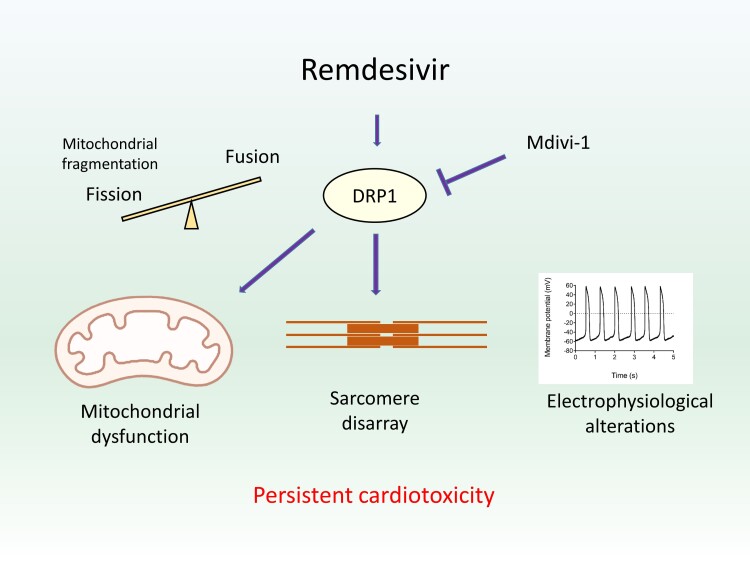
Human induced pluripotent stem cell-derived cardiomyocytes (hiPSC-CMs) were exposed to remdesivir under normoxic and hypoxic conditions to simulate mild and severe COVID-19, respectively. Remdesivir induced mitochondrial fragmentation, reduced redox potential, and suppressed mitochondrial respiration at levels below the estimated plasma concentration under both normoxic and hypoxic conditions. Non-mitochondrial damage such as electrophysiological alterations and sarcomere disarray were also observed. Importantly, some of these changes persisted after the cessation of treatment, culminating in increased cell death. Mechanistically, we found that inhibition of DRP1, a regulator of mitochondrial fission, ameliorated the cardiotoxic effects of remdesivir, showing that remdesivir-induced cardiotoxicity was preventable and excessive mitochondrial fission might contribute to this phenotype.
Using an in vitro model, we demonstrated that remdesivir can induce cardiotoxicity in hiPSC-CMs at clinically relevant concentrations. These results reveal previously unknown potential side-effects of remdesivir and highlight the importance of further investigations with in vivo animal models and active clinical monitoring to prevent lasting cardiac damage to patients.
瑞德西韦是一种腺嘌呤三磷酸类似物前药,目前是唯一正式批准用于治疗住院的 2019 年冠状病毒病(COVID-19)患者的药物。核苷/核苷酸类似物已被证明会引起线粒体损伤和心脏毒性,而这在 COVID-19 重症患者中经常发生的缺氧情况下可能会加剧。尽管与瑞德西韦相关的不良心血管事件报告很少,但临床数据有限。在这里,我们使用体外人心肌细胞模型研究了瑞德西韦是否会引起心脏毒性。
在模拟轻度和重度 COVID-19 的正常氧和低氧条件下,将人诱导多能干细胞衍生的心肌细胞(hiPSC-CMs)暴露于瑞德西韦中。在正常氧和低氧条件下,瑞德西韦诱导的线粒体碎片化、还原电势降低以及抑制线粒体呼吸的水平低于估计的血浆浓度。还观察到非线粒体损伤,如电生理改变和肌节紊乱。重要的是,一些这些变化在停止治疗后仍然存在,最终导致细胞死亡增加。从机制上讲,我们发现抑制线粒体裂变的调节因子 DRP1 可改善瑞德西韦的心脏毒性作用,表明瑞德西韦引起的心脏毒性是可预防的,并且过度的线粒体裂变可能导致这种表型。
使用体外模型,我们证明了瑞德西韦在临床相关浓度下可引起 hiPSC-CMs 的心脏毒性。这些结果揭示了瑞德西韦以前未知的潜在副作用,并强调了进一步使用体内动物模型和主动临床监测来预防对患者造成持久心脏损害的重要性。