Department of Gastroenterology, Ruijin Hospital, Shanghai Jiaotong University School of Medicine, Shanghai, China.
Institute of Digestive Disease and Department of Medicine and Therapeutics, State Key Laboratory of Digestive Disease, Li Ka Shing Institute of Health Sciences, The Chinese University of Hong Kong, Hong Kong, China.
Oncogene. 2021 Nov;40(47):6513-6526. doi: 10.1038/s41388-021-01872-9. Epub 2021 Oct 5.
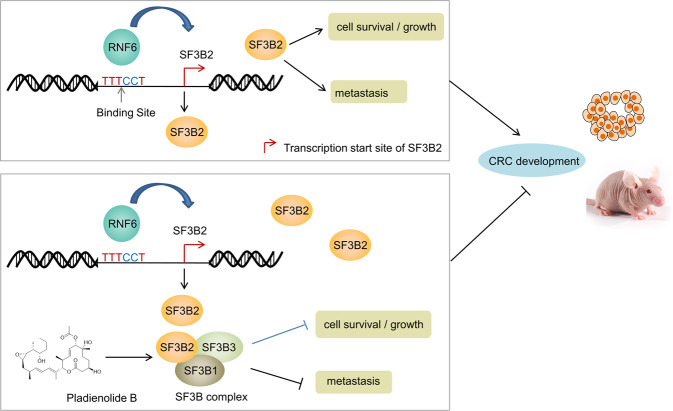
RNF6 is a RING finger protein with oncogenic potential. In this study, we established colon-specific RNF6 transgenic (tg) mice, and demonstrated that RNF6 overexpression accelerated colorectal carcinogenesis compared to wild-type littermates in a chemically induced colorectal cancer (CRC) model. To understand whether transcriptional activity of RNF6 underlies its oncogenic effect, we performed integrated chromatin immunoprecipitation (ChIP)-sequencing and RNA-sequencing analysis to identify splicing factor 3b subunit 2 (SF3B2) as a potential downstream target of RNF6. RNF6 binds to the SF3B2 promoter and the overexpression of RNF6 activates SF3B2 expression in CRC cells, primary CRC organoids, and RNF6 tg mice. SF3B2 knockout abrogated the tumor promoting effect of RNF6 overexpression, whereas the reexpression of SF3B2 recused cell growth and migration/invasion in RNF6 knockout cells, indicating that SF3B2 is a functional downstream target of RNF6 in CRC. Targeting of RNF6-SF3B2 axis with SF3B2 inhibitor with pladienolide B suppressed the growth of CRC cells with RNF6 overexpression in vitro and in vivo. Moreover, the combination of 5-fluorouracil (5-FU) plus pladienolide B exerted synergistic effects in CRC with high RNF6 expression, leading to tumor regression in xenograft models. These findings indicate that tumor promoting effect of RNF6 is achieved mainly via transcriptional upregulation of SF3B2, and that RNF6-SF3B2 axis is a promising target for CRC therapy.
RNF6 是一种具有致癌潜能的环指蛋白。在本研究中,我们建立了结肠特异性 RNF6 转基因(tg)小鼠,并在化学诱导的结直肠癌(CRC)模型中证明与野生型同窝小鼠相比,RNF6 过表达加速了结直肠肿瘤的发生。为了了解 RNF6 的转录活性是否是其致癌作用的基础,我们进行了整合染色质免疫沉淀(ChIP)-测序和 RNA 测序分析,以确定剪接因子 3b 亚基 2(SF3B2)为 RNF6 的潜在下游靶标。RNF6 结合到 SF3B2 启动子上,并且 RNF6 的过表达在 CRC 细胞、原发性 CRC 类器官和 RNF6 tg 小鼠中激活 SF3B2 的表达。SF3B2 敲除消除了 RNF6 过表达的促肿瘤作用,而 SF3B2 的重新表达在 RNF6 敲除细胞中恢复了细胞生长以及迁移/侵袭能力,表明 SF3B2 是 CRC 中 RNF6 的功能性下游靶标。用 pladienolide B 作为 SF3B2 抑制剂靶向 RNF6-SF3B2 轴,抑制了体外和体内 RNF6 过表达的 CRC 细胞的生长。此外,5-氟尿嘧啶(5-FU)与 pladienolide B 的联合使用对高 RNF6 表达的 CRC 发挥了协同作用,导致异种移植模型中的肿瘤消退。这些发现表明,RNF6 的促肿瘤作用主要是通过 SF3B2 的转录上调来实现的,并且 RNF6-SF3B2 轴是 CRC 治疗的一个有前途的靶点。