Satish Priyanka, Sadaf Murrium I, Valero-Elizondo Javier, Grandhi Gowtham R, Yahya Tamer, Zawahir Hassan, Javed Zulqarnain, Mszar Reed, Hanif Bashir, Kalra Ankur, Virani Salim, Cainzos-Achirica Miguel, Nasir Khurram
Houston Methodist DeBakey Heart and Vascular Center, Houston, TX, United States.
Yale New Haven Medical Center (Waterbury) Internal Medicine Residency Program, Waterbury, CT, United States.
Am J Prev Cardiol. 2021 Jun 20;7:100219. doi: 10.1016/j.ajpc.2021.100219. eCollection 2021 Sep.
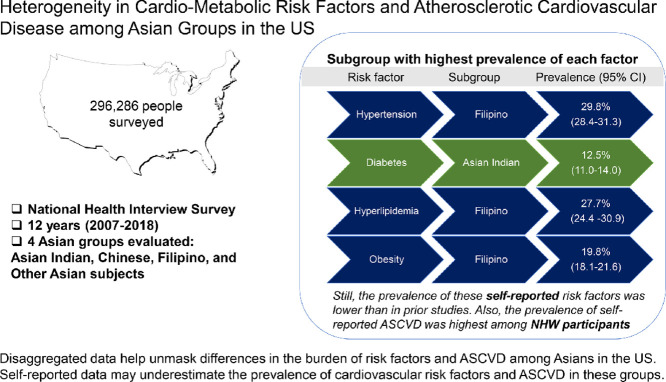
The Asian American population in the U.S. comprises various, ethnically diverse subgroups. Traditionally, this population has been studied as a single, aggregated group, potentially masking differences in risk among subgroups. Analyses using disaggregated data can help better characterize the health needs of different Asian subpopulations and inform targeted, effective public health interventions. We assessed the prevalence of cardiovascular disease (CVD) risk factors and atherosclerotic CVD (ASCVD) and their associations with socioeconomic factors among Chinese, Asian Indian, Filipino and Other Asian subjects, compared with non-Hispanic White (NHW) subjects in the U.S.
: Cross-sectional study using data from 298,286 adults from the National Health Interview Survey (NHIS) from 2007 to 2018. We utilized chi-squared tests to compare characteristics across subgroups. Weighted proportions and unadjusted and adjusted logistic regression models were utilized to examine the associations between Asian subgroups, self-reported CVD risk factors and self-reported ASCVD, as well as between socioeconomic factors within each Asian subgroup.
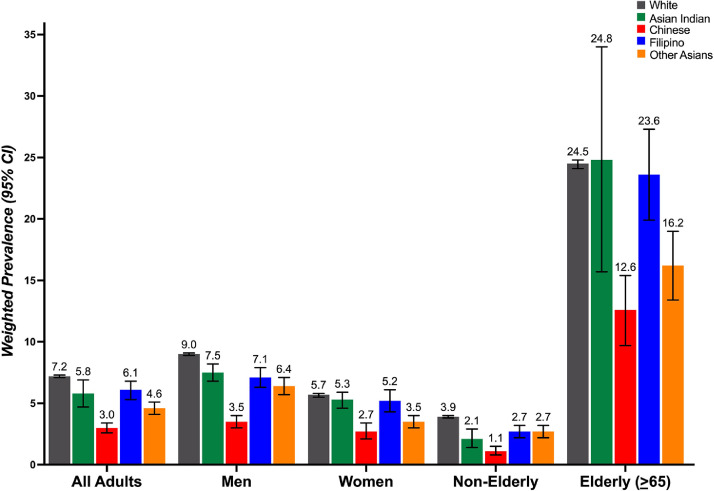
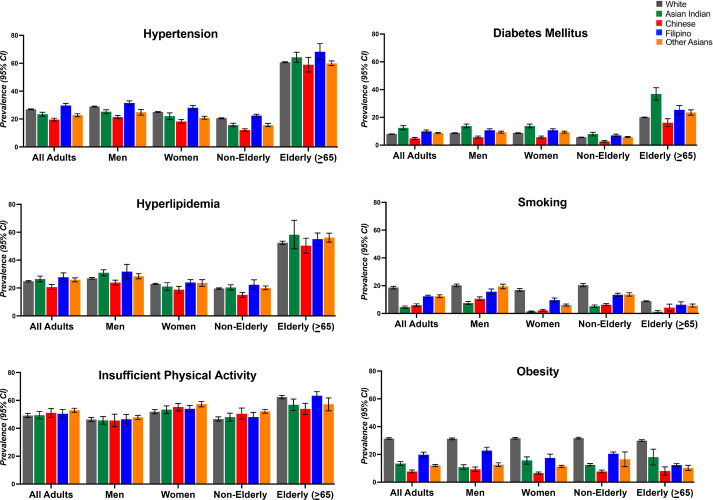
: Asian Indian subjects had the highest prevalence of diabetes (12.5%), while Filipino subjects had the highest prevalence of hyperlipidemia (27.7%), hypertension (29.8%) and obesity (19.8%). Despite this, the prevalence of self-reported ASCVD was lower in all Asian groups compared with NHWs. Chinese subjects had the lowest odds of having each of the CVD risk factors assessed.
: We found considerable heterogeneity in the distribution of risk factors as well as ASCVD among Asian subgroups in the US. Compared with health system or community-based reports, the prevalence of risk factors and ASCVD may be underestimated in some Asian NHIS subgroups. There is an urgent need for efforts to improve recruitment of Asian participants of heterogeneous socioeconomic backgrounds in national surveys, as well as to perform a thorough assessment of risk factors and disease in this population, not relying solely on self-report.
美国的亚裔美国人包括各种不同种族的亚群体。传统上,该人群一直被作为一个单一的聚合群体进行研究,这可能掩盖了亚群体之间风险的差异。使用分类数据进行分析有助于更好地描述不同亚洲亚人群体的健康需求,并为有针对性的、有效的公共卫生干预提供信息。我们评估了华裔、印度裔、菲律宾裔和其他亚裔受试者中心血管疾病(CVD)危险因素和动脉粥样硬化性心血管疾病(ASCVD)的患病率及其与社会经济因素的关联,并与美国非西班牙裔白人(NHW)受试者进行了比较。
采用2007年至2018年美国国家健康访谈调查(NHIS)中298,286名成年人的数据进行横断面研究。我们使用卡方检验来比较各亚组的特征。加权比例以及未调整和调整后的逻辑回归模型用于检验亚洲亚组、自我报告的CVD危险因素和自我报告的ASCVD之间的关联,以及每个亚洲亚组内社会经济因素之间的关联。
印度裔受试者的糖尿病患病率最高(12.5%),而菲律宾裔受试者的高脂血症(27.7%)、高血压(29.8%)和肥胖症(19.8%)患病率最高。尽管如此,与非西班牙裔白人相比,所有亚洲群体中自我报告的ASCVD患病率均较低。华裔受试者出现每种评估的CVD危险因素的几率最低。
我们发现美国亚洲亚组中危险因素以及ASCVD的分布存在相当大的异质性。与卫生系统或基于社区的报告相比,某些亚洲NHIS亚组中危险因素和ASCVD的患病率可能被低估。迫切需要努力改善全国性调查中不同社会经济背景的亚洲参与者的招募情况,并对该人群的危险因素和疾病进行全面评估,而不仅仅依赖自我报告。