Department of Paediatrics and Child Health, Aga Khan University, Karachi, Pakistan.
Centre of Excellence in Women and Child Health, Aga Khan University, Karachi, Pakistan.
Am J Clin Nutr. 2022 Feb 9;115(2):492-502. doi: 10.1093/ajcn/nqab341.
In Pakistan, the prevalence of stunting among children younger than 5 y has remained above WHO critical thresholds (≥30%) over the past 2 decades.
We hypothesized that an unconditional cash transfer (UCT) combined with lipid-based nutrient supplement (LNS) and/or social and behavior change communication (SBCC) will prevent stunting among children 6-23 mo of age.
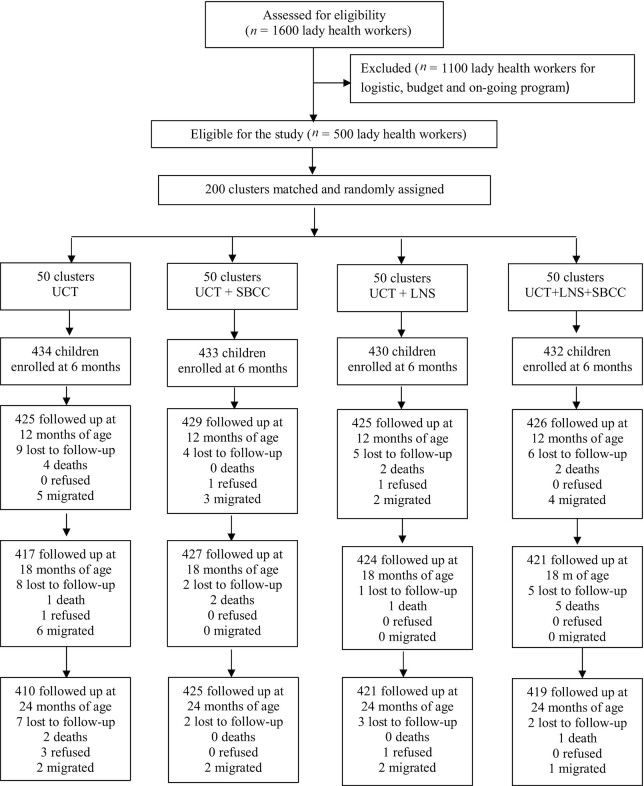
This was a 4-arm, community-based cluster randomized controlled trial conducted in the district of Rahim Yar Khan, Pakistan. A total of 1729 children (UCT, n = 434; UCT + SBCC, n = 433; UCT + LNS, n = 430; and UCT + LNS + SBCC, n = 432) were enrolled at 6 mo of age and measured monthly for 18 mo until the age of 24 mo.
At 24 mo of age, children who received UCT + LNS [rate ratio (RR): 0.85; 95% CI: 0.74, 0.97; P = 0.015) and UCT + LNS + SBCC (RR: 0.86; 95% CI: 0.77, 0.96; P = 0.007) had a significantly lower risk of being stunted compared with the UCT arm. No significant difference was noted among children who received UCT + SBCC (RR: 1.03; 95% CI: 0.91, 1.16; P = 0.675) in the risk of being stunted compared with the UCT arm. The pooled prevalence of stunting among children aged 6-23 mo was 41.7%, 44.8%, 38.5%, and 39.3% in UCT, UCT + SBCC, UCT + LNS, and UCT + LNS + SBCC, respectively. In pairwise comparisons, a significant impact on stunting among children in UCT + LNS (P = 0.029) and UCT + LNS + SBCC (P = <0.001) was noted compared with the UCT arm.
UCT combined with LNS and UCT + LNS + SBCC were effective in reducing the prevalence of stunting among children aged 6-23 mo in marginalized populations. UCT + SBCC was not effective in reducing the child stunting prevalence. This trial was registered at clinicaltrials.gov as NCT03299218.
在过去的 20 年中,巴基斯坦 5 岁以下儿童发育迟缓的患病率一直高于世界卫生组织的临界阈值(≥30%)。
我们假设无条件现金转移(UCT)与脂质基营养素补充剂(LNS)和/或社会和行为改变沟通(SBCC)相结合将预防 6-23 月龄儿童发育迟缓。
这是一项在巴基斯坦拉希姆亚尔汗地区进行的 4 臂、基于社区的随机对照试验。共有 1729 名儿童(UCT 组,n=434;UCT+SBCC 组,n=433;UCT+LNS 组,n=430;UCT+LNS+SBCC 组,n=432)在 6 月龄时入组,并在 18 个月龄时每月测量一次,直到 24 月龄。
在 24 月龄时,接受 UCT+LNS 治疗的儿童(RR:0.85;95%CI:0.74,0.97;P=0.015)和 UCT+LNS+SBCC 治疗的儿童(RR:0.86;95%CI:0.77,0.96;P=0.007)发育迟缓的风险明显低于 UCT 组。接受 UCT+SBCC 治疗的儿童(RR:1.03;95%CI:0.91,1.16;P=0.675)与 UCT 组相比,发育迟缓的风险没有显著差异。在 6-23 月龄儿童中,UCT、UCT+SBCC、UCT+LNS 和 UCT+LNS+SBCC 组的发育迟缓患病率分别为 41.7%、44.8%、38.5%和 39.3%。在两两比较中,UCT+LNS(P=0.029)和 UCT+LNS+SBCC(P<0.001)组儿童的发育迟缓发生率有显著影响。
UCT 联合 LNS 和 UCT+LNS+SBCC 可有效降低边缘人群中 6-23 月龄儿童发育迟缓的发生率。UCT+SBCC 不能有效降低儿童发育迟缓的发生率。该试验在 clinicaltrials.gov 注册,编号为 NCT03299218。