Sato Shigeru, Yoshida Riku, Kiyono Ryosuke, Yahata Kaoru, Yasaka Koki, Nunes João Pedro, Nosaka Kazunori, Nakamura Masatoshi
Institute for Human Movement and Medical Sciences, Niigata University of Health and Welfare, Niigata, Japan.
Department of Physical Therapy, Niigata University of Health and Welfare, Niigata, Japan.
Front Physiol. 2021 Sep 16;12:734509. doi: 10.3389/fphys.2021.734509. eCollection 2021.
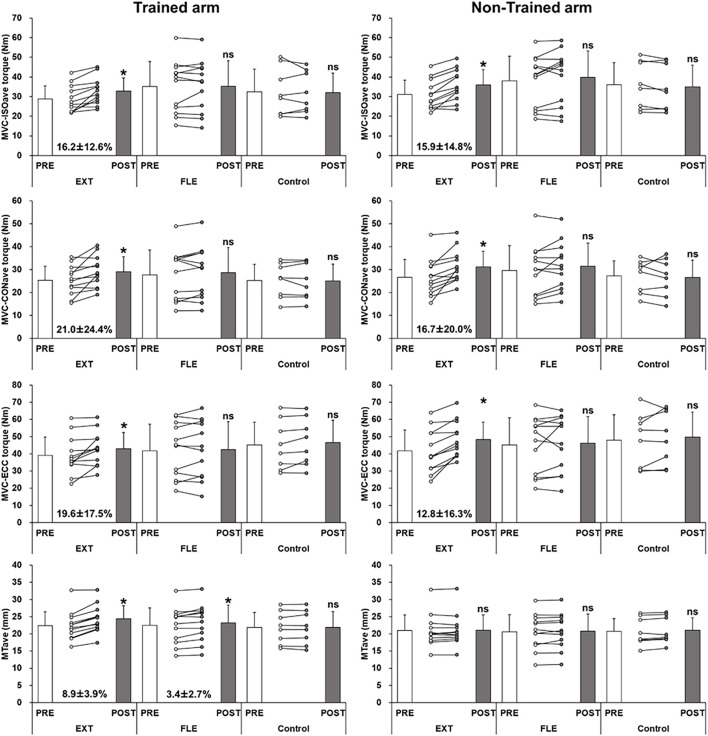
The present study compared two unilateral arm curl resistance exercise protocols with a different starting and finishing elbow joint angle in the same ROM for changes in elbow flexors strength and muscle thickness of the trained and non-trained arms. Thirty-two non-resistance trained young adults were randomly assigned to one of the three groups: extended joint training (0°-50°; EXT, = 12); flexed joint training (80°-130°; FLE, = 12); and non-training control ( = 8). The exercise training was performed by the dominant arms twice a week for 5 weeks with gradual increases in the training volume over 10 training sessions, and the non-dominant (non-trained) arms were investigated for the cross-education effect. Maximal voluntary contraction torque of isometric (MVC-ISO), concentric (MVC-CON), and eccentric contractions (MVC-ECC), and thickness (MT) of biceps brachii and brachialis of the trained and non-trained arms were assessed at baseline and 4-8 days after the last training session. The control group did not show significant changes in any variables. Significant ( < 0.05) increases in MVC-ISO torque (16.2 ± 12.6%), MVC-CON torque (21.1 ± 24.4%), and MVC-ECC torque (19.6 ± 17.5%) of the trained arm were observed for the EXT group only. The magnitude of the increase in MT of the trained arm was greater ( < 0.05) for EXT (8.9 ± 3.9%) than FLE (3.4 ± 2.7%). The cross-education effect was evident for MVC-ISO (15.9 ± 14.8%) and MVC-CON (16.7 ± 20.0%) torque of the EXT group only. These results suggest that resistance training at the extended elbow joint induces greater muscle adaptations and cross-education effects than that at flexed elbow joint.
本研究比较了两种单侧手臂弯举抗阻训练方案,在相同的活动范围内,起始和结束时肘关节角度不同,观察训练侧和未训练侧手臂的屈肘肌力量和肌肉厚度的变化。32名未经抗阻训练的年轻成年人被随机分为三组之一:伸展关节训练组(0°-50°;EXT,n = 12);屈曲关节训练组(80°-130°;FLE,n = 12);以及非训练对照组(n = 8)。训练由优势手臂每周进行两次,共5周,在10次训练中逐渐增加训练量,同时对非优势(未训练)手臂进行交叉训练效果研究。在基线以及最后一次训练后4-8天,评估训练侧和未训练侧手臂的等长最大自主收缩扭矩(MVC-ISO)、向心最大自主收缩扭矩(MVC-CON)和离心最大自主收缩扭矩(MVC-ECC),以及肱二头肌和肱肌的厚度(MT)。对照组的任何变量均未显示出显著变化。仅EXT组观察到训练侧手臂的MVC-ISO扭矩(16.2±12.6%)、MVC-CON扭矩(21.1±24.4%)和MVC-ECC扭矩(19.6±17.5%)有显著(P<0.05)增加。EXT组训练侧手臂MT增加幅度(8.9±3.9%)大于FLE组(3.4±2.7%)(P<0.05)。仅EXT组的MVC-ISO(15.9±14.8%)和MVC-CON(16.7±20.0%)扭矩出现明显的交叉训练效果。这些结果表明,伸展肘关节的抗阻训练比屈曲肘关节的抗阻训练能诱导更大的肌肉适应和交叉训练效果。