Syed Muzammil H, Zamzam Abdelrahman, Khan Hamzah, Singh Krishna, Forbes Thomas L, Rotstein Ori, Abdin Rawand, Eikelboom John, Qadura Mohammad
Division of Vascular Surgery, St. Michael's Hospital, Toronto, Ontario, Canada.
Department of Medical Biophysics, Schulich School of Medicine and Dentistry, University of Western Ontario, London, Ontario, Canada.
JVS Vasc Sci. 2020 Sep 2;1:168-175. doi: 10.1016/j.jvssci.2020.08.003. eCollection 2020.
Peripheral arterial disease (PAD) affects more than 150 million people worldwide and is associated with high rates of lower extremity amputation, myocardial infarction, stroke and death. Fatty acid binding protein 3 (FABP3) is released into circulation in patients with skeletal muscle injury. In this pilot study, we investigated a possible association between PAD and blood levels of FABP3.
Blood samples were collected from patients with clinical symptoms and diagnostic findings indicative of PAD (PAD group; ankle-brachial index [ABI] <0.9; n = 75) and in those without clinical or diagnostic features of PAD (non-PAD group; ABI >0.9; n = 75) presenting to vascular surgery ambulatory clinics at St. Michael's Hospital. Plasma samples were analyzed by protein multiplex to quantify FABP3 levels.
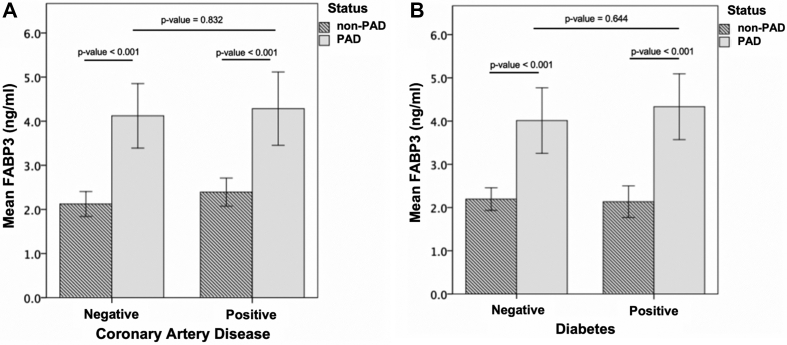
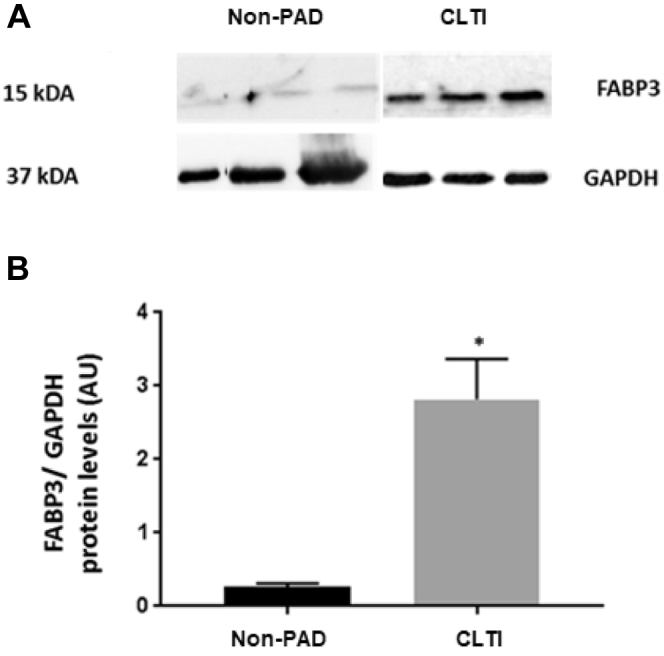
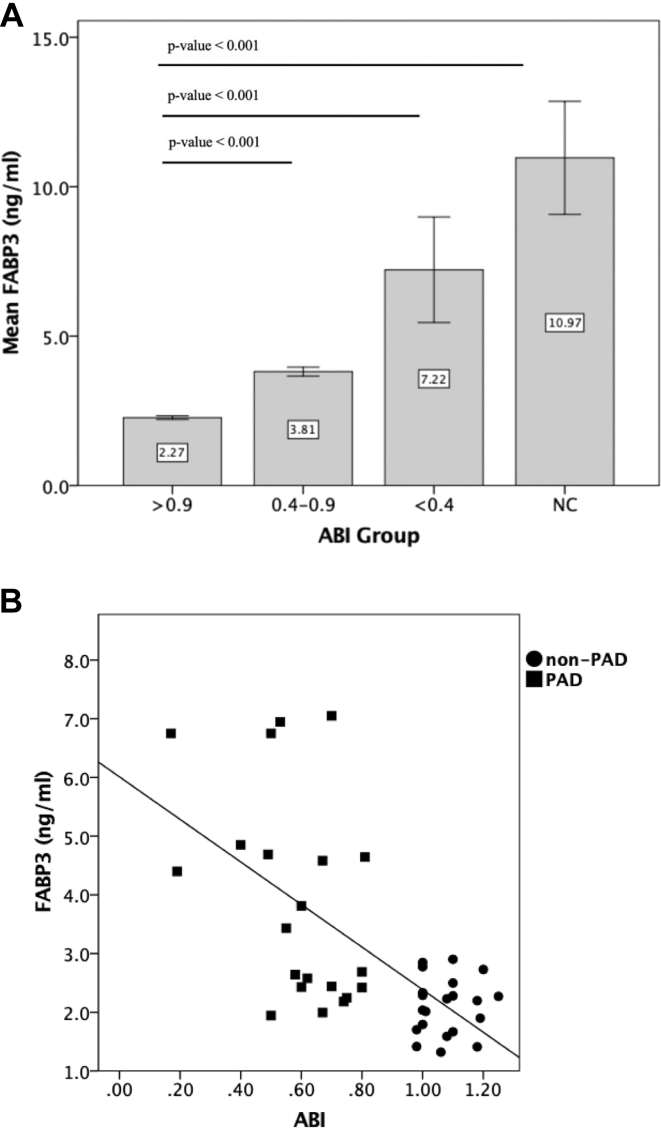
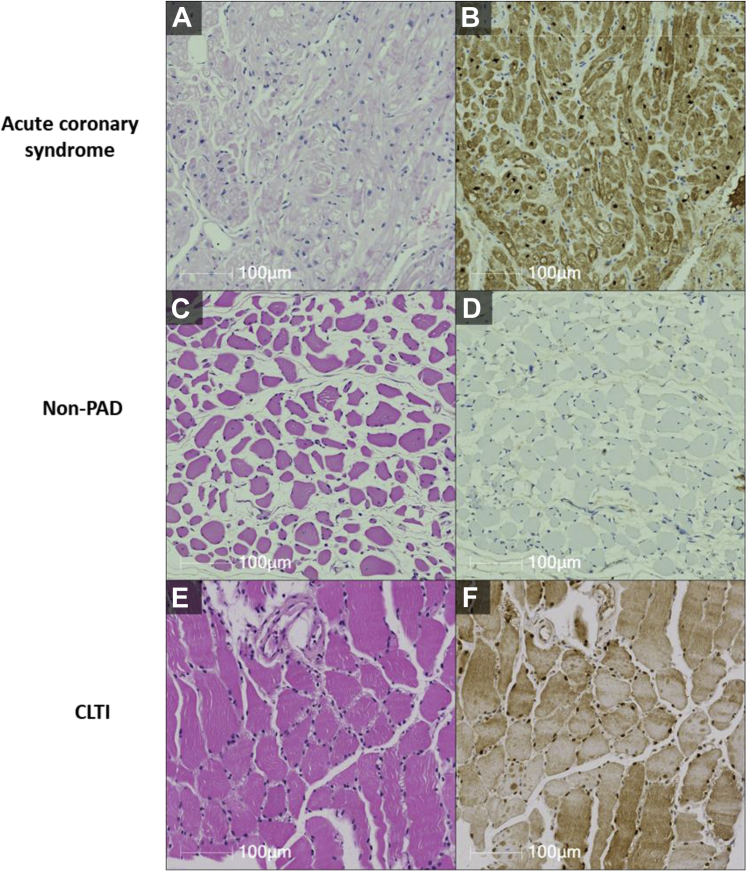
PAD patients were found to have higher blood levels of FABP3 compared to patients without PAD (mean 3.90 ± 1.69 vs 2.03 ± 0.78; < .001). A subgroup analysis demonstrated that the FABP3 levels were increased by almost two-fold in patients with PAD, independent of coronary artery disease ( < .001) or diabetes mellitus status ( < .001). Moreover, a significant negative correlation between FABP3 and the ABI was observed in PAD and patients without PAD matched groups (r = -0.51; = .001). Last, immunohistochemistry demonstrated elevated expressions of FABP3 within skeletal muscle obtained from patients with the most severe form of PAD, chronic limb-threatening ischemia, when compared with patients without PAD.
Patients with PAD have elevated plasma levels of FABP3. An increasing severity of PAD is associated with higher FABP3 levels.
外周动脉疾病(PAD)在全球影响着超过1.5亿人,与下肢截肢、心肌梗死、中风及死亡的高发生率相关。脂肪酸结合蛋白3(FABP3)在骨骼肌损伤患者中会释放到循环系统中。在这项初步研究中,我们调查了PAD与FABP3血液水平之间可能存在的关联。
从圣迈克尔医院血管外科门诊的有临床症状和诊断结果提示患有PAD的患者(PAD组;踝肱指数[ABI]<0.9;n = 75)以及无PAD临床或诊断特征的患者(非PAD组;ABI>0.9;n = 75)采集血样。通过蛋白质多重分析来检测血浆样本以量化FABP3水平。
与无PAD的患者相比,发现PAD患者的FABP3血液水平更高(均值3.90±1.69对2.03±0.78;P<0.001)。亚组分析表明,PAD患者的FABP3水平增加了近两倍,与冠状动脉疾病(P<0.001)或糖尿病状态(P<0.001)无关。此外,在PAD组和匹配的无PAD患者组中观察到FABP3与ABI之间存在显著负相关(r = -0.51;P = 0.001)。最后,免疫组织化学显示,与无PAD的患者相比,从患有最严重形式的PAD即慢性肢体威胁性缺血的患者获取的骨骼肌中FABP3表达升高。
PAD患者的血浆FABP3水平升高。PAD严重程度增加与更高的FABP3水平相关。