Research School of Behavioural and Cognitive Neuroscience, University of Groningen, Groningen, the Netherlands.
Department of Otorhinolaryngology, 10173University Medical Center Groningen, University of Groningen, Groningen, the Netherlands.
Trends Hear. 2021 Jan-Dec;25:23312165211045306. doi: 10.1177/23312165211045306.
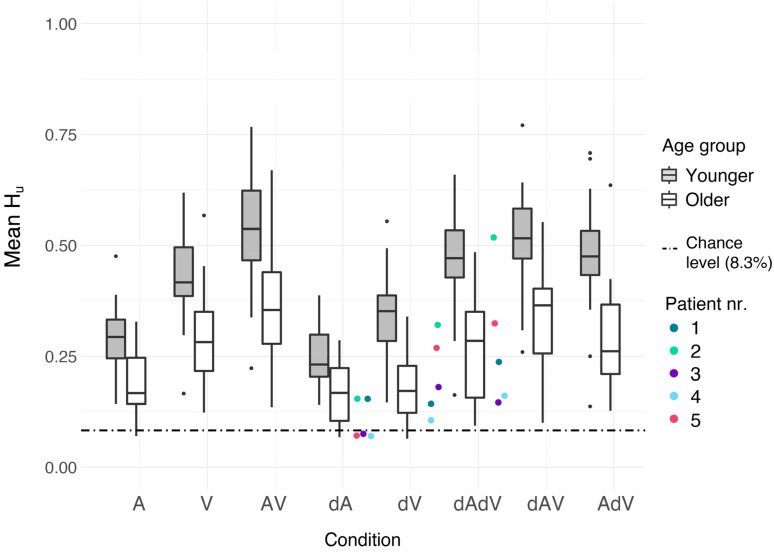
Since emotion recognition involves integration of the visual and auditory signals, it is likely that sensory impairments worsen emotion recognition. In emotion recognition, young adults can compensate for unimodal sensory degradations if the other modality is intact. However, most sensory impairments occur in the elderly population and it is unknown whether older adults are similarly capable of compensating for signal degradations. As a step towards studying potential effects of real sensory impairments, this study examined how degraded signals affect emotion recognition in older adults with normal hearing and vision. The degradations were designed to approximate some aspects of sensory impairments. Besides emotion recognition accuracy, we recorded eye movements to capture perceptual strategies for emotion recognition. Overall, older adults were as good as younger adults at integrating auditory and visual information and at compensating for degraded signals. However, accuracy was lower overall for older adults, indicating that aging leads to a general decrease in emotion recognition. In addition to decreased accuracy, older adults showed smaller adaptations of perceptual strategies in response to video degradations. Concluding, this study showed that emotion recognition declines with age, but that integration and compensation abilities are retained. In addition, we speculate that the reduced ability of older adults to adapt their perceptual strategies may be related to the increased time it takes them to direct their attention to scene aspects that are relatively far away from fixation.
由于情感识别涉及视觉和听觉信号的整合,因此感觉障碍很可能会使情感识别恶化。在情感识别中,如果另一种模态是完整的,那么年轻人可以补偿单模态感觉退化。然而,大多数感觉障碍发生在老年人群体中,尚不清楚老年人是否同样能够补偿信号退化。作为研究真实感觉障碍潜在影响的一步,本研究考察了正常听力和视力的老年人中,退化信号如何影响情感识别。这些退化是为了模拟感觉障碍的某些方面而设计的。除了情感识别准确性外,我们还记录了眼动,以捕捉情感识别的感知策略。总的来说,老年人在整合听觉和视觉信息以及补偿退化信号方面与年轻人一样出色。然而,老年人的准确性总体较低,这表明衰老会导致情感识别能力普遍下降。除了准确性下降外,老年人在视频退化时感知策略的适应性较小。总之,本研究表明,情感识别随年龄增长而下降,但整合和补偿能力得以保留。此外,我们推测,老年人适应感知策略的能力下降可能与他们将注意力转移到离注视点相对较远的场景方面所需的时间增加有关。