Department of Medical Technology and Sciences, Faculty of Health Sciences, Kyoto Tachibana University, 34 Yamada-cho Oyake Yamashina-ku, Kyoto, 607-8175, Japan.
Faculty of Bioscience, Nagahama Institute of Bio-Science and Technology, Nagahama-shi, Shiga, Tamuracho, 1266526-0829, Japan.
Inflammation. 2022 Feb;45(1):180-195. doi: 10.1007/s10753-021-01537-5. Epub 2021 Oct 10.
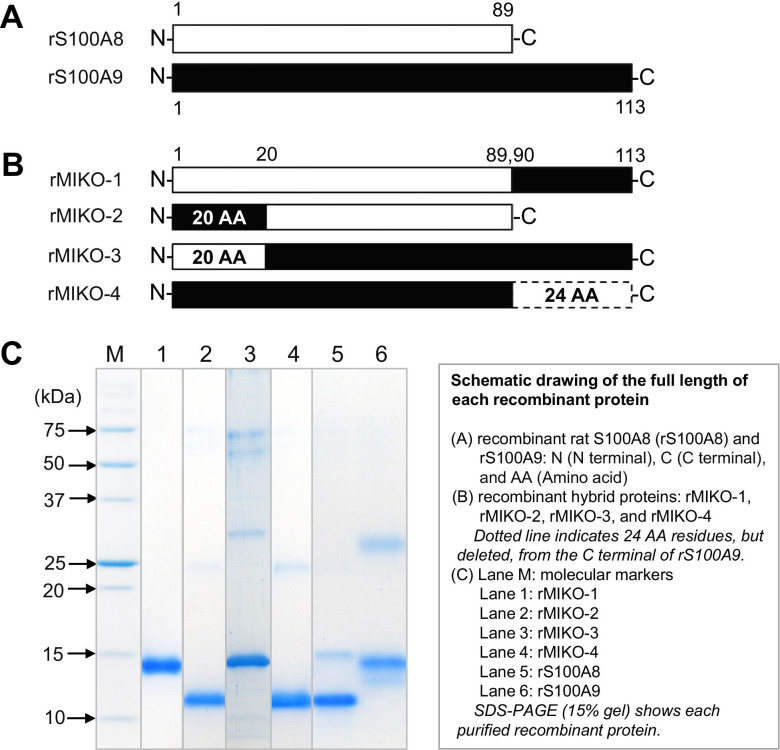
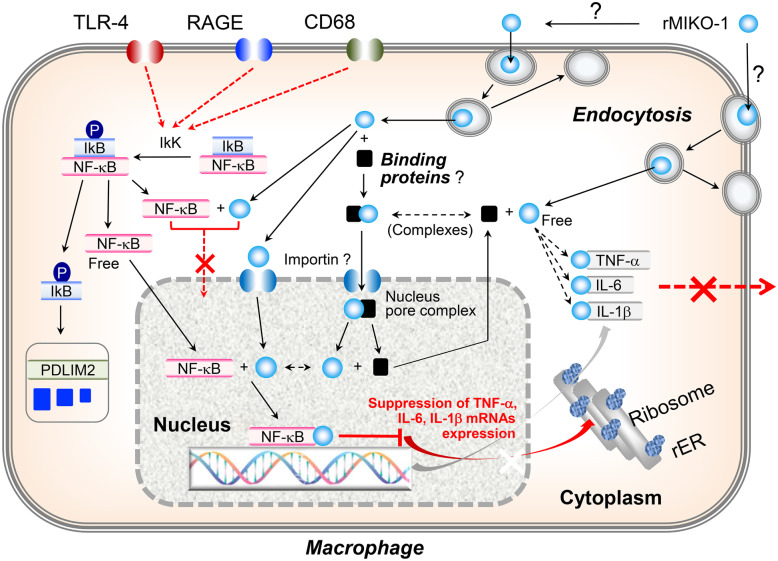
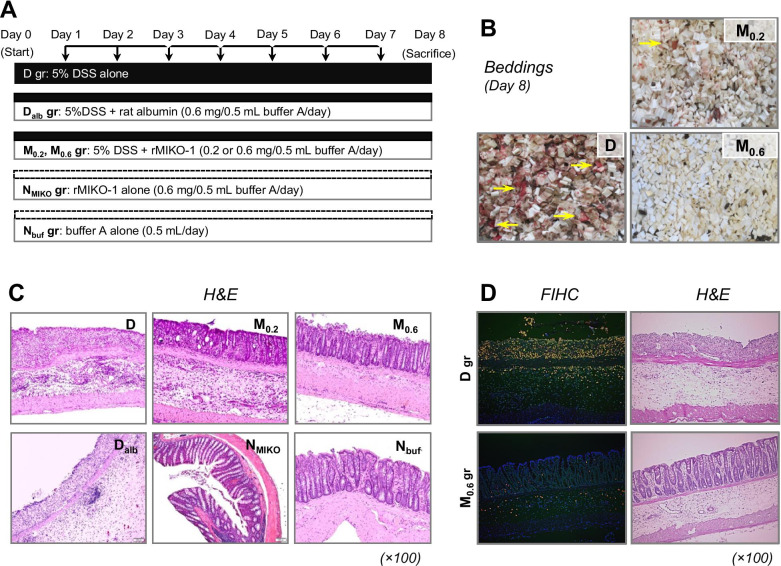
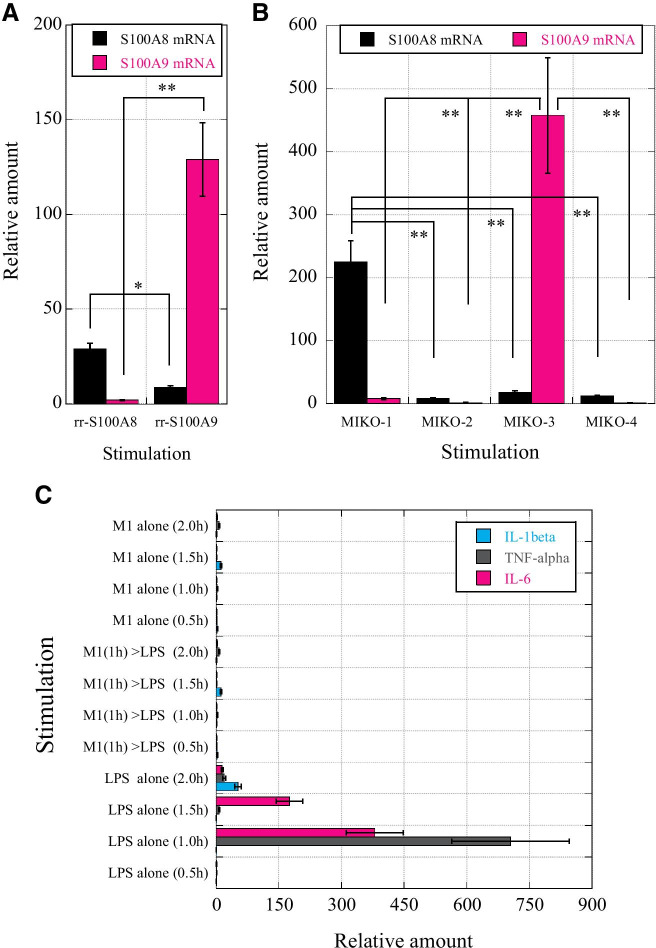
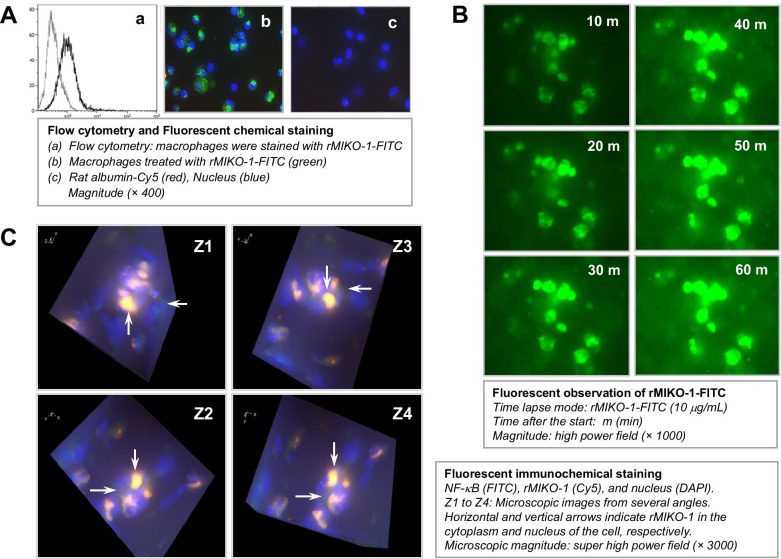
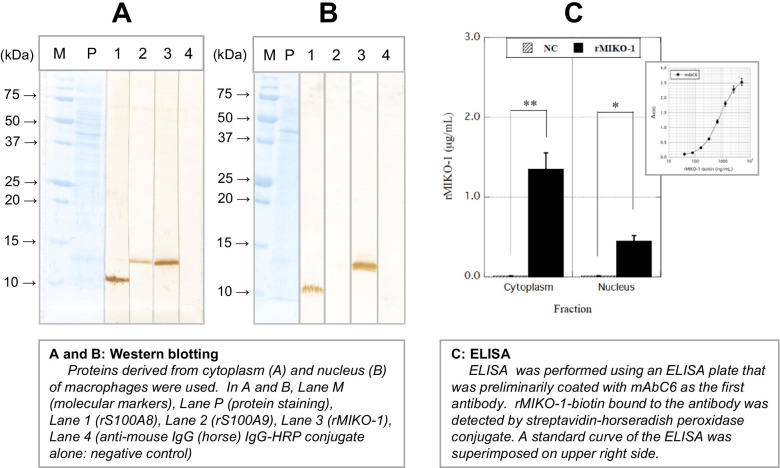
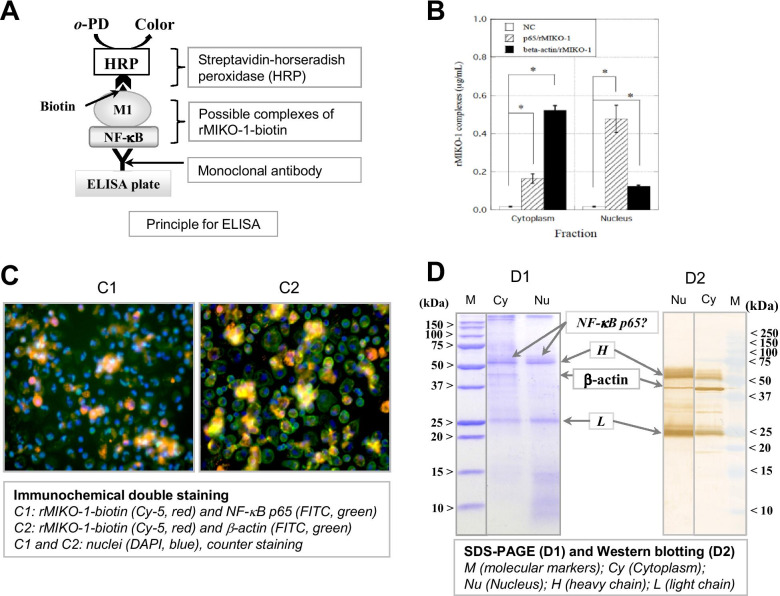
We newly developed a hybrid protein, tentatively named rMIKO-1, using gene technology. We herein investigated the effects of rMIKO-1 on activated macrophages and discussed its potential as a suppressor of experimental colitis. Fluorescent microscopy was used to observe the dynamic mobility of rMIKO-1 in macrophages. Sodium dodecyl sulfate-polyacrylamide gel electrophoresis, Western blotting, fluorescent immunochemical staining, flow cytometry, enzyme-linked immunosorbent assays, a polymerase chain reaction/quantitative polymerase chain reaction, and hematoxylin and eosin staining were conducted to assess the potential activity of rMIKO-1. A large amount of bleeding was observed in rats treated with 5% dextran sulfate sodium (DSS) alone on day 8 after treatment initiation, but not in those treated with 5% DSS plus rMIKO-1. In the in vitro assay, rMIKO-1 rapidly bound to macrophages, immediately entered cells by an unknown mechanism, and then migrated inside the nucleus. This result suggests that rMIKO-1 plays important immunological roles in the nucleus. Despite the activation of macrophages by lipopolysaccharide, the mRNA expression of pro-inflammatory cytokines, such as tumor necrosis factor-α, interleukin-6, and interleukin-1β, was significantly suppressed in macrophages preliminarily treated with rMIKO-1 for 1 h. Complexes of rMIKO-1 with nuclear factor-kappa B (NF-κB)/p65 and β-actin formed in activated macrophages, which attenuated experimental colitis in rats. These results strongly suggest that rMIKO-1 negatively regulates excessively activated macrophages through the NF-κB/p65 signaling pathway. Therefore, rMIKO-1 is a novel suppressor of experimental colitis in rats through the negative regulation of activated macrophages.
我们新利用基因技术开发了一种混合蛋白,暂定名为 rMIKO-1。在此,我们研究了 rMIKO-1 对活化巨噬细胞的影响,并讨论了其作为实验性结肠炎抑制剂的潜力。荧光显微镜用于观察 rMIKO-1 在巨噬细胞中的动态迁移。通过十二烷基硫酸钠-聚丙烯酰胺凝胶电泳、Western 印迹、荧光免疫化学染色、流式细胞术、酶联免疫吸附试验、聚合酶链反应/定量聚合酶链反应和苏木精和伊红染色来评估 rMIKO-1 的潜在活性。在治疗开始后第 8 天,单独用 5%葡聚糖硫酸钠(DSS)处理的大鼠出现大量出血,但用 5% DSS 加 rMIKO-1 处理的大鼠没有出血。在体外试验中,rMIKO-1 迅速与巨噬细胞结合,立即通过未知机制进入细胞,然后在核内迁移。这一结果表明 rMIKO-1 在核内发挥重要的免疫作用。尽管巨噬细胞被脂多糖激活,但在 rMIKO-1 预处理 1 小时的巨噬细胞中,促炎细胞因子如肿瘤坏死因子-α、白细胞介素-6 和白细胞介素-1β 的 mRNA 表达明显受到抑制。rMIKO-1 与核因子-κB(NF-κB)/p65 和 β-肌动蛋白形成复合物,在激活的巨噬细胞中形成,减轻了大鼠的实验性结肠炎。这些结果强烈表明,rMIKO-1 通过 NF-κB/p65 信号通路负调控过度激活的巨噬细胞。因此,rMIKO-1 通过负调控活化的巨噬细胞成为大鼠实验性结肠炎的一种新型抑制剂。