J Med Libr Assoc. 2021 Jul 1;109(3):441-449. doi: 10.5195/jmla.2021.1173.
This study compares two maps of biomedical sciences using Medical Subject Headings (MeSH) term co-assignments versus MeSH terms of citing/cited articles and reveals similarities and differences between the two approaches.
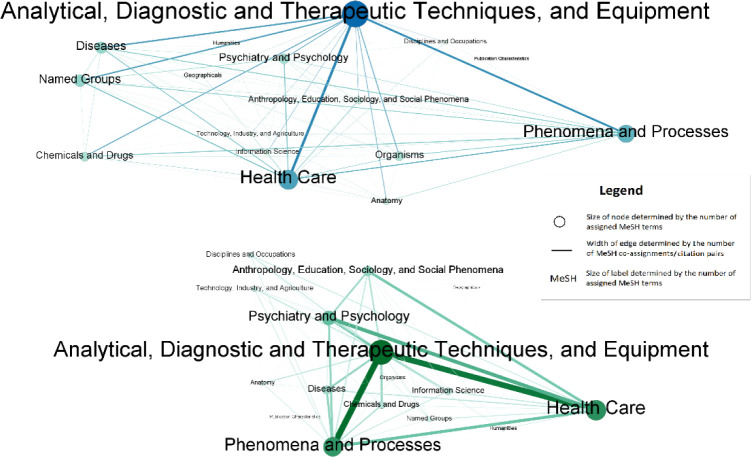
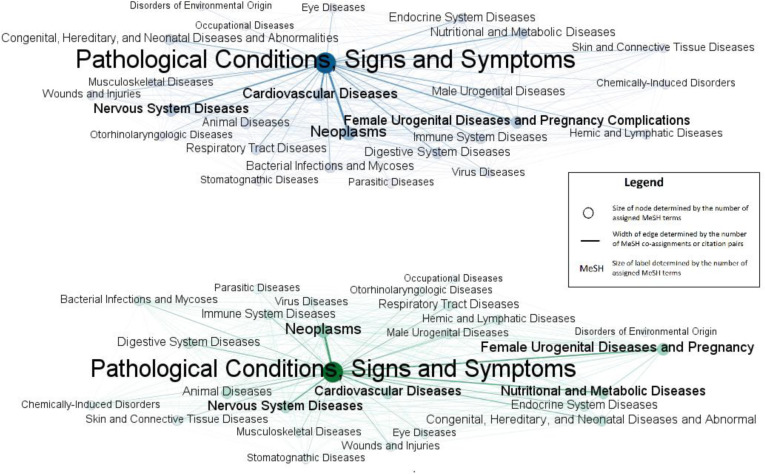
MeSH terms assigned to 397,475 journal articles published in 2015, as well as their 4,632,992 cited references, were retrieved from Web of Science and MEDLINE databases, respectively, which formed over 7 million MeSH co-assignments and nearly 18 million direct citation pairs. We generated six network visualizations of biomedical science at three levels using Gephi software based on these MeSH co-assignments and citation pairs.
The MeSH co-assignment map contained more nodes and edges, as MeSH co-assignments cover all medical topics discussed in articles. By contrast, the MeSH citation map contained fewer but larger nodes and wider edges, as citation links indicate connections to two similar medical topics.
These two types of maps emphasize different aspects of biomedical sciences, with MeSH co-assignment maps focusing on the relationship between topics in different categories and MeSH direct citation maps providing insights into relationships between topics in the same or similar category.
本研究使用主题词共分配与引用/被引文献的主题词对比,比较了两种生物医学科学图谱,揭示了这两种方法的异同。
从 Web of Science 和 MEDLINE 数据库中分别检索了 2015 年发表的 397475 篇期刊文章以及它们的 4632992 条被引参考文献的主题词,形成了超过 700 万个主题词共分配和近 1800 万对直接引文对。我们使用 Gephi 软件基于这些主题词共分配和引文对生成了六个生物医学科学的网络可视化,分为三个层次。
主题词共分配图谱包含更多的节点和边,因为主题词共分配涵盖了文章中讨论的所有医学主题。相比之下,主题词直接引文图谱包含的节点较少但更大,边更宽,因为引文链接表明与两个类似的医学主题有关。
这两种类型的图谱强调了生物医学科学的不同方面,主题词共分配图谱侧重于不同类别主题之间的关系,而主题词直接引文图谱则提供了同一或相似类别主题之间关系的见解。