Graduate Institute of Clinical Medicine, College of Medicine, Kaohsiung Medical University, Kaohsiung 807, Taiwan.
Division of Hematology and Oncology, Department of Internal Medicine, Kaohsiung Medical University Hospital, Kaohsiung Medical University, Kaohsiung 807, Taiwan.
Biomed Res Int. 2021 Sep 30;2021:3291762. doi: 10.1155/2021/3291762. eCollection 2021.
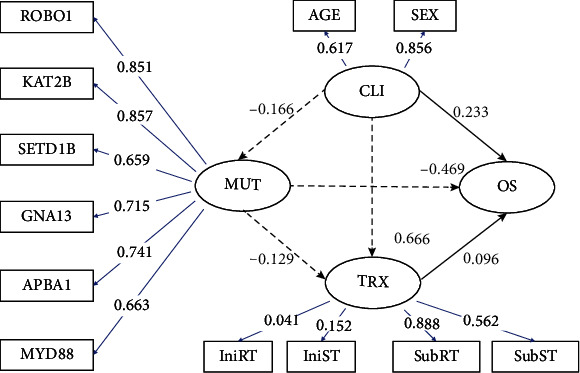
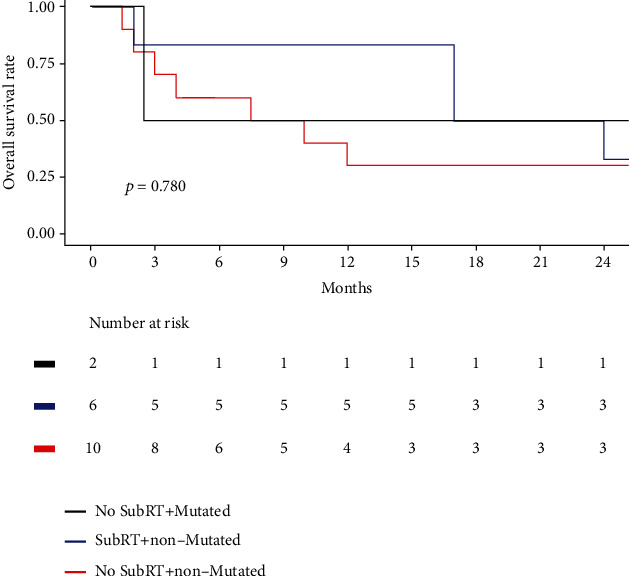
Primary central nervous system lymphoma (PCNSL) is a rare lymphoma, and the disease course is often aggressive with poor prognosis outcomes. PCNSL undergoes germinal center reactions and impairs B-cell maturation. However, angiogenesis is also involved in the tumorigenesis and progression of PCNSL. This study investigated the effects of the tumor microenvironment and angiogenesis-associated genomic alterations on the outcomes of PCNSL. The analysis also evaluated the influence of treatment modality and timing on PCNSL survival using partial least squares variance-based path modeling (PLS-PM). PLS-PM can be used to evaluate the complex relationship between prognostic variables and disease outcomes with a small sample of measurements and structural models. A total of 19 immunocompetent PCNSL samples were analyzed by exome sequencing. Our results suggest that the timing of radiotherapy and mutations of and are potential indicators of PCNSL outcomes and may be affected by baseline characteristics such as age and sex. Our results also showed that patients with no mutations of ROBO1 and KAT2B, SubRT subgroup showed favorable survival outcomes compared with no SubRT subgroup in short-term follow-up. All SubRT patients have received high-dose methotrexate induction chemotherapy in the initial treatment. Therefore, initial induction chemotherapy combined with subsequent radiotherapy might improve survival outcomes in PCNSL patients who have no ROBO1 and KAT2B somatic mutations in short-term follow-up. The overall findings suggest that the tumor microenvironment and angiogenesis-associated genomic alterations and treatment modalities are potential indicators of overall survival and may be affected by the baseline characteristics of PCNSL patients.
原发性中枢神经系统淋巴瘤(PCNSL)是一种罕见的淋巴瘤,疾病进程通常具有侵袭性,预后较差。PCNSL 经历生发中心反应,损害 B 细胞成熟。然而,血管生成也参与了 PCNSL 的发生和进展。本研究调查了肿瘤微环境和血管生成相关基因组改变对 PCNSL 结局的影响。该分析还使用偏最小二乘方差基于路径建模(PLS-PM)评估了治疗方式和时间对 PCNSL 生存的影响。PLS-PM 可用于评估预后变量与疾病结局之间的复杂关系,样本量小,结构模型简单。总共对 19 例免疫功能正常的 PCNSL 样本进行了外显子组测序分析。我们的结果表明,放疗时间和 和 突变是 PCNSL 结局的潜在指标,可能受年龄和性别等基线特征的影响。我们的结果还表明,在短期随访中,无 ROBO1 和 KAT2B 突变的 SubRT 亚组患者的生存结局优于无 SubRT 亚组。所有 SubRT 患者在初始治疗中均接受了大剂量甲氨蝶呤诱导化疗。因此,在短期随访中,初始诱导化疗联合随后的放疗可能会改善无 ROBO1 和 KAT2B 体细胞突变的 PCNSL 患者的生存结局。总体研究结果表明,肿瘤微环境和血管生成相关的基因组改变以及治疗方式是总生存的潜在指标,可能受 PCNSL 患者基线特征的影响。