Centre for Rural Economy, School of Natural and Environmental Sciences, Newcastle University, Kings Road, Newcastle, NE1 7RU, UK.
Department for Environment, Food and Rural Affairs, Lancaster House, Hampshire Court, Newcastle-Upon-Tyne, NE4 7YH, UK.
Environ Manage. 2022 Jan;69(1):31-44. doi: 10.1007/s00267-021-01546-y. Epub 2021 Oct 11.
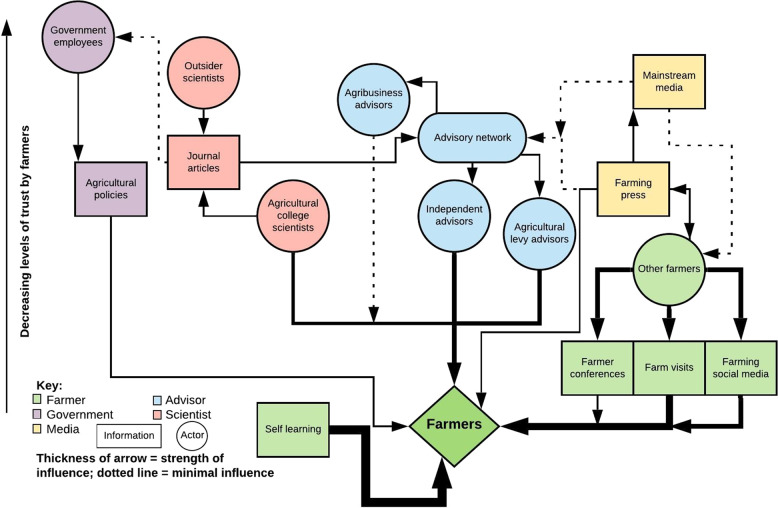
The exponential rise of information available means we can now, in theory, access knowledge on almost any question we ask. However, as the amount of unverified information increases, so too does the challenge in deciding which information to trust. Farmers, when learning about agricultural innovations, have historically relied on in-person advice from traditional 'experts', such as agricultural advisers, to inform farm management. As more farmers go online for information, it is not clear whether they are now using digital information to corroborate in-person advice from traditional 'experts', or if they are foregoing 'expert' advice in preference for peer-generated information. To fill this knowledge gap, we sought to understand how farmers in two contrasting European countries (Hungary and the UK) learnt about sustainable soil innovations and who influenced them to innovate. Through interviews with 82 respondents, we found farmers in both countries regularly used online sources to access soil information; some were prompted to change their soil management by farmer social media 'influencers'. However, online information and interactions were not usually the main factor influencing farmers to change their practices. Farmers placed most trust in other farmers to learn about new soil practices and were less trusting of traditional 'experts', particularly agricultural researchers from academic and government institutions, who they believed were not empathetic towards farmers' needs. We suggest that some farmers may indeed have had enough of traditional 'experts', instead relying more on their own peer networks to learn and innovate. We discuss ways to improve trustworthy knowledge exchange between agricultural stakeholders to increase uptake of sustainable soil management practices, while acknowledging the value of peer influence and online interactions for innovation and trust building.
信息呈指数级增长,意味着我们现在理论上可以获取几乎任何我们提出的问题的知识。然而,随着未经证实的信息的增加,决定信任哪些信息的挑战也越来越大。农民在了解农业创新时,历来依赖传统的“专家”(如农业顾问)的面对面建议来指导农场管理。随着越来越多的农民上网获取信息,目前尚不清楚他们现在是否在利用数字信息来证实传统“专家”的当面建议,还是他们更愿意选择同行生成的信息而不听取“专家”的建议。为了填补这一知识空白,我们试图了解在两个具有鲜明对比的欧洲国家(匈牙利和英国),农民是如何了解可持续土壤创新以及谁影响他们进行创新的。通过对 82 名受访者的采访,我们发现两国的农民都经常使用在线资源获取土壤信息;一些农民受到农民社交媒体“影响者”的启发,改变了他们的土壤管理方式。然而,在线信息和互动通常不是影响农民改变其做法的主要因素。农民最信任其他农民来了解新的土壤做法,对传统的“专家”(尤其是来自学术和政府机构的农业研究人员)的信任度较低,他们认为这些专家不理解农民的需求。我们认为,一些农民可能确实已经受够了传统的“专家”,而是更多地依赖自己的同行网络来学习和创新。我们讨论了如何改善农业利益相关者之间值得信赖的知识交流,以提高可持续土壤管理实践的采用率,同时承认同行影响和在线互动在创新和信任建立方面的价值。