Institute of Urban and Industrial Water Management, Technische Universität Dresden, 01062 Dresden, Germany.
SCNU Environmental Research Institute, Guangdong Provincial Key Laboratory of Chemical Pollution and Environmental Safety & MOE Key Laboratory of Theoretical Chemistry of Environment, South China Normal University, China; School of Environment, South China Normal University, University Town, Guangzhou, China.
Sci Total Environ. 2022 Feb 1;806(Pt 4):150888. doi: 10.1016/j.scitotenv.2021.150888. Epub 2021 Oct 9.
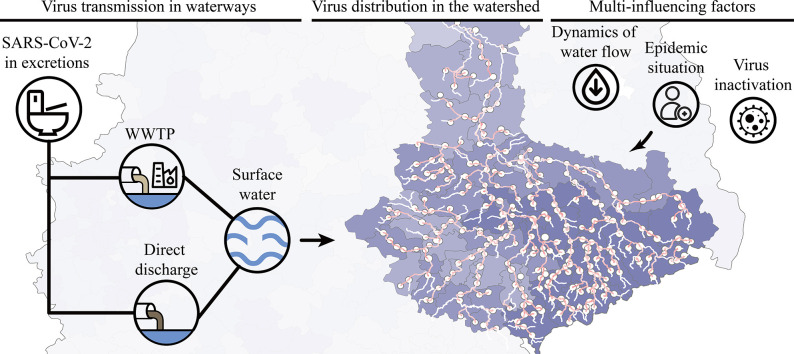
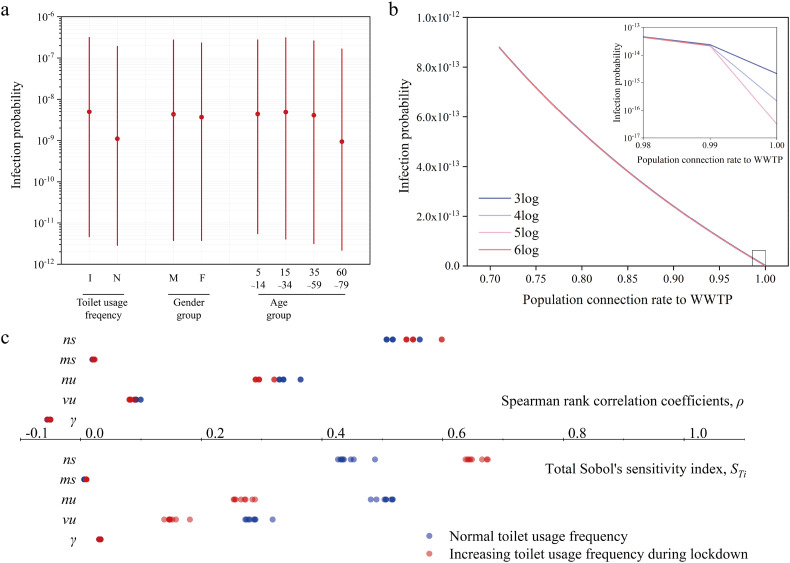
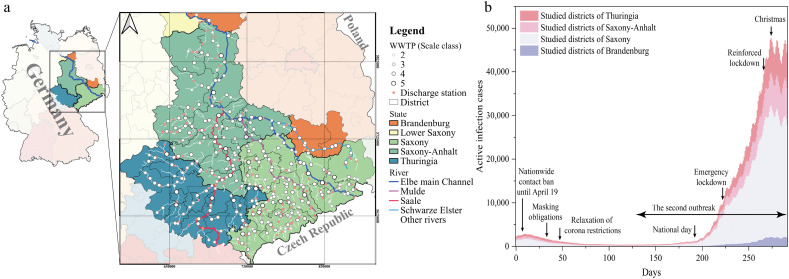
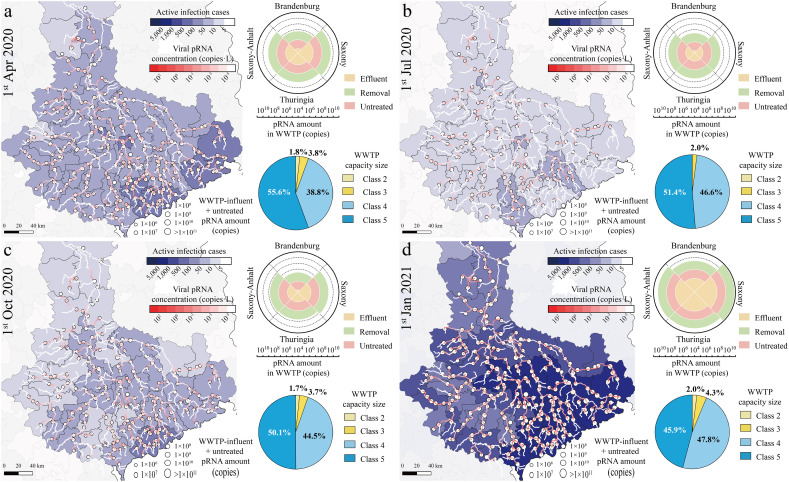
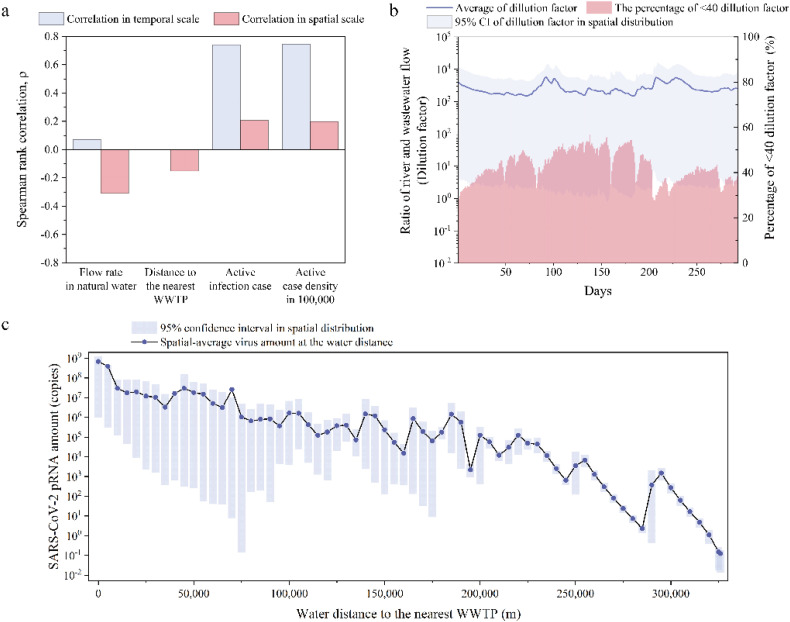
The outbreak of COVID-19, caused by severe acute respiratory syndrome coronavirus 2 (SARS-CoV-2), has already become an unprecedented global pandemic. However, the transmission of SARS-CoV-2, especially the protected SARS-CoV-2 RNA (pRNA) with infectious particles in waterways, is still largely unexplored. In this study, we developed a model to estimate SARS-CoV-2 transmission from the risk source in the excretion of patients to the final exposure in surface water. The model simulated the spatial and temporal distribution of the viral pRNA concentrations in the surface water of the Elbe watershed from March 2020 to January 2021. The results show that the WWTPs with the maximum capacity of >10,000 population equivalents were responsible for 95% of the viral load discharged into the surface water. We estimated the pRNA concentrations in surface water to be 1.33 × 10 copies·L on average in the watershed based on the model simulation on viral transmission. It had considerable variations in spatial and temporal scales, which are dominantly controlled by epidemic situations and virus transport with decay in water, respectively. A quantitative microbial risk assessment was conducted to estimate the viral infection probability from surface water ingestion with consideration of the influence of toilet usage frequency and gender/age population groups. All the infection probabilities in the study period were lower than the reference risk levels of 10 and 10. The individuals aged 15-34 years had the highest infection probability of 4.86 × 10 on average from surface water ingestion during swimming activities. The data provided herein suggest that the low pRNA concentrations and infection probability reflected that the waterways were unlikely to be a significant transmission route for SARS-CoV-2.
新型冠状病毒肺炎(COVID-19)由严重急性呼吸综合征冠状病毒 2(SARS-CoV-2)引起,已成为前所未有的全球大流行。然而,SARS-CoV-2 的传播,特别是带有传染性颗粒的病毒保护 RNA(pRNA)在水系中的传播,仍在很大程度上尚未得到探索。在本研究中,我们开发了一个模型来估计 SARS-CoV-2 从患者排泄物中的传染源到地表水中最终暴露的传播。该模型模拟了 2020 年 3 月至 2021 年 1 月期间易北河流域地表水病毒 pRNA 浓度的时空分布。结果表明,处理能力大于 10000 人口当量的 WWTPs 负责将 95%的病毒负荷排入地表水。根据病毒传播模型模拟,我们估计流域地表水的 pRNA 浓度平均为 1.33×10 拷贝·L。它在时空尺度上都有相当大的变化,主要分别受疫情和病毒在水中的传输及衰减控制。进行了定量微生物风险评估,以估计从地表水摄入中感染病毒的概率,同时考虑了厕所使用频率和性别/年龄人群的影响。在研究期间,所有感染概率均低于 10 和 10 的参考风险水平。在游泳活动期间,15-34 岁的个体从地表水摄入中感染的平均概率最高,为 4.86×10。本研究提供的数据表明,低浓度的 pRNA 和感染概率反映出水系不太可能成为 SARS-CoV-2 的重要传播途径。