Vita-Salute San Raffaele University, Milano, Italy; Psychiatry & Clinical Psychobiology, Division of Neuroscience, Scientific Institute IRCCS Ospedale San Raffaele, Milano.
Vita-Salute San Raffaele University, Milano, Italy; Mood Disorders Unit, Scientific Institute IRCCS Ospedale San Raffaele, Milano, Italy.
Eur Neuropsychopharmacol. 2022 Jan;54:1-6. doi: 10.1016/j.euroneuro.2021.09.009. Epub 2021 Oct 9.
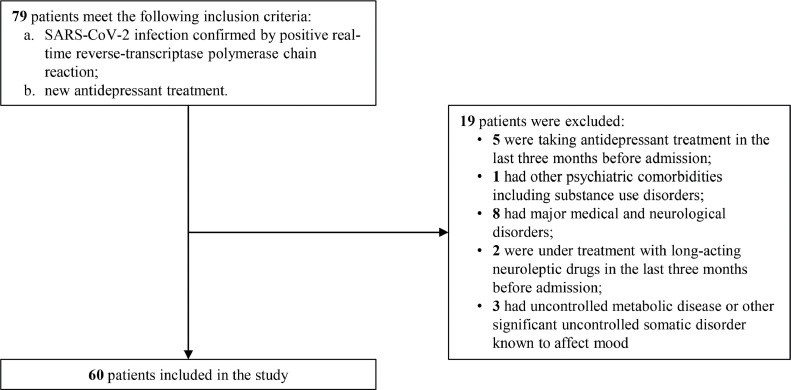
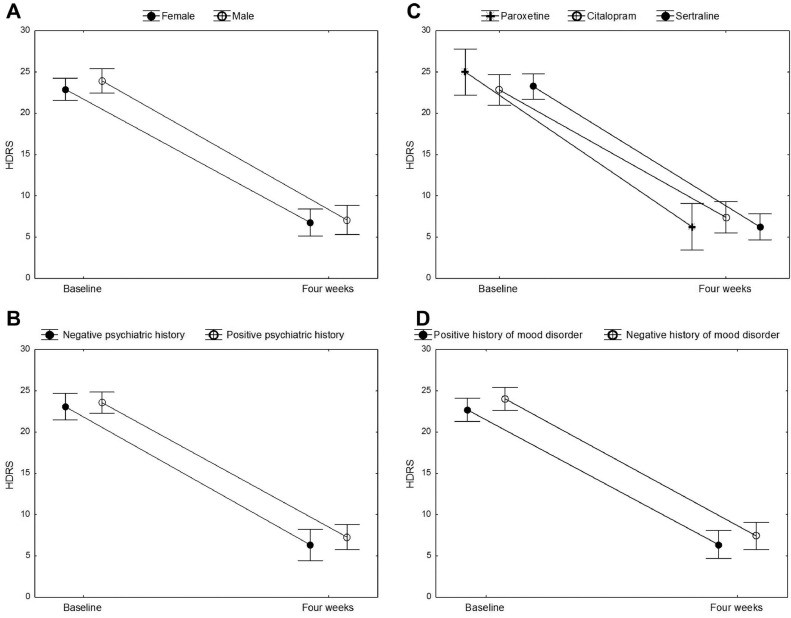
The spreading of the Severe Acute Respiratory Syndrome Coronavirus (COVID-19) pandemic could be associated with psychiatric implications. After COVID-19, depression was reported in 40% of patients at one-, three-, and six-months follow-up. Emerging literature suggests anti-inflammatory and antiviral properties of antidepressants in the treatment of SARS-CoV-2. We aim to investigate the efficacy of Selective Serotonin Reuptake Inhibitor (SSRI) in treating post-COVID depression. We included 60 patients affected by a major depressive episode and treated with SSRI in the six months following recovery from COVID. The severity of depression was rated at baseline and after four weeks on the Hamilton Depression Rating Scale (HDRS). Response to treatment was considered when the patients achieved a 50% HDRS reduction. To investigate changes of depressive symptomatology over time, repeated measures ANOVAs according to clinical variables were performed. We found that 55 (92%) patients showed a clinical response to antidepressant. Patients showed a significant decrease over time of HDRS score (baseline HDRS = 23.37 ± 3.94, post-treatment HDRS = 6.71±4.41, F = 618.90, p < 0.001), irrespectively of sex, previous psychiatric history, previous history of mood disorder, and SSRI type. This is the first study to explore the SSRI efficacy in post-COVID depression, suggesting rapid antidepressant effects in most patients. SSRIs treatment could contribute to the rapid antidepressant response by directly targeting the neuroinflammation triggered by SARS-CoV-2. We suggest screening psychopathology of COVID-19 survivors to diagnose emergent depression and pharmacologically treat it to reduce the disease burden and related years of life lived with disability.
严重急性呼吸系统综合症冠状病毒(COVID-19)大流行的传播可能与精神科影响有关。COVID-19 后,在 1、3 和 6 个月随访时,40%的患者报告有抑郁症状。新兴文献表明,抗抑郁药具有抗 SARS-CoV-2 的抗炎和抗病毒特性。我们旨在研究选择性 5-羟色胺再摄取抑制剂(SSRI)在治疗 COVID 后抑郁中的疗效。我们纳入了 60 名患有重性抑郁发作并在 COVID 康复后 6 个月内接受 SSRI 治疗的患者。在汉密尔顿抑郁评定量表(HDRS)上,在基线和 4 周后评估抑郁严重程度。当患者达到 HDRS 减少 50%时,认为治疗有反应。为了研究抑郁症状随时间的变化,根据临床变量进行了重复测量方差分析。我们发现,55 名(92%)患者对抗抑郁药有临床反应。患者的 HDRS 评分随时间显著下降(基线 HDRS=23.37±3.94,治疗后 HDRS=6.71±4.41,F=618.90,p<0.001),与性别、既往精神病史、既往心境障碍史和 SSRI 类型无关。这是第一项探索 COVID 后 SSRI 疗效的研究,表明大多数患者的抗抑郁作用迅速。SSRI 治疗可能通过直接靶向 SARS-CoV-2 引发的神经炎症来促进快速抗抑郁反应。我们建议对 COVID-19 幸存者进行精神病理学筛查,以诊断新发抑郁,并进行药物治疗,以降低疾病负担和相关残疾生活年数。