Department of Economics and Management, University of Florence, Florence, Italy.
Doctors with Africa CUAMM, Padova, Italy.
Int J Health Policy Manag. 2022 Sep 1;11(9):1894-1904. doi: 10.34172/ijhpm.2021.116. Epub 2021 Aug 29.
As countries health financing policies are expected to support progress towards universal health coverage (UHC), an analysis of these policies is particularly relevant in low- and middle-income countries (LMICs). In 2001, the government of Uganda abolished user-fees to improve accessibility to health services for the population. However, after almost 20 years, the incidence of catastrophic health expenditures is still very high, and the health financing system does not provide a pooled prepayment scheme at national level such as an integrated health insurance scheme. This article aims at analysing the Ugandan experience of health financing reforms with a specific focus on financial protection. Financial protection represents a key pillar of UHC and has been central to health systems reforms even before the launch of the UHC definition.
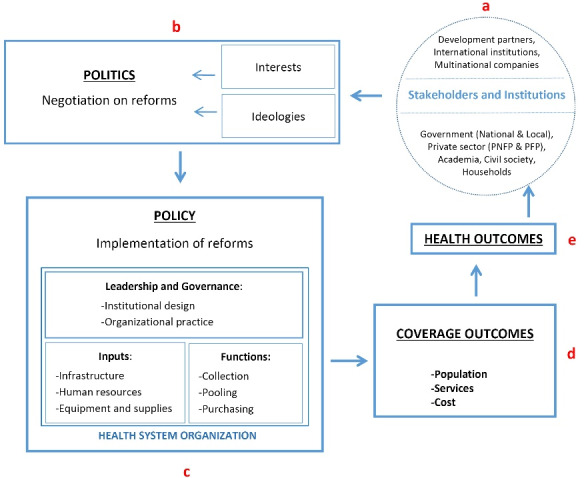
The qualitative study adopts a political economy perspective and it is based on a desk review of relevant documents and a multi-level stakeholder analysis based on 60 key informant interviews (KIIs) in the health sector.
We find that the current political situation is not yet conducive for implementing a UHC system with widespread financial protection: dominant interests and ideologies do not create a net incentive to implement a comprehensive scheme for this purpose. The health financing landscape remains extremely fragmented, and community-based initiatives to improve health coverage are not supported by a clear government stewardship.
By examining the negotiation process for health financing reforms through a political economy perspective, this article intends to advance the debate about politically-tenable strategies for achieving UHC and widespread financial protection for the population in LMICs.
随着各国卫生筹资政策有望支持实现全民健康覆盖(UHC)的目标,对这些政策进行分析在中低收入国家(LMICs)尤为重要。2001 年,乌干达政府取消了医疗服务的用户付费,以提高人民获得卫生服务的可及性。然而,近 20 年后,灾难性卫生支出的发生率仍然很高,卫生筹资系统在国家层面上没有提供一种集合预付款计划,如综合医疗保险计划。本文旨在分析乌干达的卫生筹资改革经验,特别关注财务保护。财务保护是 UHC 的一个关键支柱,甚至在 UHC 定义发布之前,它一直是卫生系统改革的核心。
这项定性研究采用政治经济学视角,基于对相关文件的桌面审查和基于 60 次卫生部门关键利益攸关方访谈(KIIs)的多层次利益相关者分析。
我们发现,当前的政治局势还不利于实施具有广泛财务保护的 UHC 系统:主导利益和意识形态没有为此目的实施全面计划创造净激励。卫生筹资格局仍然极其分散,社区为改善卫生覆盖范围而采取的举措没有得到明确的政府管理的支持。
本文通过政治经济学视角来审查卫生筹资改革的谈判过程,旨在推进关于在 LMICs 实现 UHC 和广泛的人口财务保护的可行政治策略的辩论。