Centre for Health Policy and Management, School of Medicine, Trinity College Dublin, Dublin, Ireland.
Med Decis Making. 2022 May;42(4):513-523. doi: 10.1177/0272989X211050918. Epub 2021 Oct 11.
There is increasing interest in risk-stratified approaches to cancer screening in cost-effectiveness analysis (CEA). Current CEA practice regarding risk stratification is heterogeneous and guidance on the best approach is lacking. This article suggests how stratification in CEA can be improved.
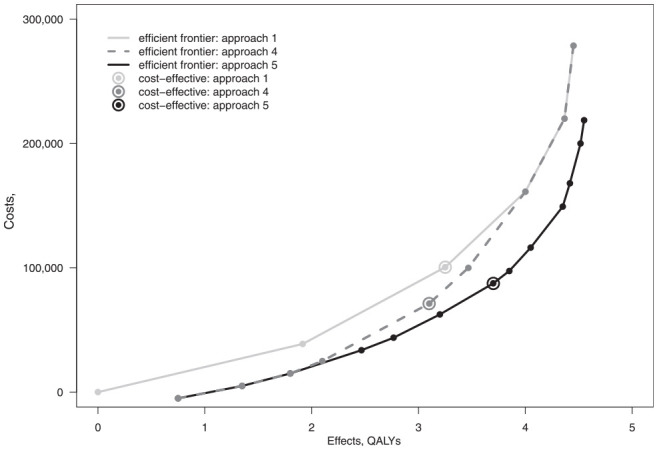
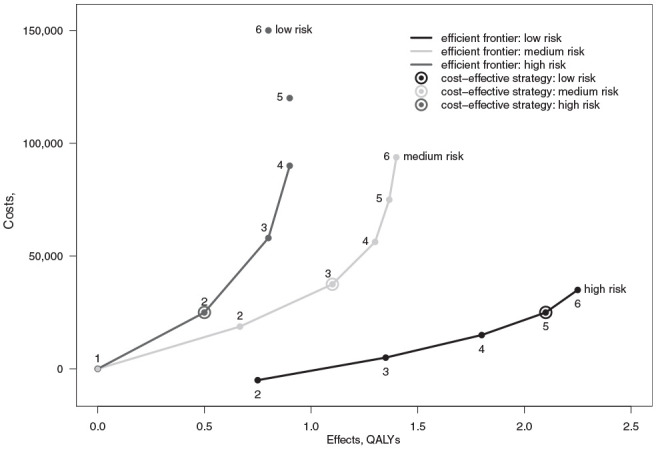
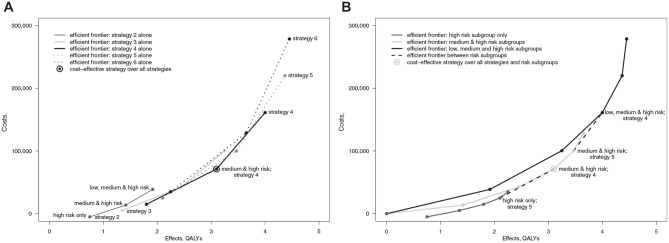
I use a simple example of a hypothetical screening intervention with 3 potential recipient risk strata. The screening intervention has 6 alternative intensities, each with different costs and effects, all of which vary between strata. I consider a series of alternative stratification approaches, demonstrating the consequences for estimated costs, effects, and the choice of optimal strategy. I supplement this analysis with applied examples from the literature.
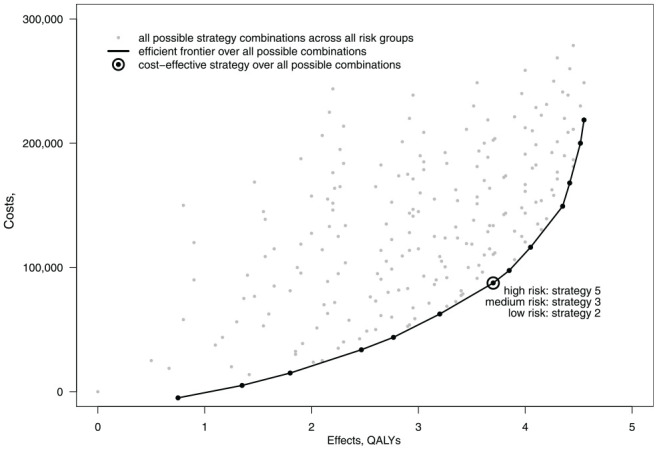
Adopting the same screening policy for all strata yields the least efficient strategies, where efficiency is understood as the volume of net health benefit generated across a range of cost-effectiveness threshold values. Basic stratification that withholds screening from lower-risk strata while adopting a common strategy for those screened increases efficiency. Greatest efficiency is achieved when different strata receive separate strategies. While complete optimization can be achieved within a single analysis by considering all possible policy combinations, the resulting number of strategy combinations may be inconveniently large. Optimization with separate strata-specific analyses is simpler and more transparent. Despite this, there can be good reasons to simulate all strata together in a single analysis.
If the benefits of risk stratification are to be fully realized, policy makers need to consider the extent to which stratification is feasible, and modelers need to simulate those choices adequately. It is hoped this analysis will clarify those policy and modeling choices and therefore lead to improved population health outcomes.
在成本效益分析(CEA)中,人们对癌症筛查的风险分层方法越来越感兴趣。目前关于风险分层的 CEA 实践存在异质性,缺乏最佳方法的指导。本文提出了如何改进 CEA 中的分层方法。
我使用一个带有 3 个潜在受检者风险层的假设性筛查干预的简单示例。该筛查干预有 6 种不同的强度,每种强度的成本和效果都不同,而且在不同的层之间都有所不同。我考虑了一系列替代分层方法,展示了对估计成本、效果和最优策略选择的影响。我还从文献中提供了应用实例来补充分析。
对所有层采用相同的筛查策略会产生效率最低的策略,其中效率被理解为在一系列成本效益阈值下产生的净健康效益量。对低风险层不进行筛查而对接受筛查的人群采用共同策略的基本分层可以提高效率。当不同的层接受单独的策略时,可以实现最大的效率。虽然通过考虑所有可能的政策组合,在单个分析中可以实现完全优化,但由此产生的策略组合数量可能不方便太大。采用单独的、针对特定层的分析进行优化更简单、更透明。尽管如此,还是有充分的理由在单个分析中一起模拟所有层。
如果要充分实现风险分层的好处,决策者需要考虑分层的可行性程度,建模者需要充分模拟这些选择。希望本文的分析能够澄清这些政策和建模选择,从而改善人口健康结果。