Department of Dietetics, University Medical Center Utrecht, Utrecht University, Utrecht, The Netherlands.
Division of Human Nutrition, Wageningen University, Wageningen, The Netherlands.
Eur J Cancer Care (Engl). 2022 Jan;31(1):e13518. doi: 10.1111/ecc.13518. Epub 2021 Oct 12.
To assess variations in nutritional interventions during chemoradiotherapy (CRT) among the Dutch Head and Neck Oncology centres (HNOCs).
An online questionnaire about nutritional interventions and dietetic practices was sent to 14 oncology dietitians of the HNOCs.
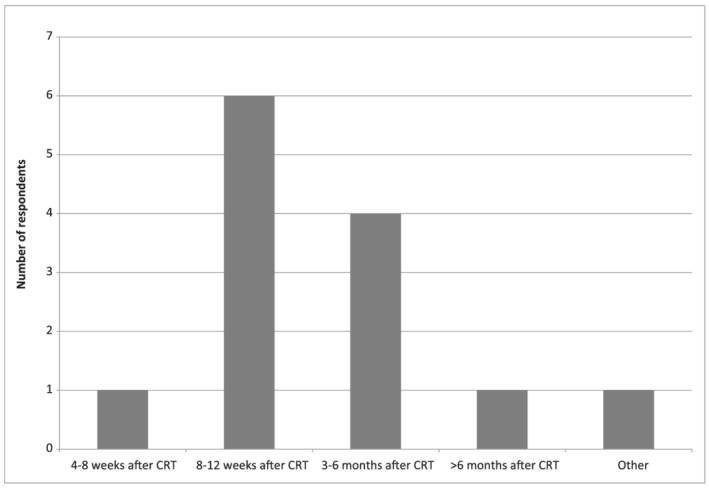
The response rate was 93%. The number of scheduled dietetic consultations varied from two to seven during CRT. Most centres (77%) reported using a gastrostomy for tube feeding in the majority of patients. Gastrostomies were placed prophylactically upon indication (39%) or in all patients (15%), reactive (15%), or both (31%). For calculating energy requirements, 54% of the dietitians used the Food and Agriculture Organization/World Health Organization and United Nations University (FAO/WHO/UNU) formula and 77% uses 1.2-1.5 g/kg body weight for calculating protein requirements. Almost half of the centres (46%) reported to remove the gastrostomy between 8 and 12 weeks after CR. Most centres (92%) reported to end dietary treatment within 6 months after CRT.
This study shows substantial variation in dietetic practice, especially in the use of a gastrostomy for tube feeding, between the HNOCs. There is a need for concise dietetic guidelines.
评估荷兰头颈部肿瘤治疗中心(HNOC)在放化疗(CRT)期间营养干预措施的差异。
向 14 名 HNOC 的肿瘤营养师在线发送了一份关于营养干预措施和饮食实践的问卷。
应答率为 93%。在 CRT 期间,安排的饮食咨询次数从两次到七次不等。大多数中心(77%)报告在大多数患者中使用胃造口术进行管饲。胃造口术预防性放置(39%)或全部患者(15%)、反应性(15%)或两者兼而有之(31%)。在计算能量需求方面,54%的营养师使用了粮农组织/世界卫生组织和联合国大学(FAO/WHO/UNU)公式,77%的营养师使用 1.2-1.5 g/kg 体重来计算蛋白质需求。近一半的中心(46%)报告在 CRT 后 8 至 12 周之间取出胃造口管。大多数中心(92%)报告在 CRT 后 6 个月内结束饮食治疗。
本研究表明,HNOC 之间的饮食实践存在很大差异,尤其是在使用胃造口术进行管饲方面。需要制定简明的饮食指南。