Theivanthiran Balamayooran, Haykal Tarek, Cao Linda, Holtzhausen Alisha, Plebanek Michael, DeVito Nicholas C, Hanks Brent A
Department of Medicine, Division of Medical Oncology, Duke University, Durham, NC 27708, USA.
Lineburger Comprehensive Cancer Center, University of North Carolina at Chapel Hill, Chapel Hill, NC 27599, USA.
Cancers (Basel). 2021 Sep 23;13(19):4753. doi: 10.3390/cancers13194753.
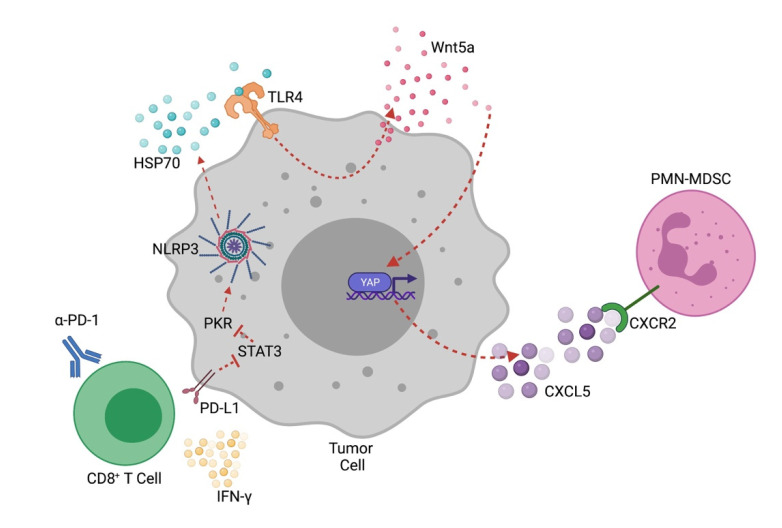
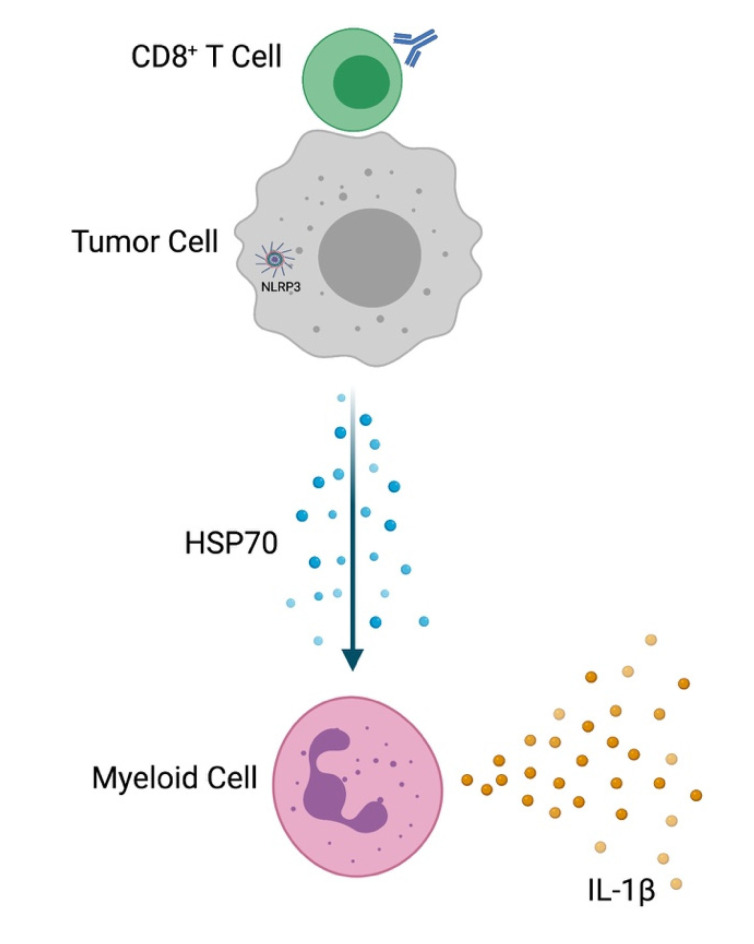
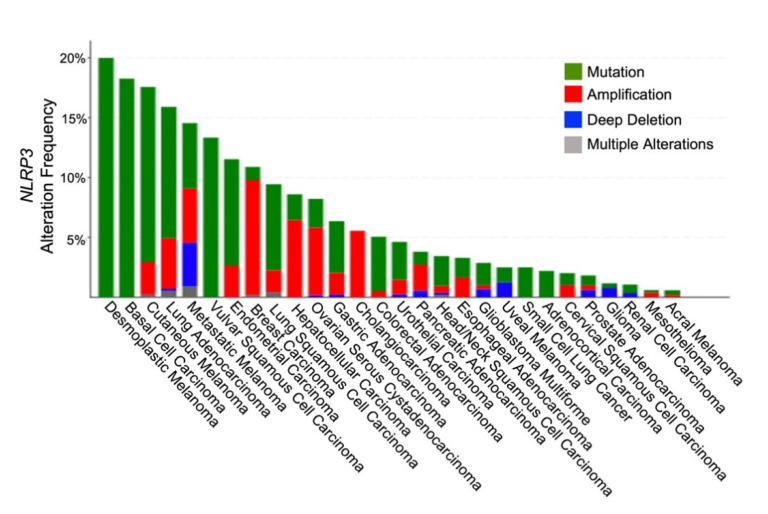
The tumor-intrinsic NOD-like receptor family, pyrin-domain-containing-3 (NLRP3) inflammasome, plays an important role in regulating immunosuppressive myeloid cell populations in the tumor microenvironment (TME). While prior studies have described the activation of this inflammasome in driving pro-tumorigenic mechanisms, emerging data is now revealing the tumor NLRP3 inflammasome and the downstream release of heat shock protein-70 (HSP70) to regulate anti-tumor immunity and contribute to the development of adaptive resistance to anti-PD-1 immunotherapy. Genetic alterations that influence the activity of the NLRP3 signaling axis are likely to impact T cell-mediated tumor cell killing and may indicate which tumors rely on this pathway for immune escape. These studies suggest that the NLRP3 inflammasome and its secreted product, HSP70, represent promising pharmacologic targets for manipulating innate immune cell populations in the TME while enhancing responses to anti-PD-1 immunotherapy. Additional studies are needed to better understand tumor-specific regulatory mechanisms of NLRP3 to enable the development of tumor-selective pharmacologic strategies capable of augmenting responses to checkpoint inhibitor immunotherapy while minimizing unwanted off-target effects. The execution of upcoming clinical trials investigating this strategy to overcome anti-PD-1 resistance promises to provide novel insight into the role of this pathway in immuno-oncology.
肿瘤内在的含吡喃结构域的NOD样受体家族成员3(NLRP3)炎性小体在调节肿瘤微环境(TME)中的免疫抑制性髓系细胞群体方面发挥着重要作用。虽然先前的研究描述了这种炎性小体在驱动促肿瘤机制中的激活情况,但新出现的数据现在揭示了肿瘤NLRP3炎性小体以及热休克蛋白70(HSP70)的下游释放,以调节抗肿瘤免疫并促进对抗程序性死亡蛋白1(PD-1)免疫疗法的适应性耐药的发展。影响NLRP3信号轴活性的基因改变可能会影响T细胞介导的肿瘤细胞杀伤,并可能表明哪些肿瘤依赖于该途径进行免疫逃逸。这些研究表明,NLRP3炎性小体及其分泌产物HSP70是在TME中操纵先天性免疫细胞群体,同时增强对抗PD-1免疫疗法反应的有前景的药理学靶点。需要进一步的研究来更好地理解NLRP3的肿瘤特异性调节机制,以开发能够增强对检查点抑制剂免疫疗法反应,同时将不必要的脱靶效应降至最低的肿瘤选择性药理学策略。即将开展的调查该策略以克服抗PD-1耐药性的临床试验的实施有望为该途径在免疫肿瘤学中的作用提供新的见解。