Laboratory of Genetics, Wageningen University and Research, 6700 HB Wageningen, The Netherlands.
Laboratory of Food Microbiology, Wageningen University and Research, 6700 HB Wageningen, The Netherlands.
Int J Environ Res Public Health. 2021 Sep 26;18(19):10093. doi: 10.3390/ijerph181910093.
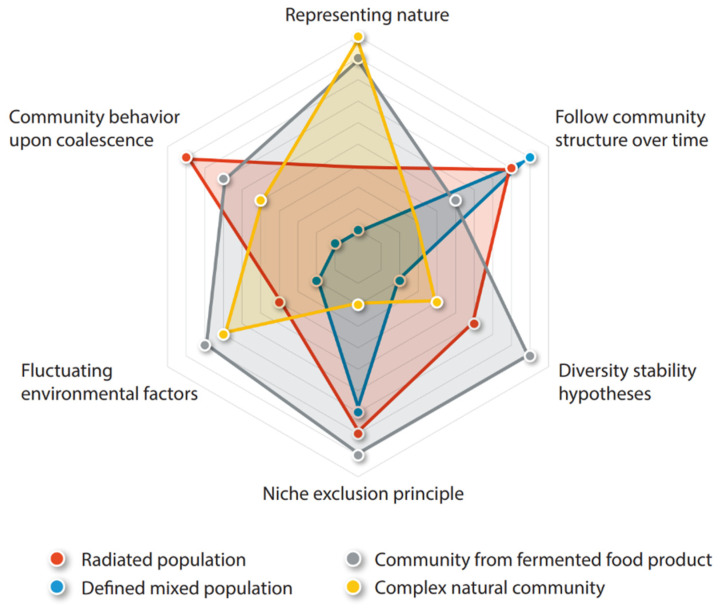
Eco-evolutionary forces are the key drivers of ecosystem biodiversity dynamics. This resulted in a large body of theory, which has partially been experimentally tested by mimicking evolutionary processes in the laboratory. In the first part of this perspective, we outline what model systems are used for experimental testing of eco-evolutionary processes, ranging from simple microbial combinations and, more recently, to complex natural communities. Microbial communities of spontaneous fermented foods are a promising model system to study eco-evolutionary dynamics. They combine the complexity of a natural community with extensive knowledge about community members and the ease of manipulating the system in a laboratory setup. Due to rapidly developing sequencing techniques and meta-omics approaches incorporating data in building ecosystem models, the diversity in these communities can be analysed with relative ease while hypotheses developed in simple systems can be tested. Here, we highlight several eco-evolutionary questions that are addressed using microbial communities from fermented foods. These questions relate to analysing species frequencies in space and time, the diversity-stability relationship, niche space and community coalescence. We provide several hypotheses of the influence of these factors on community evolution specifying the experimental setup of studies where microbial communities of spontaneous fermented food are used.
生态进化力量是生态系统生物多样性动态的关键驱动因素。这导致了大量的理论,其中部分已经通过在实验室中模拟进化过程进行了实验验证。在本观点的第一部分,我们概述了用于实验测试生态进化过程的模型系统,范围从简单的微生物组合到最近的复杂自然群落。自发发酵食品的微生物群落是研究生态进化动态的有前途的模型系统。它们将自然群落的复杂性与对群落成员的广泛了解以及在实验室环境中轻松操纵系统的能力结合在一起。由于快速发展的测序技术和包含生态系统模型构建数据的宏基因组学方法,这些群落的多样性可以相对容易地进行分析,同时可以在简单系统中开发的假设进行测试。在这里,我们强调了使用发酵食品中的微生物群落来解决的几个生态进化问题。这些问题涉及分析物种在空间和时间上的频率、多样性-稳定性关系、生态位空间和群落聚合。我们提供了这些因素对群落进化影响的几个假设,指定了使用自发发酵食品微生物群落的研究的实验设置。