Yang Qiuwei, Peng Xi
School of Civil and Transportation Engineering, Ningbo University of Technology, Ningbo 315211, China.
Engineering Research Center of Industrial Construction in Civil Engineering of Zhejiang, Ningbo University of Technology, Ningbo 315211, China.
Materials (Basel). 2021 Sep 23;14(19):5514. doi: 10.3390/ma14195514.
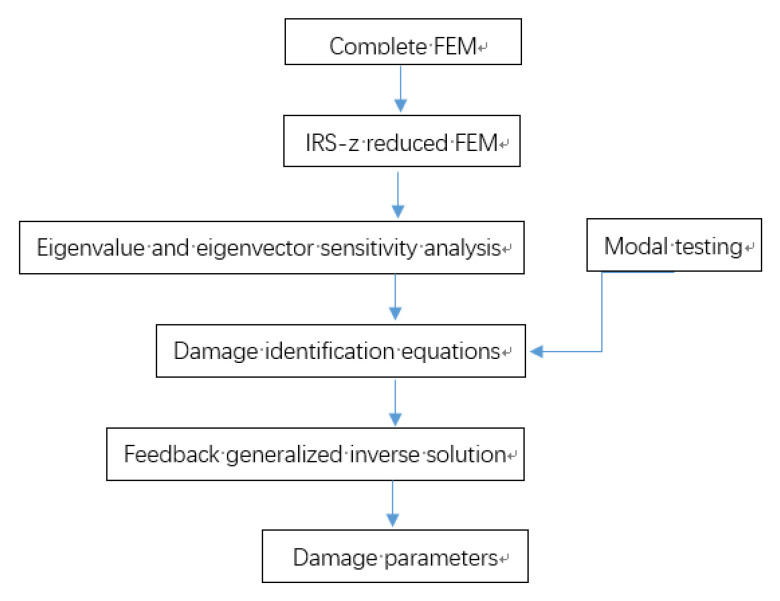
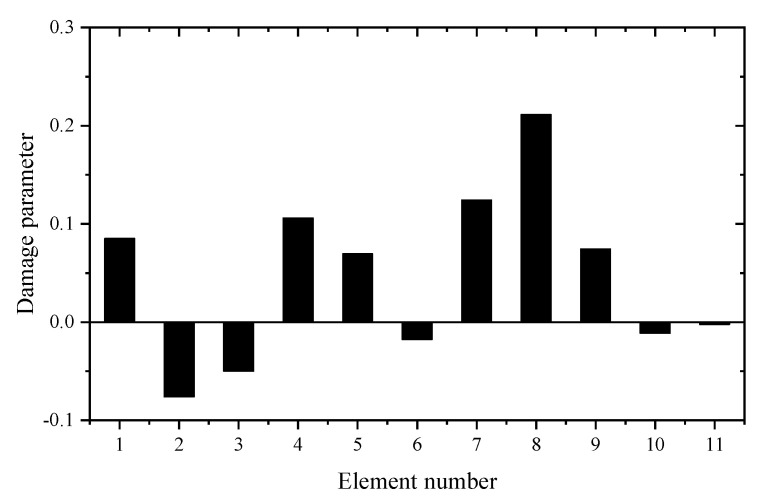
Sensitivity analysis is widely used in engineering fields, such as structural damage identification, model correction, and vibration control. In general, the existing sensitivity calculation formulas are derived from the complete finite element model, which requires a large amount of calculation for large-scale structures. In view of this, a fast sensitivity analysis algorithm based on the reduced finite element model is proposed in this paper. The basic idea of the proposed sensitivity analysis algorithm is to use a model reduction technique to avoid the complex calculation required in solving eigenvalues and eigenvectors by the complete model. Compared with the existing sensitivity calculation formulas, the proposed approach may increase efficiency, with a small loss of accuracy of sensitivity analysis. Using the fast sensitivity analysis, the linear equations for structural damage identification can be established to solve the desired elemental damage parameters. Moreover, a feedback-generalized inverse algorithm is proposed in this work in order to improve the calculation accuracy of damage identification. The core principle of this feedback operation is to reduce the number of unknowns, step by step, according to the generalized inverse solution. Numerical and experimental examples show that the fast sensitivity analysis based on the reduced model can obtain almost the same results as those obtained by the complete model for low eigenvalues and eigenvectors. The feedback-generalized inverse algorithm can effectively overcome the ill-posed problem of the linear equations and obtain accurate results of damage identification under data noise interference. The proposed method may be a very promising tool for sensitivity analysis and damage identification based on the reduced finite element model.
灵敏度分析在工程领域中广泛应用,如结构损伤识别、模型修正和振动控制。一般来说,现有的灵敏度计算公式是从完整有限元模型推导而来的,对于大型结构需要大量计算。鉴于此,本文提出了一种基于缩减有限元模型的快速灵敏度分析算法。所提出的灵敏度分析算法的基本思想是使用模型缩减技术来避免完整模型求解特征值和特征向量时所需的复杂计算。与现有的灵敏度计算公式相比,该方法可以提高效率,且灵敏度分析精度有小幅度损失。利用快速灵敏度分析,可以建立用于结构损伤识别的线性方程组来求解所需的单元损伤参数。此外,本文还提出了一种反馈广义逆算法以提高损伤识别的计算精度。这种反馈操作的核心原理是根据广义逆解逐步减少未知数的数量。数值和实验例子表明,基于缩减模型的快速灵敏度分析对于低阶特征值和特征向量能够获得与完整模型几乎相同的结果。反馈广义逆算法能够有效克服线性方程组的不适定问题,并在数据噪声干扰下获得准确的损伤识别结果。所提出的方法可能是基于缩减有限元模型进行灵敏度分析和损伤识别的一种非常有前景的工具。