Hu Bo, Li Yunzhe, Yin Lairong
Hunan Provincial Key Laboratory of Intelligent Manufacturing Technology for High-Performance Mechanical Equipment, Changsha University of Science and Technology, Changsha 410114, China.
State Key Laboratory of Advanced Design and Manufacturing for Vehicle Body, Hunan University, Changsha 410082, China.
Sensors (Basel). 2021 Sep 22;21(19):6328. doi: 10.3390/s21196328.
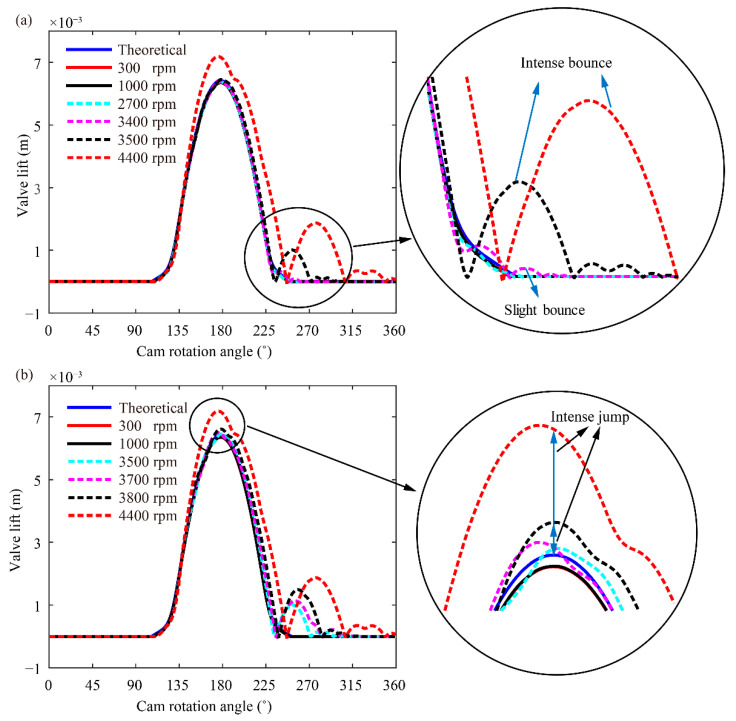
The valve train is one of the main sources of engine vibration, and its dynamic performance is crucial for output power and fuel consumption. The flexibilities of slender bars and beams should be emphasised in the design of valve trains to develop high-power and high-speed engines with industrial applications. A flexible dynamic model of a valve train system is proposed. In the proposed model, the components, except the cam and gear bodies, are modelled as flexible bodies with multidirectional deformations. The gyroscopic effects of the camshaft, cams and gear discs are also considered to predict dynamic responses at high speeds accurately. Gear meshing, the friction of the cam-tappet pair, the centrifugal force of the cams and valve clearance are also considered. Experiments on housing vibration and pushrod stress are conducted to validate the proposed model. Results show that the proposed model can predict the dynamic stress of the flexible components well and predict the trend shown by the housing vibration. The proposed model shows that excessive cam rotation speed and valve clearance will cause intense bounce and jump phenomena. The proposed model can be an important reference for designing engine work speed, adjusting valve clearance and improving component durability.
气门机构是发动机振动的主要来源之一,其动态性能对于输出功率和燃油消耗至关重要。在气门机构设计中应重视细长杆和梁的柔性,以开发适用于工业应用的高功率、高速发动机。提出了一种气门机构系统的柔性动力学模型。在所提出的模型中,除凸轮和齿轮体外,其他部件均被建模为具有多向变形的柔性体。还考虑了凸轮轴、凸轮和齿轮盘的陀螺效应,以准确预测高速下的动态响应。同时考虑了齿轮啮合、凸轮 - 挺柱副的摩擦、凸轮的离心力和气门间隙。进行了壳体振动和推杆应力实验以验证所提出的模型。结果表明,所提出的模型能够很好地预测柔性部件的动态应力,并预测壳体振动所呈现的趋势。所提出的模型表明,凸轮转速过高和气门间隙过大将导致强烈的弹跳和跳动现象。所提出的模型可为设计发动机工作转速、调整气门间隙和提高部件耐久性提供重要参考。