Department of Interventional Neuroradiology, Beijing Neurosurgical Institute and Beijing Tiantan Hospital, Capital Medical University, Beijing, China.
State Key Laboratory of Brain and Cognitive Science, Institute of Biophysics, Chinese Academy of Sciences, 15 Datun Road, Beijing, 100101, China.
Eur Radiol. 2022 Apr;32(4):2384-2392. doi: 10.1007/s00330-021-08331-9. Epub 2021 Oct 13.
To compare the visibility of intracranial aneurysm wall and thickness quantification between 7 and 3 T vessel wall imaging and evaluate the association between aneurysm size and wall thickness.
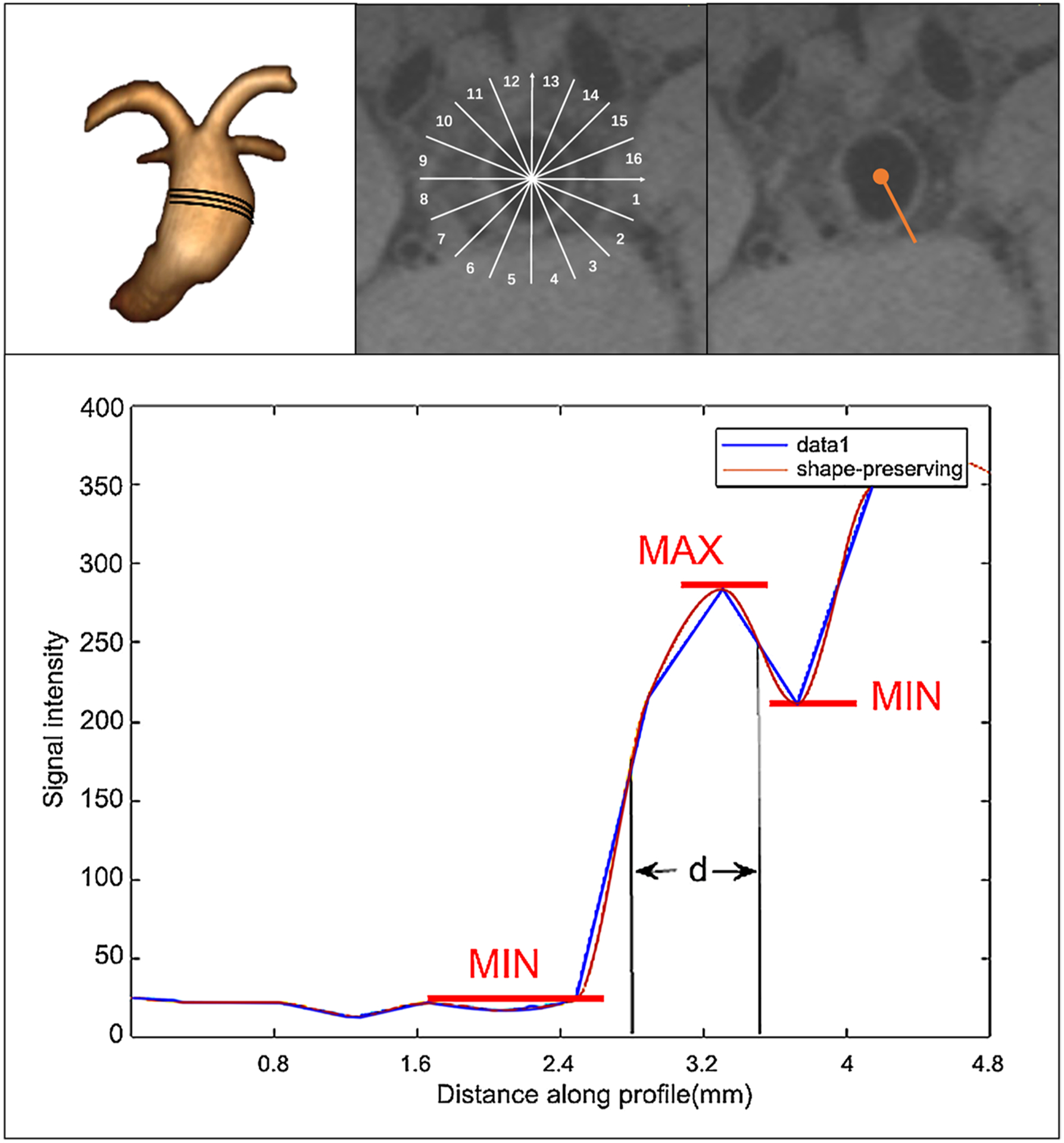
Twenty-nine patients with 29 unruptured intracranial aneurysms were prospectively recruited for 3D T1-weighted vessel wall MRI at both 3 T and 7 T with 0.53 mm (3 T) and 0.4 mm (7 T) isotropic resolution, respectively. Two neuroradiologists independently evaluated wall visibility (0-5 Likert scale), quantified the apparent wall thickness (AWT) using a semi-automated full-width-half-maximum method, calculated wall sharpness, and measured the wall-to-lumen contrast ratio (CR).
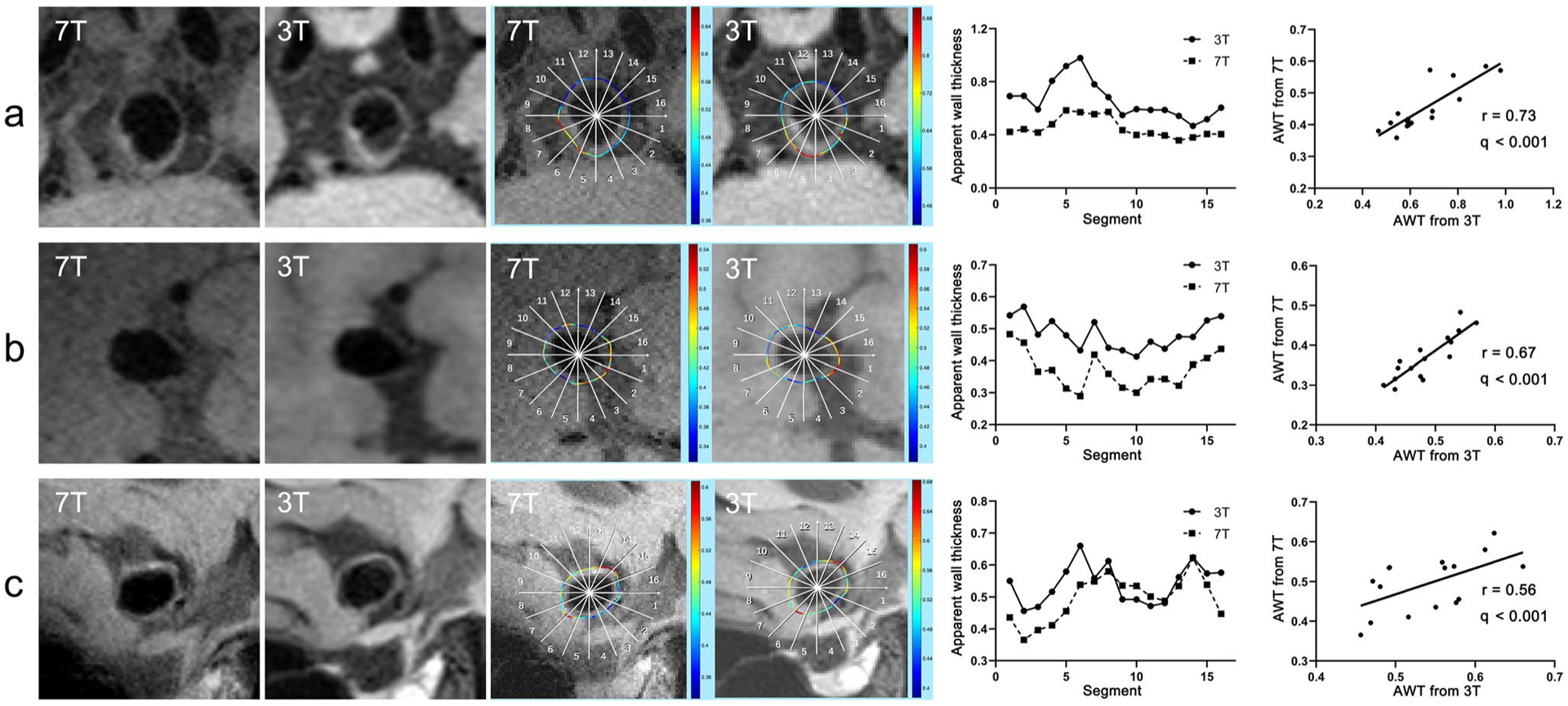
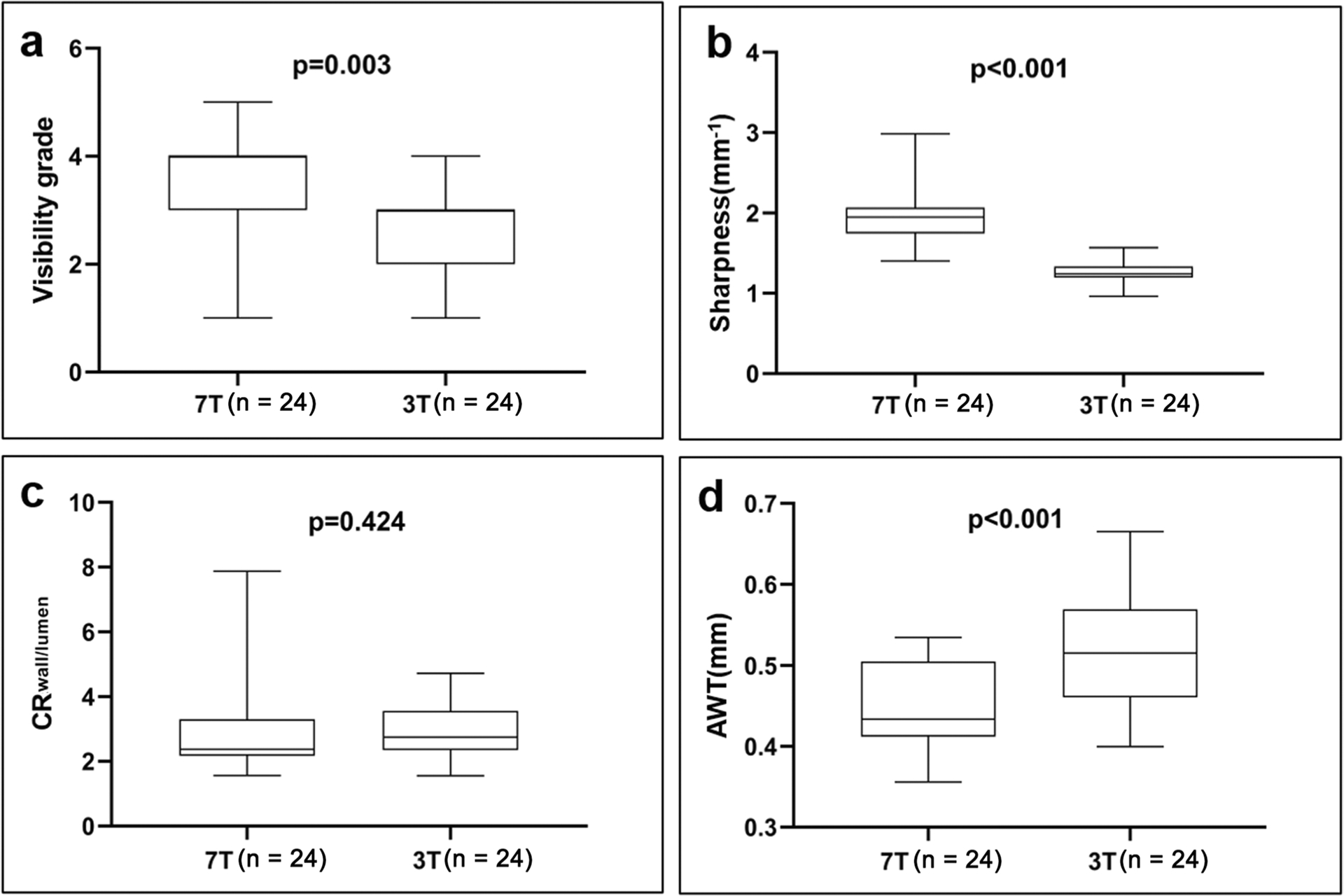
Twenty-four patients with 24 aneurysms were included in this study. 7 T achieved significantly better aneurysm wall visibility than 3 T (3.6 ± 1.1 vs 2.7 ± 0.8, p = 0.003). AWT measured on 3 T and 7 T had a good correlation (averaged r = 0.63 ± 0.19). However, AWT on 3 T was 15% thicker than that on 7 T (0.52 ± 0.07 mm vs 0.45 ± 0.05 mm, p < 0.001). Wall sharpness on 7 T was 57% higher than that on 3 T (1.95 ± 0.32 mm vs 1.24 ± 0.15 mm, p < 0.001). CR on 3 T and 7 T was comparable (p = 0.424). AWT on 7 T was positively correlated with aneurysm size (saccular: r = 0.58, q = 0.046; fusiform: r = 0.67, q = 0.049).
7 T provides better visualization of intracranial aneurysm wall with higher sharpness than 3 T. 3 T overestimates the wall thickness relative to 7 T. Aneurysm wall thickness is positively correlated with aneurysm size. 7 T MRI is a promising tool to evaluate aneurysm wall in vivo.
• 7 T provides better visualization of intracranial aneurysm wall with higher sharpness than 3 T. • 3 T overestimates the wall thickness comparing with 7 T. • Aneurysm wall thickness is positively correlated with aneurysm size.
比较 7T 和 3T 血管壁成像颅内动脉瘤壁的可视性和厚度定量,并评估动脉瘤大小与壁厚度之间的关系。
前瞻性招募 29 例 29 个未破裂颅内动脉瘤患者,分别在 3T 和 7T 进行 3D T1 加权血管壁 MRI 检查,空间分辨率分别为 0.53mm(3T)和 0.4mm(7T)。两位神经放射科医生独立评估壁的可视性(0-5 级 Likert 量表),使用半自动全宽半高法定量测量表观壁厚度(AWT),计算壁锐度,并测量壁-腔对比度比(CR)。
本研究共纳入 24 例患者的 24 个动脉瘤。7T 比 3T 显著提高了动脉瘤壁的可视性(3.6±1.1 比 2.7±0.8,p=0.003)。3T 和 7T 测量的 AWT 具有良好的相关性(平均 r=0.63±0.19)。然而,3T 上的 AWT 比 7T 厚 15%(0.52±0.07mm 比 0.45±0.05mm,p<0.001)。7T 上的壁锐度比 3T 高 57%(1.95±0.32mm 比 1.24±0.15mm,p<0.001)。3T 和 7T 的 CR 无差异(p=0.424)。7T 上的 AWT 与动脉瘤大小呈正相关(囊状:r=0.58,q=0.046;梭形:r=0.67,q=0.049)。
7T 提供了比 3T 更好的颅内动脉瘤壁可视化效果,壁锐度更高。3T 相对于 7T 高估了壁厚度。动脉瘤壁厚度与动脉瘤大小呈正相关。7T MRI 是一种很有前途的活体评估动脉瘤壁的工具。