Department of Neurology, Translational Medicine Center, Huaihe Hospital Affiliated to Henan University, Kaifeng 475000, Henan, China.
Department of Pathophysiology, Key Laboratory of Neurological Disease of National Education Ministry and Hubei Province, Institute for Brain Research, School of Basic Medicine, Tongji Medical College, Huazhong University of Science and Technology, Wuhan 430030, Hubei, China.
Aging (Albany NY). 2021 Oct 13;13(20):23620-23636. doi: 10.18632/aging.203634.
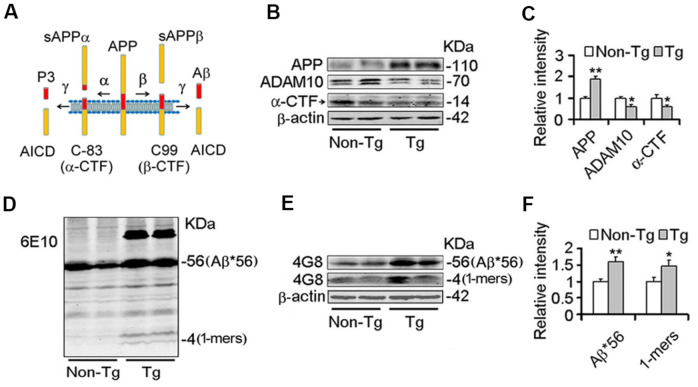
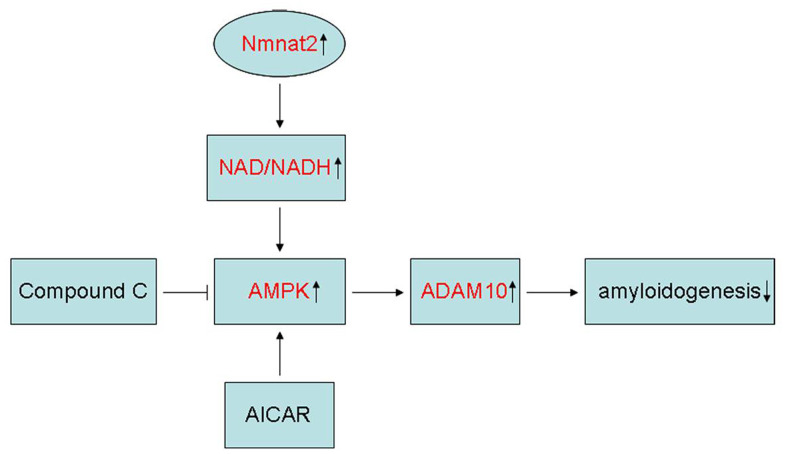
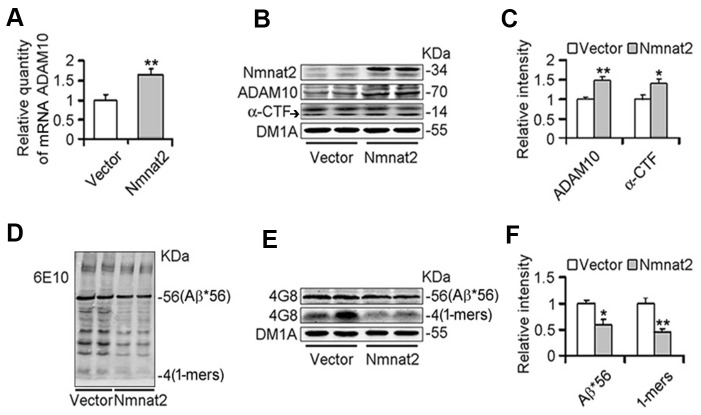
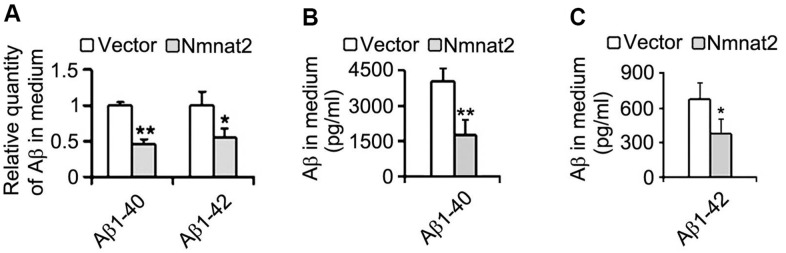
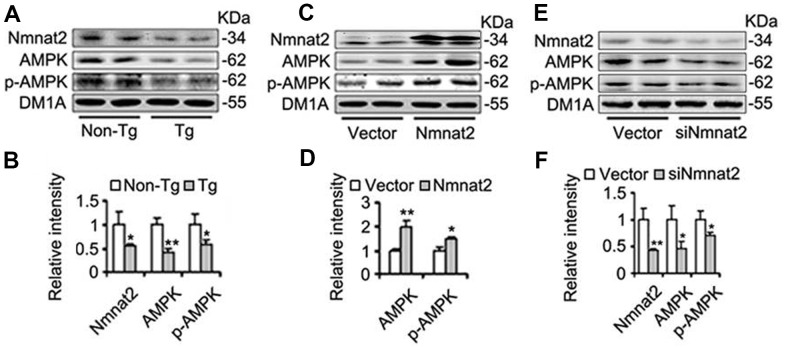
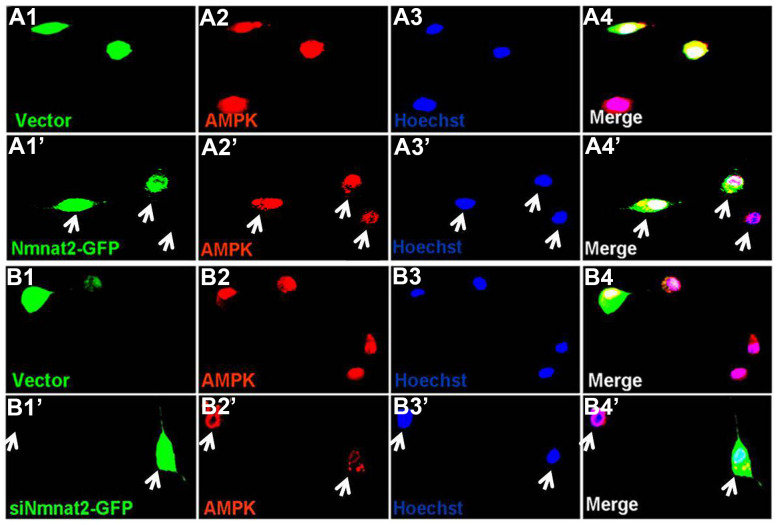
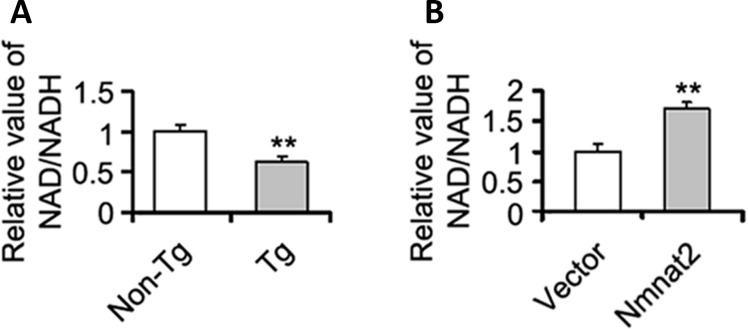
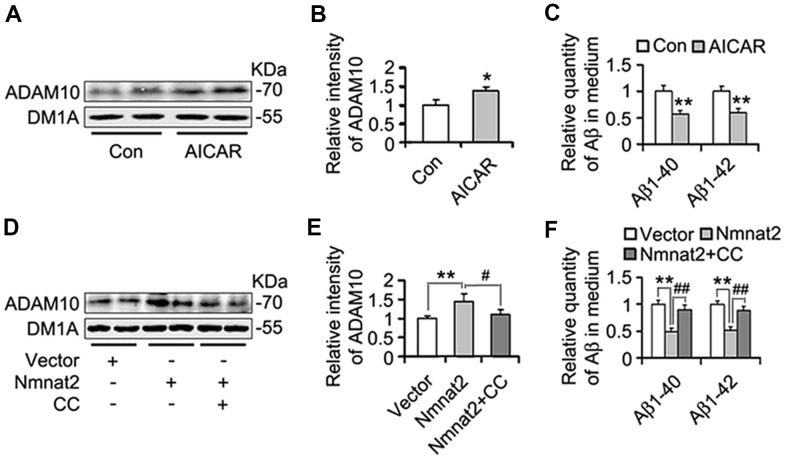
Amyloid-β (Aβ) accumulating is considered as a causative factor for formation of senile plaque in Alzheimer's disease (AD), but its mechanism is still elusive. The Nicotinamide mononucleotide adenylyltransferase 2 (Nmnat2), a key redox cofactor for energy metabolism, is reduced in AD. Accumulative evidence has shown that the decrease of α-secretase activity, a disintegrin and metalloprotease domain 10 (ADAM10), is responsible for the increase of Aβ productions in AD patient's brain. Here, we observe that the activity of α-secretase ADAM10 and levels of Nmnat2 are significantly decreased, meanwhile there is a simultaneous elevation of Aβ in Tg2576 mice. Over-expression of Nmnat2 increases the mRNA expression of α-secretase ADAM10 and its activity and inhibits Aβ production in N2a/APPswe cells, which can be abolished by Compound C, an AMPK antagonist, suggesting that AMPK is involved in over-expression of Nmnat2 against Aβ production. The further assays demonstrate that Nmnat2 activates AMPK by up-regulating the ratio of NAD/NADH, moreover AMPK agonist AICAR can also increase ADAM10 activity and reduces Aβ1-40/1-42. Taken together, Nmnat2 suppresses Aβ production and up-regulates ADAM10 in AMPK activity-dependent manner, suggesting that Nmnat2 may serve as a new potential target in arresting AD.
β淀粉样蛋白(Aβ)的积累被认为是阿尔茨海默病(AD)中老年斑形成的一个致病因素,但它的机制仍不清楚。烟酰胺单核苷酸腺苷转移酶 2(Nmnat2)是能量代谢的关键氧化还原辅助因子,在 AD 中减少。越来越多的证据表明,α-分泌酶活性的降低,即解整合素金属蛋白酶域 10(ADAM10),是导致 AD 患者大脑中 Aβ产生增加的原因。在这里,我们观察到α-分泌酶 ADAM10 的活性和 Nmnat2 的水平显著降低,同时 Tg2576 小鼠的 Aβ也同时升高。Nmnat2 的过表达增加了 N2a/APPswe 细胞中 α-分泌酶 ADAM10 的 mRNA 表达及其活性,并抑制了 Aβ的产生,而 AMPK 拮抗剂 Compound C 可消除这种作用,表明 AMPK 参与了 Nmnat2 对 Aβ产生的抑制作用。进一步的研究表明,Nmnat2 通过上调 NAD/NADH 的比值来激活 AMPK,此外,AMPK 激动剂 AICAR 也可以增加 ADAM10 的活性并减少 Aβ1-40/1-42。总之,Nmnat2 通过依赖 AMPK 活性来抑制 Aβ的产生并上调 ADAM10,这表明 Nmnat2 可能成为阻止 AD 的一个新的潜在靶点。