Vaccine Research Area, Foundation for the Promotion of Health and Biomedical Research of Valencia Region, FISABIO, Avda. de Catalunya, 21, 46020, Valencia, Spain.
Facultad de Medicina y Ciencias de la Salud, Universidad Católica de Valencia San Vicente Mártir, Valencia, Spain.
BMC Med Ethics. 2021 Oct 13;22(1):138. doi: 10.1186/s12910-021-00708-1.
The H2020 i-CONSENT project has developed a set of guidelines that offer ethical recommendations and practical tools aimed at making the informed consent process in clinical studies more comprehensive, tailored, and inclusive. An analysis of the appropriateness of some of its novel recommendations was carried out by a group of experts representing different stakeholders.
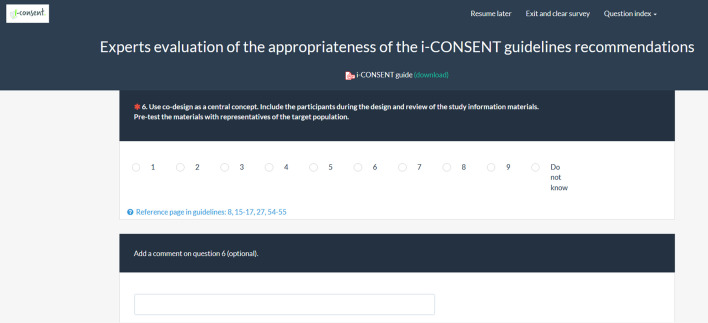
An adaptation of the RAND/UCLA Appropriateness Method was used to assess the level of agreement on the recommendations among 14 representatives of different stakeholders, including patients, regulators, investigators, ethics experts, and the pharmaceutical industry. The process included two rounds of rating and a virtual meeting.
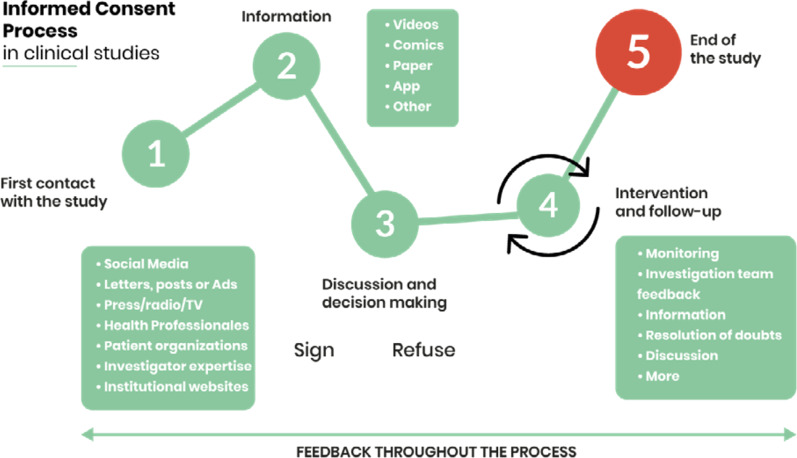
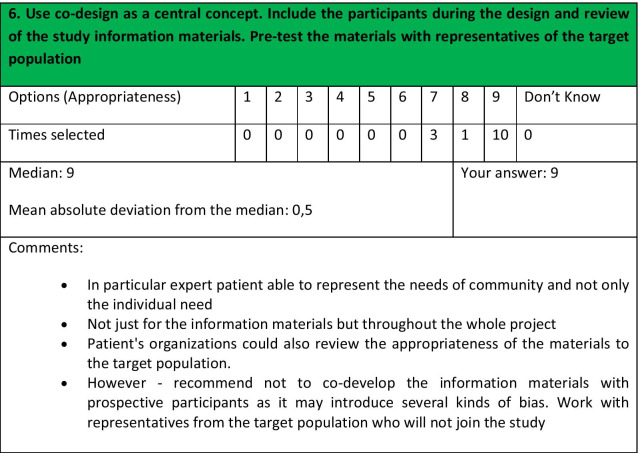
Fifty-three recommendations were evaluated. After the first round, 34 recommendations were judged "appropriate"; 19 were judged "uncertain"; and none was judged "inappropriate". After the second round, 9 "uncertains" changed to "appropriate". All recommendations rated medians of 6.5-9 on a 1-9 scale (1 = "extremely inappropriate", 5 = "uncertain", 9 = "extremely appropriate"). The sections "General recommendations" and "Gender perspective during the consent process for clinical studies" showed the highest "uncertainty" rating. The four keys to improving the understanding of the ICP in clinical studies are to: (1) consider consent a two-way continuous interaction that begins at the first contact with the potential participant and continues until the end of the study; (2) improve investigators' communication skills; (3) co-create the information; and (4) use a layered approach, including information to compensate for the potential participant's possible lack of health literacy and a glossary of terms.
The RAND/UCLA method has demonstrated validity for assessing the appropriateness of recommendations in ethical guidelines. The recommendations of the i-CONSENT guidelines were mostly judged "appropriate" by all stakeholders involved in the informed consent process.
H2020 i-CONSENT 项目制定了一套指南,提供了伦理建议和实用工具,旨在使临床研究中的知情同意过程更加全面、量身定制和包容。一组代表不同利益相关者的专家对其中一些新颖建议的适当性进行了分析。
采用 RAND/UCLA 适宜性方法对 14 名来自不同利益相关者(包括患者、监管机构、研究者、伦理专家和制药行业)的代表对建议的一致性进行评估。该过程包括两轮评分和一次虚拟会议。
评估了 53 项建议。第一轮后,34 项建议被判定为“适当”;19 项被判定为“不确定”;没有被判定为“不适当”。第二轮后,9 项“不确定”变为“适当”。所有建议的中位数均为 1-9 尺度上的 6.5-9(1=“非常不适当”,5=“不确定”,9=“非常适当”)。在 1-9 尺度上,“一般建议”和“临床研究同意过程中的性别视角”这两个部分的“不确定性”评分最高。提高对临床研究中 ICP 理解的四个关键是:(1)将同意视为从潜在参与者的第一次接触开始并持续到研究结束的双向持续互动;(2)提高研究者的沟通技巧;(3)共同创造信息;(4)使用分层方法,包括补偿潜在参与者可能缺乏健康素养的信息和术语表。
RAND/UCLA 方法已证明可用于评估伦理准则中建议的适当性。知情同意过程中涉及的所有利益相关者都认为 i-CONSENT 指南的建议大多是“适当的”。